
The one inch of fish per gallon rule is a myth when used as a strict stocking formula — it ignores body shape, waste production, activity level, and actual tank capacity. While the one inch per gallon guideline gives beginners a quick starting point, treating it as a golden standard leads to overstocked tanks, stressed fish, and dangerous water quality problems. The one inch per gallon rule is a handy rule-of-thumb, not a reliable method for determining how many fish an aquarium can support.
Overstocking Kills Fish
A 10-gallon tank stocked to “10 inches” of goldfish holds roughly 8.5 gallons of actual water supporting fish that produce 2–3x more waste than tropical species of the same size. The result: ammonia spikes within days, not weeks. Always research species-specific requirements before adding fish.
Three Common Misconceptions About the One Inch Per Gallon Rule
Misconception 1: Measuring Fish at Purchase Size
Many aquarists calculate stocking based on a fish’s size at the pet store. Buying aquarium fish without researching adult sizes is a common mistake. A one-inch juvenile Oscar may reach 12 to 14 inches at maturity, and a tiny common pleco grows to over 15 inches. Stocking calculations must always use full adult dimensions, which can differ dramatically from juvenile size.
Misconception 2: Growth Is Linear
The one inch per gallon rule assumes fish growth only affects length, but fish expand in height, width, and mass simultaneously as they mature. A fish twice as long may have four times the body volume and produce four times the waste. The one inch per gallon rule treats a slim one-inch neon tetra the same as a round-bodied one-inch juvenile goldfish — two fish with vastly different space and filtration needs.
Misconception 3: Tank Labels Reflect Actual Water Volume
A labeled 10-gallon aquarium does not hold 10 gallons of water once fully established. Substrate, decorations, heaters, filters, and the space below the rim reduce actual water volume to approximately 8.5 to 9 gallons — a 10 to 15 percent reduction. A 20-gallon tank might hold only 17 gallons of swimmable water. Stocking based on the label rather than actual volume overestimates available capacity from the start.
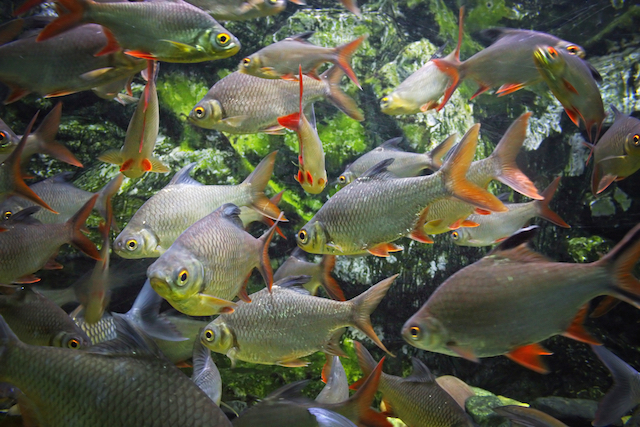
A well-stocked aquarium balances fish numbers with filtration capacity, swimming space, and species compatibility — not just inches per gallon.
Six Factors the One Inch Per Gallon Rule Ignores
Factor 1: Body Shape and Mass
Fish species exhibit dramatically different body shapes, and the one inch per gallon rule treats every species identically regardless of body mass. A three-inch goldfish displaces far more water and produces far more waste than a three-inch zebra danio.
| Species | Adult Length | Body Shape | Bioload | Minimum Tank Size |
|---|---|---|---|---|
| Neon Tetra | 1.5 inches | Slim, streamlined | Very Low | 10 gallons (school of 6) |
| Zebra Danio | 2 inches | Slim, torpedo | Low | 10 gallons (school of 6) |
| Betta Fish | 2.5 inches | Medium, flowing fins | Low | 5 gallons |
| Fancy Goldfish | 6–8 inches | Round, heavy-bodied | Very High | 20 gallons (single fish) |
| Common Pleco | 15+ inches | Broad, armored | Very High | 75+ gallons |
| Oscar | 12–14 inches | Large, thick-bodied | Very High | 75+ gallons |
Neon Tetra
1.5 inches
Slim, streamlined
Very Low
10 gallons (school of 6)
Zebra Danio
2 inches
Slim, torpedo
Low
10 gallons (school of 6)
Betta Fish
2.5 inches
Medium, flowing fins
Low
5 gallons
Fancy Goldfish
6–8 inches
Round, heavy-bodied
Very High
20 gallons (single fish)
Common Pleco
15+ inches
Broad, armored
Very High
75+ gallons
Oscar
12–14 inches
Large, thick-bodied
Very High
75+ gallons
Factor 2: Waste Production Varies by Species
Waste output differs enormously between fish species of similar size. Small tetras and rasboras produce minimal ammonia, while goldfish and plecos generate two to three times more waste per inch of body length. Heavy waste producers overwhelm biological filtration faster and require more water volume, stronger filters, and more frequent water changes per inch of fish.
Factor 3: Activity Levels and Swimming Space
Active swimming species like zebra danios, tiger barbs, and rainbow fish need significantly more horizontal swimming space than sedentary species like betta fish. Confining high-energy swimmers to undersized tanks causes chronic stress, fin nipping, and abnormal repetitive behavior — even when the one inch per gallon math technically “allows” it.
Factor 4: Aggression and Territorial Behavior
Territorial and aggressive fish like African cichlids and Oscar fish require dedicated space for establishing individual territories, regardless of total stocking capacity. A 20-gallon tank might support 20 inches of peaceful community fish like neon tetras and corydoras catfish, but the same tank could only house a single pair of aggressive dwarf cichlids like German blue rams. Mixing incompatible species leads to common fish keeping mistakes that no stocking formula can prevent — aggression and territorial disputes override any mathematical calculation.
Factor 5: Tank Shape Affects Oxygen Exchange
Tank surface area — not just volume — determines oxygen exchange capacity. A tall, narrow 20-gallon column tank provides far less gas exchange than a long, shallow 20-gallon breeder tank, despite holding identical water volume. The surface area stocking method provides a more accurate baseline: approximately one inch of slim-bodied fish per 12 square inches of water surface area.
Surface Area Calculation
Calculate your tank’s surface area by multiplying width by length. A 20-by-10-inch footprint provides 200 square inches, supporting roughly 16 to 17 inches of slim-bodied fish like neon tetras or zebra danios. Reduce this number by 25 to 50 percent for heavy-bodied species like goldfish.
Factor 6: Biological Filtration Needs Time
Adding all fish simultaneously overwhelms the tank’s beneficial bacteria colonies. The nitrogen cycle requires weeks to establish bacteria populations that convert toxic ammonia into less harmful nitrate. Introduce fish gradually — no more than two to three at a time — over four to six weeks while monitoring ammonia, nitrite, and pH levels with a test kit.
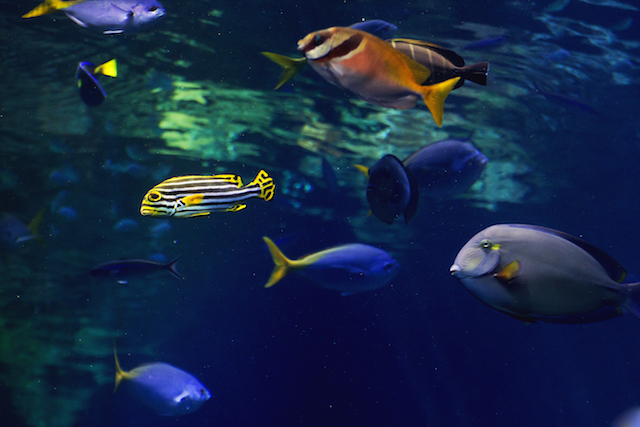
Community tanks with diverse species require individualized stocking research — a slim-bodied tetra and a heavy-bodied goldfish cannot be calculated the same way.
A Better Approach to Stocking Your Aquarium
Before Adding Fish, Research Each Species:
- Full adult size (not juvenile size at the store)
- Body shape and actual mass relative to length
- Waste production level and dietary habits
- Activity level and minimum swimming space requirements
- Territorial behavior and species compatibility
- Preferred water parameters (temperature, pH, hardness)
Practical Stocking Guidelines:
- Use the surface area method (1 inch per 12 square inches) as an alternative baseline
- Consult species-specific stocking guides and online calculators like AqAdvisor or Fishlore's stocking forum
- Start with fewer fish than you think you need — you can always add more
- Add fish slowly over 4 to 6 weeks to let biological filtration adjust
- Monitor water parameters regularly with a reliable test kit
- Invest in filtration rated for more than your tank's labeled volume
Signs Your Aquarium Is Overstocked
Overstocked aquariums show warning signs before fish start dying. Recognizing these symptoms early prevents disease outbreaks and fish loss:
- Ammonia or nitrite readings above zero — Biological filtration cannot keep up with the waste load, even in a cycled tank
- Fish gasping at the water surface — Oxygen levels drop when too many fish compete for dissolved oxygen in limited water volume
- Increased aggression or fin nipping — Crowded fish become territorial even if their species is normally peaceful
- Cloudy or foul-smelling water — Bacterial blooms from excess organic waste overwhelm filtration
- Rapid pH swings — High waste concentrations acidify water faster than buffering capacity can compensate
If any of these symptoms appear despite regular maintenance, reduce stocking levels or upgrade filtration before adding more fish.
When the One Inch Per Gallon Rule Works (Roughly)
The one inch of fish per gallon rule provides a reasonable rough estimate — but only for a narrow set of conditions. Slim-bodied, low-waste community species in well-filtered tanks come closest to matching the rule’s assumptions:
- Small, slim-bodied community fish like neon tetras, harlequin rasboras, and zebra danios
- Species with moderate waste production and peaceful temperaments
- Tanks with adequate filtration rated for the full tank volume
- Properly cycled, established aquariums with stable water chemistry
The one inch per gallon rule fails completely when any of those conditions are absent. Heavy-bodied, high-waste, or aggressive species break the rule’s math entirely:
- Large, messy fish like goldfish, plecos, Oscars, and cichlids
- Aggressive or territorial species that need individual territory space
- Nano tanks under 10 gallons where small errors cause rapid water quality crashes
- Heavily decorated tanks with significantly reduced actual water volume
- Tall, narrow tanks with limited surface area for oxygen exchange
Conclusion
The one inch of fish per gallon rule serves as a rough estimate — nothing more. Successful aquarium stocking depends on researching each species individually, understanding your specific tank’s dynamics, and observing your fish’s behavior and water quality over time. When in doubt, understock rather than overstock. Your fish will be healthier, your water cleaner, and your maintenance schedule far more manageable.
For more guidance on choosing the right tank size and setting up your first aquarium, explore our freshwater care guides.
What is the one inch of fish per gallon rule?
The one inch of fish per gallon rule suggests stocking one inch of adult fish length per gallon of aquarium water. A 10-gallon tank could theoretically hold 10 inches of fish. However, this is a rough guideline that ignores body shape, waste production, and tank dynamics — not a precise formula for stocking any aquarium.
Why doesn't the one inch per gallon rule always work?
The one inch per gallon rule ignores critical factors including fish body shape (a round-bodied goldfish displaces far more water than a slim neon tetra of the same length), waste production rates, activity levels, territorial behavior, and actual water volume after adding substrate and decorations. A labeled 10-gallon tank typically holds only 8.5 to 9 gallons once fully set up.
How should I calculate fish stocking instead?
Research each species' adult size, body shape, waste output, and compatibility requirements individually. Use the surface area method (one inch of fish per 12 square inches of water surface) as an alternative baseline. Online stocking calculators like AqAdvisor provide species-specific guidance. Always introduce fish gradually over several weeks to avoid overwhelming biological filtration.
What happens if I overstock my aquarium?
Overstocking an aquarium leads to ammonia spikes, elevated nitrite and nitrate levels, oxygen depletion, increased disease transmission, stress-related aggression, and potentially fish death. Even heavy filtration cannot fully compensate for overstocking because biological waste accumulates faster than bacteria can process it. Overstocked tanks require significantly more frequent water changes and maintenance.
Does the one inch per gallon rule work for goldfish?
The one inch per gallon rule fails completely for goldfish. A single fancy goldfish requires 20 gallons minimum, and common goldfish need 40 gallons or more. Goldfish produce two to three times more ammonia than similarly sized tropical fish, grow up to 12 inches as adults, and need strong filtration and frequent water changes regardless of tank size.
Is there a better stocking rule than one inch per gallon?
The surface area method provides a more accurate baseline: stock one inch of slim-bodied fish per 12 square inches of water surface area. A 20-by-10-inch tank footprint offers 200 square inches, supporting roughly 16 inches of slim-bodied fish like neon tetras or danios. For heavy-bodied or messy species, reduce this number by 25 to 50 percent.
Related Topics
Found this helpful?
Share this guide with your fellow aquarium enthusiasts!

Written by
FTW Team
The FishTankWorld editorial team brings together experienced aquarists to help you succeed in the hobby.