
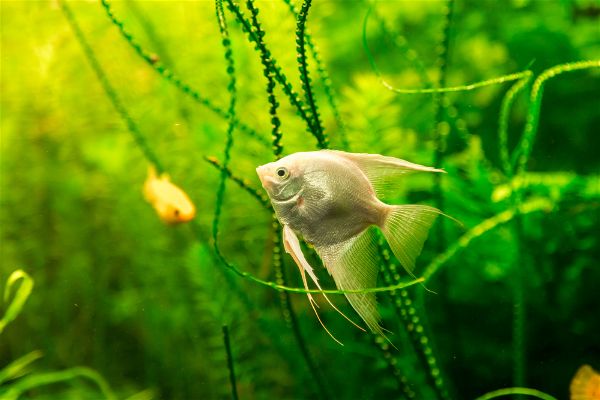
A low tech planted aquarium uses hardy plant species, basic equipment, and no CO2 injection to create a beautiful underwater garden. Low-tech planted tanks cost less to set up, require less maintenance, and still produce lush, natural-looking results that rival more complex systems. The approach works for beginners and experienced fishkeepers alike.
Setting up a low tech planted aquarium involves choosing the right tank and equipment, selecting compatible plant species, following a proper setup sequence, adding fish gradually, and maintaining the system long-term.
Low-Tech vs. High-Tech: What's the Difference?
A low-tech planted aquarium skips CO2 injection, uses moderate lighting, and relies on hardy plant species that draw carbon from fish respiration and natural decomposition. High-tech setups use pressurized CO2, intense lighting, and demanding plant species. The trade-off: low-tech tanks grow slower but cost far less and need minimal daily attention.
| Factor | Low-Tech Planted Tank | High-Tech Planted Tank |
|---|---|---|
| CO2 System | Not required | Pressurized CO2 + diffuser ($150-400) |
| Lighting | Standard LED or fluorescent | High-output LED with PAR 50+ |
| Plant Species | Hardy, low-demand species | High-demand species requiring CO2 and strong light |
| Maintenance | Weekly water change, light trimming | Daily CO2 monitoring, frequent trimming |
| Startup Cost | $50-150 for equipment | $300-700+ for equipment |
| Algae Risk | Lower (balanced nutrients) | Higher (if CO2/light imbalanced) |
| Skill Level | Beginner-friendly | Intermediate to advanced |
CO2 System
Not required
Pressurized CO2 + diffuser ($150-400)
Lighting
Standard LED or fluorescent
High-output LED with PAR 50+
Plant Species
Hardy, low-demand species
High-demand species requiring CO2 and strong light
Maintenance
Weekly water change, light trimming
Daily CO2 monitoring, frequent trimming
Startup Cost
$50-150 for equipment
$300-700+ for equipment
Algae Risk
Lower (balanced nutrients)
Higher (if CO2/light imbalanced)
Skill Level
Beginner-friendly
Intermediate to advanced
Essential Equipment for a Low-Tech Planted Tank
Aquarium
Any freshwater aquarium works for a low-tech planted setup, but tanks under 10 gallons are ideal for beginners. Rimless glass aquariums offer clear viewing from all angles and suit the natural aesthetic of planted tanks. Position the aquarium on sturdy furniture away from HVAC vents that cause temperature fluctuations.
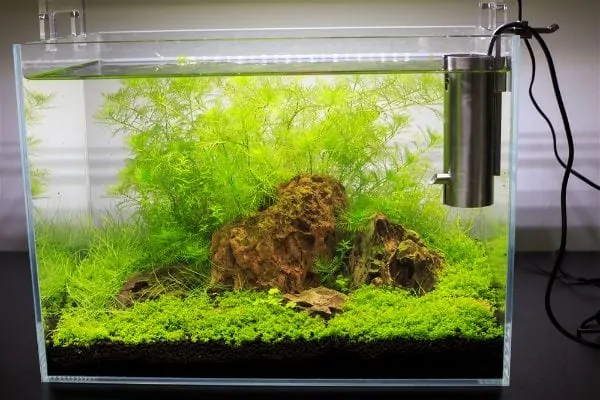
A rimless tank with driftwood hardscape and carpet plants — achievable with a low-tech approach
Natural Sunlight Is Acceptable
Low-tech planted aquariums tolerate some natural sunlight from a nearby window. Unlike high-tech setups where precise light control matters, low-tech tanks benefit from ambient daylight. Monitor for algae if the tank receives prolonged direct sun.
Lighting
Low-tech aquarium plants need full-spectrum lighting for photosynthesis. Full-spectrum fluorescent tubes and white-appearing LED fixtures both work well for low-tech tanks. Run lights 6-8 hours daily on a timer — longer photoperiods promote algae growth without benefiting plants in a low-tech system.
- Avoid reef-specific lighting heavy in blue spectrum — blue light benefits corals, not freshwater plants
- Standard aquarium hoods often include adequate lighting for low-tech plants
- Stronger lighting requires CO2 supplementation to avoid algae problems
For specific fixture recommendations, see our guide to the best LED lights for planted tanks.
Substrate
Fine-grain gravel with a 1-4mm particle size provides proper root anchoring for low-tech aquarium plants. Specialty aquatic plant substrates (such as Fluval Stratum or ADA Aqua Soil) hold roots securely while providing direct nutrient contact that promotes healthy growth. Regular large-pebble gravel allows plant roots to shift and prevents nutrient absorption at the root zone.
Layer 2-3 inches of substrate, sloping slightly toward the back for visual depth. For detailed substrate comparisons, see our best substrate for planted tank guide.
Filtration
Gentle water circulation delivers dissolved nutrients and carbon dioxide to plant leaves without stripping CO2 from the water. A hang-on-back power filter provides adequate mechanical and biological filtration while maintaining gentle water movement. Avoid strong surface agitation — excessive turbulence at the waterline drives CO2 out of the water column, reducing the carbon available to plants.
Temperature
Many low-tech planted aquariums don’t need a heater at all. Java Fern, Anubias nana, Java Moss, and Marimo Moss Balls tolerate room temperature (65-75°F / 18-24°C), and cold-water fish like White Cloud Mountain minnows pair well with unheated planted setups. Skipping the heater is one of the simplest ways to reduce equipment and cost.
For tropical species like cardinal tetras or dwarf cichlids, a submersible heater maintains the 75-80°F (24-27°C) range they require. Use a separate thermometer to verify accuracy — internal thermostats can drift over time.
Water Quality
Hardy low-tech aquarium plants tolerate a range of water conditions, making municipal tap water suitable for most setups. Extremely hard tap water can be diluted with RO (reverse osmosis) water to bring hardness into an acceptable range. Test water parameters after setup and adjust as needed — most low-tech species adapt to local water conditions within a few weeks.
Fertilization
Low-tech planted tanks receive some nutrients from fish waste, but supplemental fertilization supports healthier plant growth. Liquid or tablet fertilizers containing trace elements — including iron, molybdenum, and zinc — fill nutritional gaps that fish waste alone cannot cover.
Start With Half-Dose Fertilization
Begin fertilizer applications at half the manufacturer’s recommended dose. Excess nutrients in a low-tech tank fuel algae growth rather than plant growth because plants in low-light, no-CO2 environments absorb nutrients slowly. Increase the dose only if plants show deficiency symptoms like yellowing leaves or stunted growth.
9 Best Plants for a Low-Tech Aquarium
The following plant species thrive in low-tech planted aquariums without CO2 injection or intense lighting. Each species listed below grows well under standard aquarium lighting and tolerates a range of water conditions.
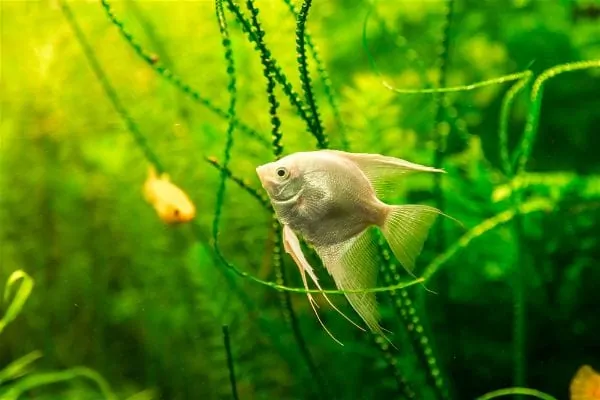
Low-tech plant species like these tall stem plants create a natural underwater environment
Water Sprite (Ceratopteris thalictroides)
Water Sprite is a fast-growing plant that fills the middle and upper levels of a low-tech aquarium. Water Sprite can be planted in substrate or left floating at the surface, where Water Sprite’s feathery leaves provide shade and cover for fish. Water Sprite’s rapid growth rate helps outcompete algae for nutrients, making Water Sprite one of the most useful plants in a new low-tech setup.
Growth Rate: Fast | Placement: Mid-tank or floating | Difficulty: Easy
Java Fern (Microsorum pteropus)
Java Fern is one of the hardiest aquarium plants available and a staple of low-tech planted tanks. Java Fern grows from a rhizome that must be attached to driftwood or rocks — never buried in substrate, which causes the rhizome to rot. Java Fern produces dark green, textured leaves and tolerates water temperatures from 68-82°F and pH from 6.0-7.5. For more on Java Fern and similar species, see our low light aquarium plants guide.
Growth Rate: Slow | Placement: Mid-tank, attached to hardscape | Difficulty: Very Easy
Anubias nana
Anubias nana is a compact, dark-leaved plant with thick, durable foliage that resists nibbling from most fish species. Anubias nana attaches to driftwood and rocks like Java Fern and requires the same rhizome care — never bury the rhizome in substrate. Anubias nana grows slowly but steadily under low light, producing new leaves every few weeks.
Growth Rate: Very Slow | Placement: Foreground to mid-tank, attached to hardscape | Difficulty: Very Easy
Never Bury the Rhizome
Java Fern and Anubias nana grow from thick horizontal stems called rhizomes. Burying the rhizome in substrate causes rot and kills the plant. Attach these species to rocks or driftwood using fishing line, cotton thread, or cyanoacrylate super glue. Once roots establish, the plant anchors itself permanently.
Dwarf Sagittaria (Sagittaria subulata)
Dwarf Sagittaria produces thin, grass-like leaves that form dense clusters across the foreground of a low-tech planted aquarium. Dwarf Sagittaria spreads through runners, gradually covering open substrate areas with a natural grass carpet. Dwarf Sagittaria tolerates a wide range of lighting and water conditions, though growth accelerates in nutrient-rich substrates.
Growth Rate: Moderate | Placement: Foreground | Difficulty: Easy
Cryptocoryne wendtii
Cryptocoryne wendtii is a low-growing plant available in green, brown, and reddish color variants. Cryptocoryne wendtii adapts well to low-light conditions and develops slowly but reliably. New Cryptocoryne wendtii plants sometimes experience “crypt melt” — leaves dissolving shortly after planting — but the root system typically survives and produces new growth within a few weeks.
Growth Rate: Slow | Placement: Foreground to mid-tank | Difficulty: Easy
Micro Sword (Lilaeopsis brasiliensis)
Micro Sword forms a light green, grass-like carpet across the substrate of a low-tech aquarium. Micro Sword spreads through runners and eventually covers open areas with a dense mat of delicate blades. Micro Sword grows more slowly without CO2 supplementation but still produces an attractive foreground carpet given enough time and a fine-grain substrate.
Growth Rate: Moderate | Placement: Foreground carpet | Difficulty: Easy
Marimo Moss Ball (Aegagropila linnaei)
Marimo Moss Balls are spherical colonies of freshwater algae (Aegagropila linnaei), not true moss. Marimo Moss Balls are among the lowest-maintenance additions to any aquarium — roll them occasionally to maintain their shape and ensure all surfaces receive light. Marimo Moss Balls absorb nitrates and provide a textured surface for shrimp to graze. Authentic Marimo Moss Balls from Japan grow extremely slowly, adding roughly 5mm per year in diameter.
Growth Rate: Extremely Slow | Placement: Foreground or midground | Difficulty: Very Easy
Java Moss (Vesicularia dubyana)
Java Moss is one of the most versatile plants for a low-tech aquarium. Java Moss attaches to driftwood, rocks, and mesh to create moss walls, tree-like formations, and natural ground cover. Java Moss thrives in low-light conditions that would stunt most other species and provides excellent shelter for fish fry and shrimp. Java Moss is also among the easiest aquarium plants to propagate — simply tear a portion off and attach it to a new surface.
Growth Rate: Moderate to Fast | Placement: Anywhere (attached to surfaces) | Difficulty: Very Easy
Christmas Moss (Vesicularia montagnei)
Christmas Moss produces fronds that branch in a pattern resembling evergreen tree limbs, giving Christmas Moss a distinctive, layered appearance. Christmas Moss is ideal for creating moss walls and carpets when tied to flat mesh or stone surfaces. Christmas Moss grows well in low-light environments and provides hiding spots for fish fry and invertebrates.
Growth Rate: Moderate | Placement: Attached to hardscape or mesh | Difficulty: Easy
How to Set Up a Low-Tech Planted Aquarium
Choose Location and Tank
Place the aquarium on sturdy furniture away from heating and cooling vents. A rimless tank under 10 gallons works well for beginners. Ensure the stand can support the full weight — water weighs 8.3 pounds per gallon.
Add and Shape the Substrate
Layer 2-3 inches of fine-grain gravel or aquatic plant substrate across the tank floor. Slope the substrate slightly higher toward the back wall to create visual depth and give foreground plants a natural setting.
Install Hardscape
Position driftwood and rocks before adding water. Driftwood provides attachment points for Java Fern, Anubias nana, and mosses. Arrange the hardscape off-center for a natural appearance.
Install Equipment
Mount the hang-on-back filter, submersible heater, and light fixture. Position the filter outflow to create gentle water circulation without strong surface agitation that removes CO2.
Plant the Aquarium
Plant rooted species (Dwarf Sagittaria, Cryptocoryne wendtii, Micro Sword) in the substrate. Attach rhizome plants (Java Fern, Anubias nana) and mosses to hardscape. Place taller species in the back, shorter species in the front.
Fill and Cycle
Fill the tank slowly to avoid disturbing the substrate. Run the filter and heater continuously. Allow 2-4 weeks for the nitrogen cycle to establish beneficial bacteria before adding fish. Plants can go in immediately — they help the cycling process.
Add Fish Gradually
After the cycle completes (ammonia and nitrite read 0 ppm), add fish in small groups over several weeks. Start with hardy species like Corydoras catfish or cardinal tetras and monitor water parameters between additions.
Compatible Fish for Low-Tech Planted Tanks
Low-tech planted aquariums support small, peaceful community fish species that complement the planted environment without damaging it. Keep stocking levels conservative — heavy bioloads produce excess waste that promotes algae growth over plant growth.
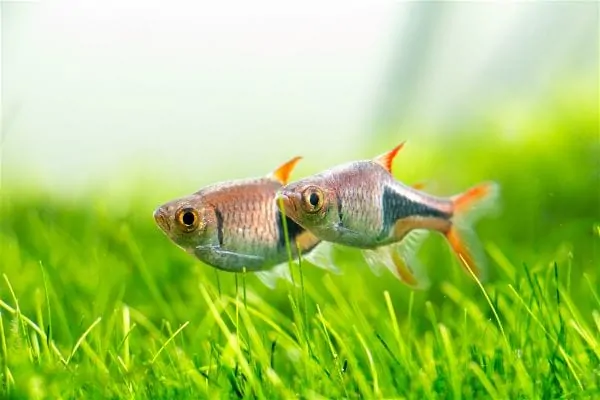
Harlequin rasboras are ideal companions for a low-tech planted tank
- Cardinal tetras — vivid blue and red coloring stands out against green plants
- Harlequin rasboras — peaceful schooling fish that stay mid-tank
- Corydoras catfish — gentle bottom-dwellers that sift through substrate without uprooting plants
- Guppies — hardy, colorful, and active at all tank levels
- Dwarf cichlids (Apistogramma species) — interesting breeding behavior and moderate temperament
- Cherry barbs — peaceful barb species that won't nip plants
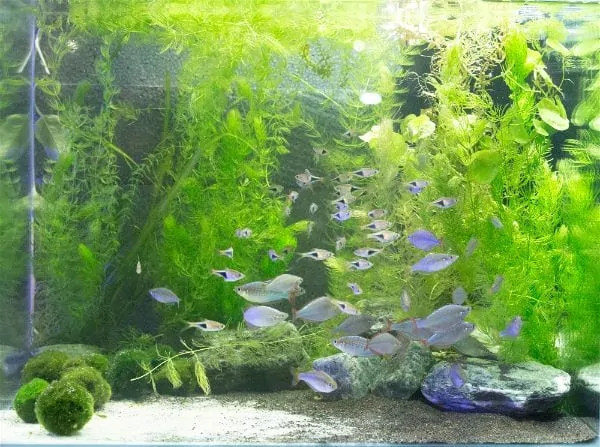
A school of small community fish thrives in a densely planted low-tech setup
Stocking Rule for Low-Tech Tanks
A common guideline is 1 inch of adult fish per 2 gallons of water in a low-tech planted tank. Conservative stocking reduces waste production, lowers algae risk, and creates a more stable environment for both fish and plants.
Cool-Water Planted Tanks: The Ultra Low-Tech Option
The simplest low-tech planted aquarium skips the heater entirely. Many popular aquarium plants thrive at room temperature (65-75°F / 18-24°C), and several cold-water fish species are colorful, active, and perfectly suited to unheated planted setups. No heater means one less piece of equipment, lower electricity cost, and fewer potential failure points.
Plants That Thrive in Cool Water
Java Fern, Anubias nana, Java Moss, Marimo Moss Balls, and Cryptocoryne wendtii all grow well without supplemental heat. Water Sprite adapts to cooler temperatures too, though Water Sprite grows slower below 72°F. These species handle the natural temperature fluctuations of an unheated room without stress.
Cool-Water Fish for Planted Tanks
- White Cloud Mountain minnows — hardy schooling fish with iridescent silver and red coloring, comfortable from 60-72°F
- Endler's livebearers — tiny, brilliantly colored fish that tolerate temperatures down to 65°F
- Zebra danios — active, striped schooling fish that thrive from 64-75°F
- Rosy barbs — colorful and energetic, comfortable from 64-72°F
- Hillstream loaches — algae-grazing bottom-dwellers that prefer cooler, well-oxygenated water
- Cherry shrimp — prolific invertebrates that breed readily in unheated planted tanks
A Great Starter Setup
A 10-gallon rimless tank with Java Fern tied to driftwood, Java Moss carpeting a rock, a Marimo Moss Ball, and a school of White Cloud Mountain minnows makes one of the easiest and most attractive aquarium setups possible. No heater, no CO2, minimal maintenance — just a filter, a light on a timer, and weekly water changes.
Maintenance Schedule
Low-tech planted aquariums require less maintenance than high-tech setups, but consistent care keeps the system balanced and algae-free.
Weekly
- Perform a 10-20% water change to replenish minerals and remove waste
- Trim fast-growing plants like Water Sprite and Java Moss before they shade lower plants
- Remove any dead or yellowing leaves to prevent decay
- Apply half-dose liquid fertilizer if using supplemental fertilization
- Wipe algae from the glass with an algae scraper
Monthly
- Rinse filter media in tank water (never tap water) to remove debris
- Test water parameters — pH, ammonia, nitrite, and nitrate
- Replant any stems that have floated loose
- Check heater accuracy with a separate thermometer
Every 3-6 Months
- Replace filter media if flow has decreased significantly
- Add root tabs near heavy root feeders like Dwarf Sagittaria and Cryptocoryne wendtii
- Divide overgrown plants and relocate or share sections
How to Prevent Algae in a Low-Tech Planted Tank
Algae growth is the most common challenge in low-tech planted aquariums. Algae compete with plants for the same resources — light and nutrients — and thrive when those resources are out of balance.
- Limit lighting to 6-8 hours daily using a timer — longer photoperiods feed algae, not plants
- Avoid overfeeding fish — uneaten food decomposes into nutrients that algae consume
- Keep fish stocking levels low to reduce waste-driven nutrient spikes
- Add fast-growing plants like Water Sprite and Java Moss that absorb nutrients before algae can
- Perform consistent weekly water changes to dilute excess nutrients
- Introduce algae-eating species like Amano shrimp or Nerite snails for natural control
Algae in New Tanks Is Normal
New low-tech planted aquariums often experience a brief algae bloom during the first 4-8 weeks as the nitrogen cycle establishes and plants root. This initial algae usually subsides as plants grow in and outcompete algae for nutrients. Resist the urge to increase maintenance dramatically — patience and consistent light schedules resolve most early algae issues.
Frequently Asked Questions
Do I need CO2 injection for a planted tank?
Low-tech planted aquariums thrive without CO2 injection. Fish respiration, biological decomposition, and surface gas exchange provide enough carbon dioxide for low-demand species like Java Fern, Anubias nana, and Java Moss. CO2 systems add cost and complexity that low-tech setups are specifically designed to avoid.
How much light do low-tech aquarium plants need?
Low-tech aquarium plants need 6-8 hours of full-spectrum lighting per day. More light promotes algae growth rather than faster plant growth in tanks without CO2 supplementation. A simple plug-in timer keeps the photoperiod consistent and prevents accidental overexposure.
What substrate is best for a low-tech planted tank?
Fine-grain gravel with a particle size of 1-4mm or a specialty aquatic plant substrate works best for low-tech planted aquariums. Large pebble gravel prevents proper root development. Specialty substrates like Fluval Stratum provide additional nutrients that support plant growth without added fertilizers.
Can I keep fish in a low-tech planted tank?
Low-tech planted tanks are ideal for small, peaceful community fish. Cardinal tetras, harlequin rasboras, Corydoras catfish, guppies, and dwarf cichlids all thrive in planted environments. Keep stocking levels low — heavy bioloads produce excess waste that promotes algae growth.
Why is there algae in my planted tank?
Algae in a low-tech planted tank usually results from too much light, overfeeding, or overstocking. Brown algae (diatoms) is especially common in new planted tanks and typically resolves within 2-3 months. Reduce the photoperiod to 6-8 hours, feed fish only what they consume in 2 minutes, and add fast-growing plants like Water Sprite or Java Moss that outcompete algae for nutrients. See our brown algae guide at fishtankworld.com/aquariums/problems/brown-algae-in-fish-tank for specific treatment steps.
How long does it take for a low-tech planted tank to grow in?
A low-tech planted aquarium typically takes 2-4 months to fill in and look established. Fast-growing species like Water Sprite and Java Moss show visible growth within weeks, while slow-growing plants like Anubias nana and Cryptocoryne wendtii take several months to spread. Patience is essential — low-tech tanks develop gradually but require far less maintenance once established.
Do low-tech planted tanks need water changes?
Weekly water changes of 10-20% help maintain water quality and replenish trace minerals that plants absorb. Water changes also dilute organic waste that feeds algae. Unlike high-tech setups that may need 50% weekly changes, low-tech planted tanks have modest water change requirements.
A low tech planted aquarium combines the beauty of an underwater garden with the simplicity of a low-maintenance system. Start with proven plant species like Java Fern, Anubias nana, and Java Moss, provide moderate lighting on a timer, and stock conservatively with peaceful community fish. The result is a thriving planted aquarium that looks impressive without the cost or complexity of CO2 injection and high-tech equipment.
For more planted tank resources, browse our complete freshwater plants guide or explore specific topics: low light aquarium plants, floating aquarium plants, LED lighting for planted tanks, and planted tank substrates.
Related Topics
Found this helpful?
Share this guide with your fellow aquarium enthusiasts!

Written by
Ynes Carrillo
Ynes grew up in the Andes mountains of Venezuela, where she spent decades as a teacher and cultivated a lush garden of native and non-native plants around her backyard fish pond. She holds a Master's degree in Education and now lives in Texas, where she keeps a low-tech planted aquarium and tends a vegetable garden. Though retired from the classroom, Ynes channels her lifelong passion for teaching into helping others succeed with fishkeeping and aquatic plants.