The best low light aquarium plants include Java Fern (Microsorum pteropus), Anubias Nana Petite, Java Moss, Amazon Sword (Echinodorus bleheri), and Hornwort (Ceratophyllum demersum). These species thrive under standard aquarium lighting without CO2 injection or liquid fertilizers, making them ideal for beginners building their first planted tank.
Low light aquarium plants absorb nitrates, produce oxygen, provide shelter for fish, and outcompete algae — transforming a basic fish tank into a thriving ecosystem without expensive equipment.
What Is Low Light?
Low light ranges from 15–30 PAR (Photosynthetically Active Radiation) at substrate level for LED fixtures, or roughly 1–2 watts per gallon for traditional fluorescent bulbs. Most standard aquarium hoods and basic LED strips fall into this range. For help choosing the right fixture, see our guide to the best LED lights for planted tanks.
Quick Comparison: All 14 Low Light Plants
| Plant | Type | Care Level | Height | Growth Rate | Best For |
|---|---|---|---|---|---|
| Amazon Sword | Stem | Easy | 12–20+ in | Moderate | Centerpiece in large tanks |
| Water Wisteria | Stem | Easy | 12–20 in | Fast | Background texture |
| Hornwort | Stem | Very Easy | 24+ in | Very Fast | Fry cover, nutrient control |
| Anacharis | Stem | Very Easy | 12–24 in | Very Fast | Nutrient absorption |
| Ludwigia Repens | Stem | Easy | 12–20 in | Fast | Adding red/green color |
| Java Fern | Fern | Very Easy | 8–14 in | Slow | Hardscape attachment |
| Java Fern 'Windelov' | Fern | Very Easy | 6–8 in | Slow | Detailed, intricate look |
| Anubias Nana Petite | Anubias | Very Easy | 2–5 in | Very Slow | Foregrounds, small tanks |
| Marimo Moss Ball | Moss (algae) | Very Easy | 1–5 in dia | Extremely Slow | Shrimp tanks, minimal care |
| Christmas Moss | Moss | Easy | 1–3 in | Moderate | Moss walls, carpets |
| Taiwan Moss | Moss | Easy | 2–4 in | Moderate | Forest-like hardscape |
| Flame Moss | Moss | Easy | 2–4 in | Slow | Accent pieces |
| Micro Sword | Carpet | Easy | 1–3 in | Moderate | Foreground grass carpet |
| Dwarf Hairgrass | Carpet | Easy–Moderate | 2–6 in | Moderate | Lush lawn-like carpet |
Amazon Sword
Stem
Easy
12–20+ in
Moderate
Centerpiece in large tanks
Water Wisteria
Stem
Easy
12–20 in
Fast
Background texture
Hornwort
Stem
Very Easy
24+ in
Very Fast
Fry cover, nutrient control
Anacharis
Stem
Very Easy
12–24 in
Very Fast
Nutrient absorption
Ludwigia Repens
Stem
Easy
12–20 in
Fast
Adding red/green color
Java Fern
Fern
Very Easy
8–14 in
Slow
Hardscape attachment
Java Fern 'Windelov'
Fern
Very Easy
6–8 in
Slow
Detailed, intricate look
Anubias Nana Petite
Anubias
Very Easy
2–5 in
Very Slow
Foregrounds, small tanks
Marimo Moss Ball
Moss (algae)
Very Easy
1–5 in dia
Extremely Slow
Shrimp tanks, minimal care
Christmas Moss
Moss
Easy
1–3 in
Moderate
Moss walls, carpets
Taiwan Moss
Moss
Easy
2–4 in
Moderate
Forest-like hardscape
Flame Moss
Moss
Easy
2–4 in
Slow
Accent pieces
Micro Sword
Carpet
Easy
1–3 in
Moderate
Foreground grass carpet
Dwarf Hairgrass
Carpet
Easy–Moderate
2–6 in
Moderate
Lush lawn-like carpet
14 Best Low Light Aquarium Plants
Stem Plants
Stem plants grow tall from rooted bases, require occasional trimming, and propagate easily by cutting and replanting stems. Most stem plants root in substrate, though some float freely.
1. Amazon Sword (Echinodorus bleheri)
Amazon Sword is a classic aquarium plant with long, bright green leaves that makes an impressive centerpiece or background plant. Amazon Sword grows quite large (12–20+ inches), making it unsuitable for tanks under 20 gallons. Amazon Sword roots heavily in substrate and benefits from root tabs for nutrition.
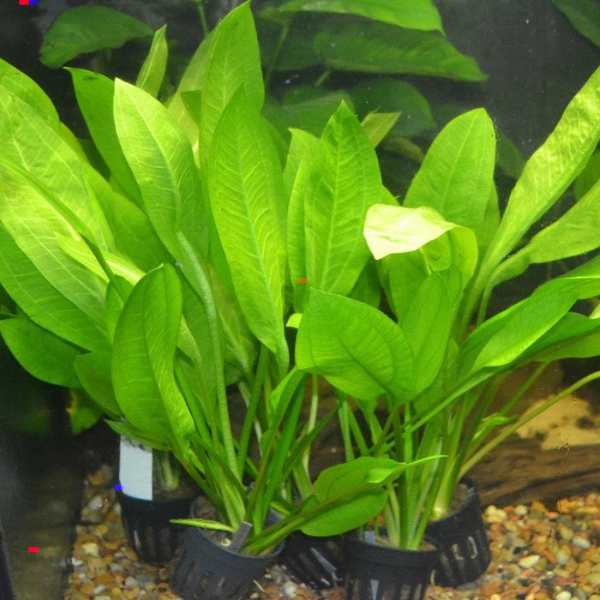
Amazon Sword makes an impressive centerpiece in larger tanks
Care Level: Easy Height: 12-20+ inches Growth Rate: Moderate
2. Water Wisteria (Hygrophila difformis)
Water Wisteria is a fast-growing stem plant with delicate, lace-like leaves. Water Wisteria grows tall and wide, making it excellent for background placement. The light green coloration adds brightness to aquascapes. Avoid keeping Water Wisteria with goldfish, which find the plant particularly tasty.
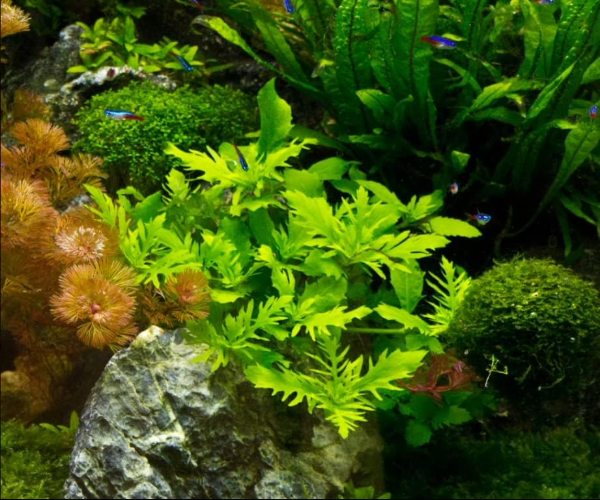
Water Wisteria's lacy leaves add texture to any aquascape
Care Level: Easy Height: 12-20 inches Growth Rate: Fast
3. Hornwort (Ceratophyllum demersum)
Hornwort is a rootless floating plant that can also be anchored to create a bushy background. Hornwort is extremely hardy and fast-growing, providing excellent cover for fry and small fish. Hornwort can exceed 24 inches, requiring regular trimming. Sometimes called Coontail, Hornwort is found on every continent except Antarctica.
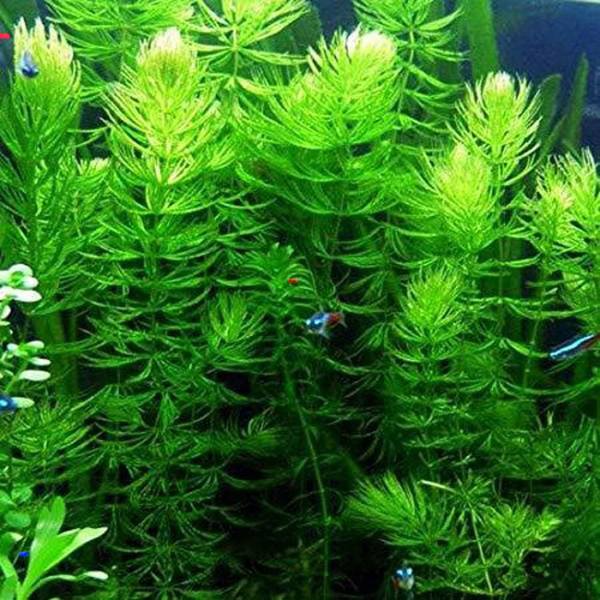
Hornwort's dense, feathery growth provides excellent cover for fry
Care Level: Very Easy Height: Can exceed 24 inches Growth Rate: Very Fast
Floating or Rooted
Hornwort naturally floats but can be weighted down with plant weights or tucked behind decorations. It has no true roots, so don’t try to plant it in substrate — it will simply detach and float away.
4. Anacharis (Egeria densa)
Anacharis, also called Brazilian Waterweed, grows either floating or rooted in substrate. Anacharis is fast-growing and excellent for absorbing excess nutrients like nitrates and phosphates. Many fish species eat Anacharis eagerly, which can benefit herbivorous fish but means the plant may not survive long in tanks with species like goldfish or silver dollars.
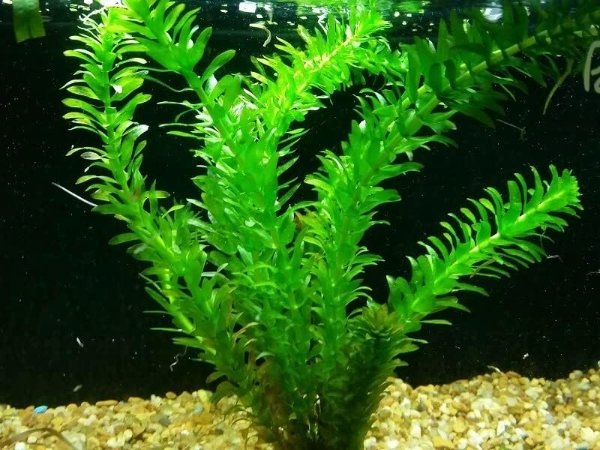
Anacharis grows rapidly and absorbs excess nutrients
Care Level: Very Easy Height: 12-24 inches Growth Rate: Very Fast
5. Ludwigia Repens (Dark Red Ludwigia)
Ludwigia Repens is a low-maintenance stem plant with attractive red and green leaves. Ludwigia Repens grows rapidly, making regular trimming necessary. In low light, Ludwigia Repens leaves appear more green than red — the red coloration intensifies with stronger lighting. Ludwigia Repens is easy to propagate by cutting and replanting stems.
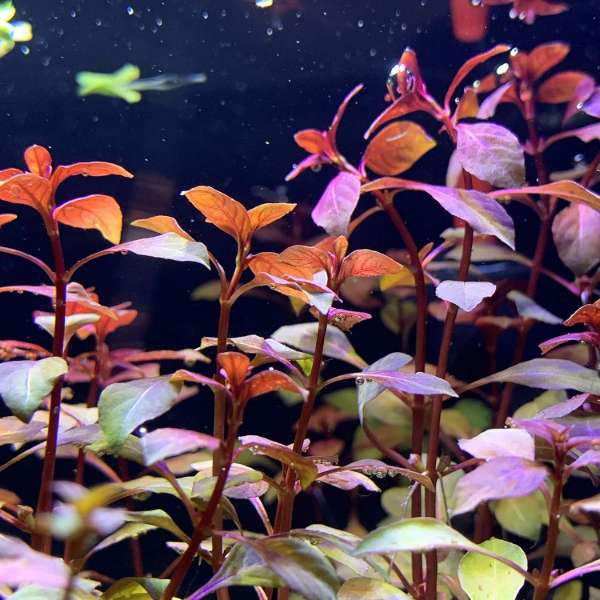
Ludwigia repens displays more red coloration under higher light
Care Level: Easy Height: 12-20 inches Growth Rate: Fast
Ferns and Anubias
Ferns and Anubias grow from rhizomes — thick horizontal stems that must never be buried in substrate. Attach ferns and Anubias to driftwood or rocks using thread, fishing line, or cyanoacrylate glue. Rhizome plants are extremely hardy and grow slowly.
6. Java Fern (Microsorum pteropus)
Java Fern is one of the most popular beginner aquarium plants. Java Fern produces dark green, textured leaves from a rhizome that must be attached to driftwood or rocks — never buried in substrate. Java Fern is extremely hardy, tolerates water temperatures from 68–82°F and pH from 6.0–7.5, and grows slowly to about 8–14 inches tall.
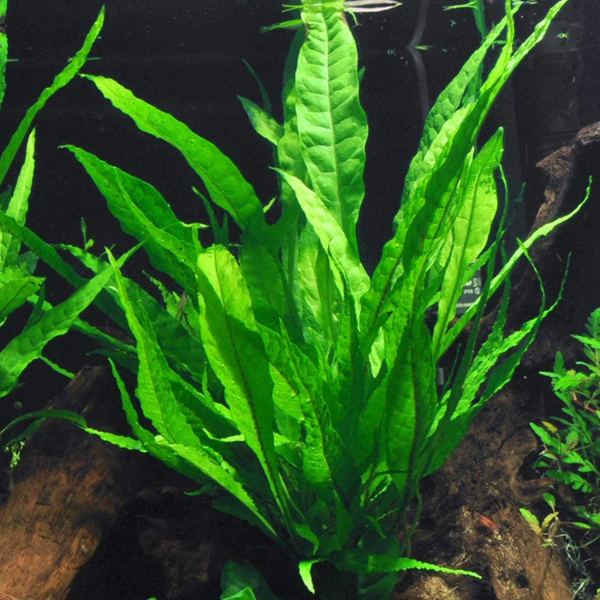
Java Fern attached to driftwood — never bury the rhizome
Care Level: Very Easy Height: 8-14 inches Growth Rate: Slow
7. Java Fern ‘Windelov’
Java Fern ‘Windelov’ is a variety of Java Fern with distinctive, finely-branched leaf tips that create an intricate, fern-like appearance. Java Fern ‘Windelov’ has the same care requirements as standard Java Fern — attach to hardscape, never bury the rhizome. Java Fern ‘Windelov’ stays slightly smaller than the standard variety at 6–8 inches.
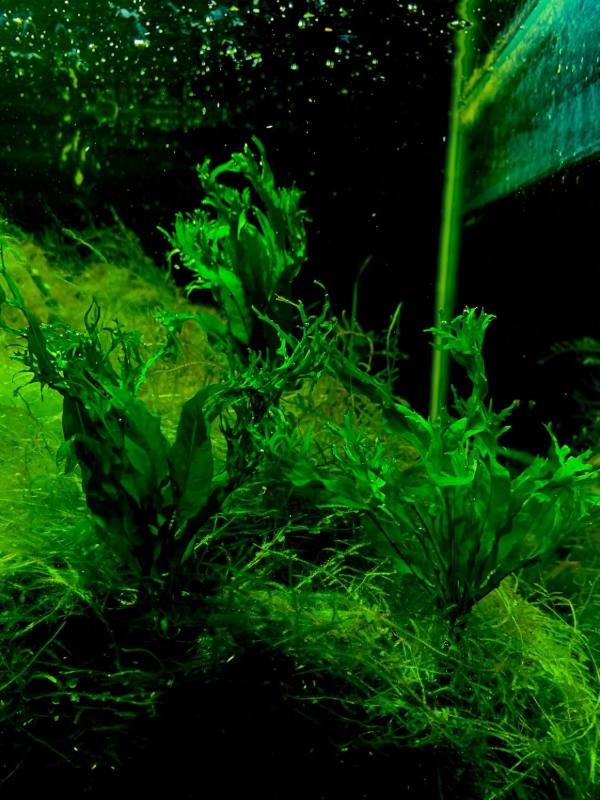
The distinctive branched tips of Java Fern 'Windelov'
Care Level: Very Easy Height: 6-8 inches Growth Rate: Slow
8. Anubias Nana Petite
Anubias Nana Petite is a small, dense-leafed Anubias variety perfect for foregrounds or attaching to small pieces of driftwood. Anubias Nana Petite is extremely low-maintenance with minimal light requirements. Anubias Nana Petite’s durable roots anchor firmly to surfaces. This variety grows very slowly, so patience is essential.
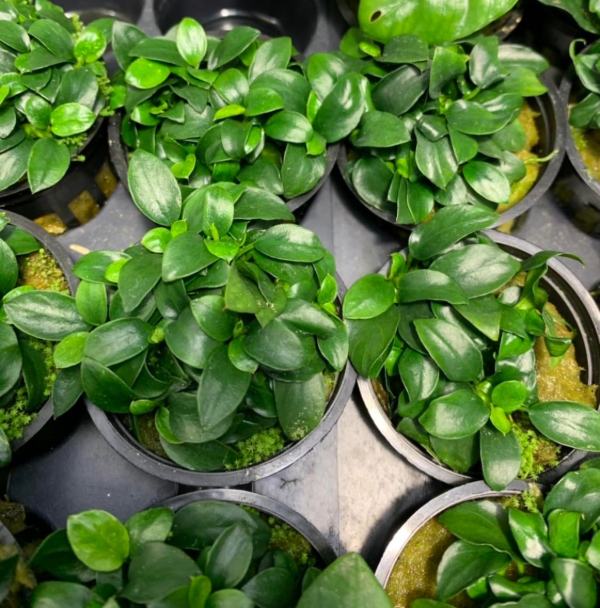
Anubias Nana Petite is perfect for foregrounds and small spaces
Care Level: Very Easy Height: 2-5 inches Growth Rate: Very Slow
Rhizome Rule
Java Fern and Anubias species have thick horizontal stems called rhizomes. If you bury the rhizome in substrate, the plant will rot and die. Attach these plants to rocks or driftwood using thread, fishing line, or super glue (cyanoacrylate). Once established, they anchor themselves.
Mosses
Aquarium mosses attach to surfaces rather than rooting in substrate, grow quickly, and require only occasional trimming. Mosses are among the easiest aquarium plants and are ideal for creating natural-looking aquascapes, especially in shrimp tanks.
9. Marimo Moss Balls
Marimo Moss Balls are not actually moss but a spherical form of the freshwater algae Aegagropila linnaei. Marimo Moss Balls are incredibly low-maintenance — just roll them occasionally to maintain their shape and ensure all sides receive light. Marimo Moss Balls absorb nitrates and provide a fun grazing surface for shrimp. Authentic Marimo have a slightly uneven texture with occasional brown spots.
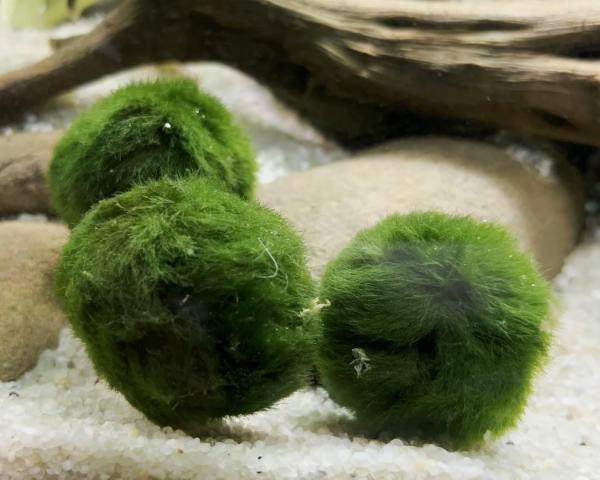
Marimo moss balls require almost no care — just roll occasionally
Care Level: Very Easy Size: 1-5 inches diameter Growth Rate: Extremely Slow
10. Christmas Moss (Vesicularia montagnei)
Christmas Moss is named for its tree-like fronds that resemble Christmas tree branches. Christmas Moss creates beautiful moss walls or carpets when attached to mesh or flat surfaces. Christmas Moss provides excellent hiding spots for fry and shrimp, and is easy to maintain with occasional trimming.
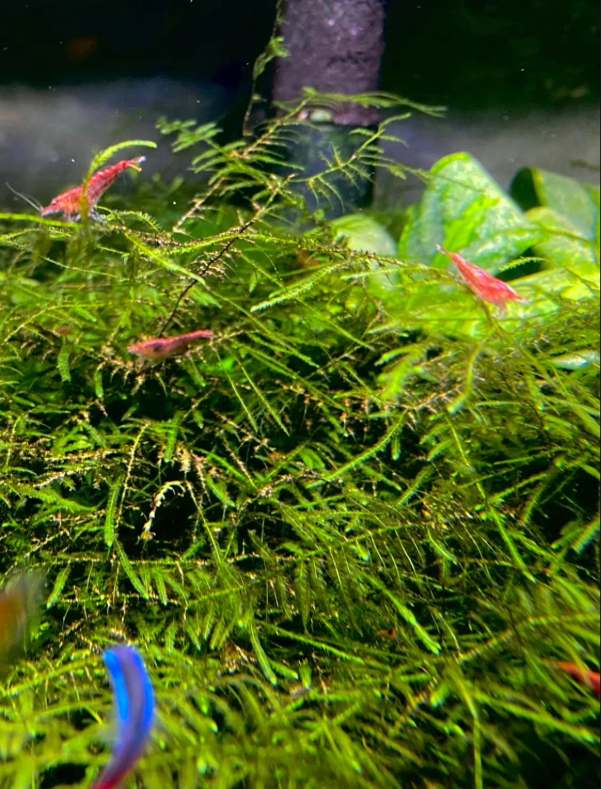
Christmas Moss fronds resemble tiny Christmas tree branches
Care Level: Easy Height: 1-3 inches Growth Rate: Moderate
11. Taiwan Moss (Taxiphyllum alternans)
Taiwan Moss creates a bushy, forest-like appearance when attached to driftwood or rocks. Taiwan Moss tolerates both cold and tropical water temperatures (59–86°F), making it one of the most versatile aquarium mosses. Taiwan Moss can grow quite large and provides excellent shelter for small fish and invertebrates.
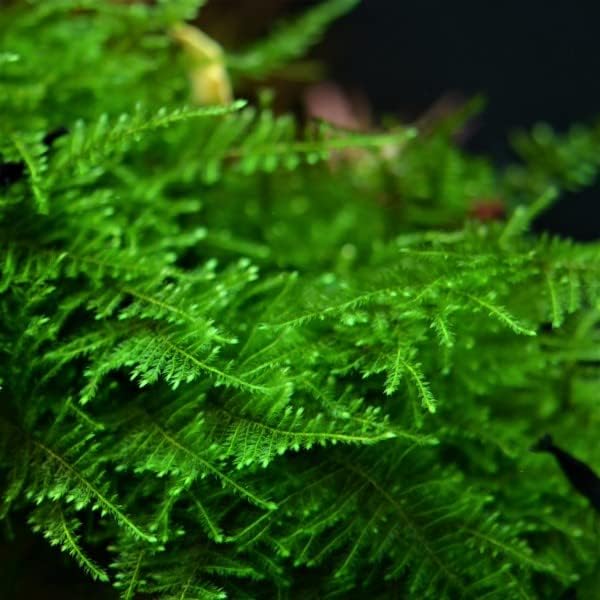
Taiwan Moss creates a lush, forest-like appearance
Care Level: Easy Height: 2-4 inches Growth Rate: Moderate
12. Flame Moss (Taxiphyllum sp. ‘Flame’)
Flame Moss is a unique aquarium moss with upward-growing fronds that twist like flames. Flame Moss grows slowly and stays dense, making it perfect for accent pieces on driftwood or rocks. Flame Moss has minimal care requirements — attach to a surface and allow it to grow naturally.
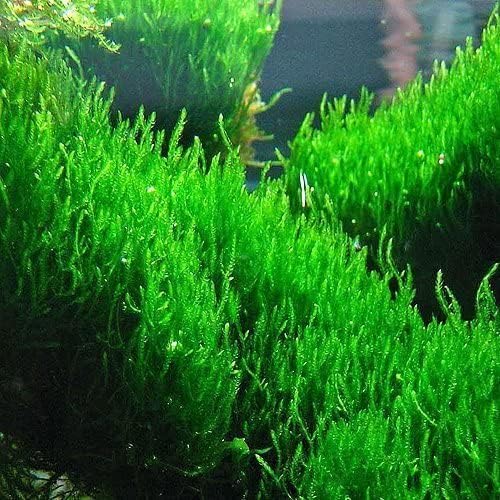
Flame Moss fronds grow upward in a distinctive twisting pattern
Care Level: Easy Height: 2-4 inches Growth Rate: Slow
Carpeting Plants
Carpeting plants spread across the substrate to create a grass-like foreground. Carpeting plants grow more slowly in low light than in high-light setups but still create attractive ground cover over time.
13. Micro Sword (Lilaeopsis brasiliensis)
Micro Sword, sometimes called Copragrass, is a foreground plant that resembles grass and creates attractive carpets. Micro Sword spreads through runners to fill in over time. Micro Sword tolerates a range of lighting conditions and can grow partially or fully submerged.
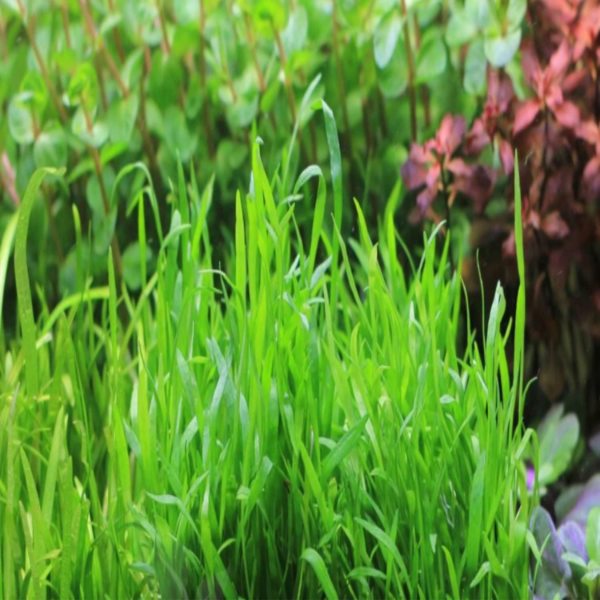
Micro Sword spreads through runners to create a grass-like carpet
Care Level: Easy Height: 1-3 inches Growth Rate: Moderate
14. Dwarf Hairgrass (Eleocharis parvula)
Dwarf Hairgrass creates a lush, grass-like carpet perfect for tank foregrounds. Dwarf Hairgrass is fast-growing compared to other carpeting plants. In low light, Dwarf Hairgrass grows slower and less dense than in high-light setups, but Dwarf Hairgrass still creates an attractive carpet. Dwarf Hairgrass provides excellent hiding places for small fish and shrimp fry.
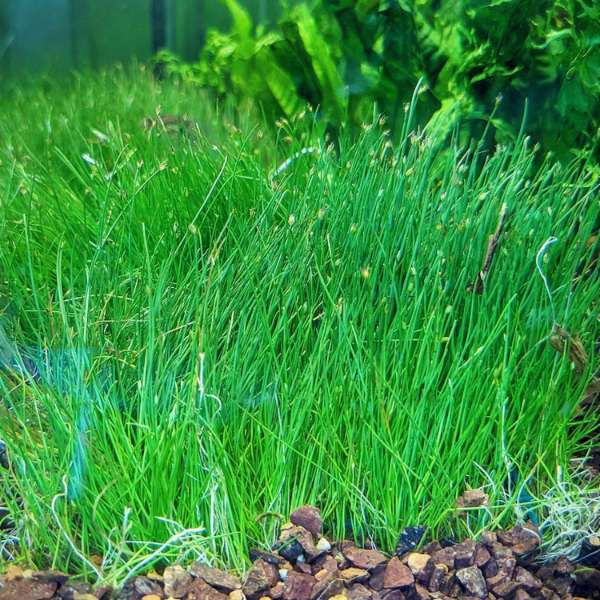
Dwarf Hairgrass creates a lush lawn-like carpet
Care Level: Easy to Moderate Height: 2-6 inches Growth Rate: Moderate
General Care Tips
Lighting
Low light aquarium plants still need consistent lighting to photosynthesize. Aim for 8–10 hours of lighting daily on a consistent schedule. Using a timer ensures consistency and prevents algae-promoting extended photoperiods. For fixture recommendations, see our best LED lights for planted tanks guide.
Substrate
Not all low light aquarium plants require specialized substrate:
- Mosses and ferns attach to hardscape — no substrate needed
- Stem plants root in any substrate, but benefit from nutrient-rich options
- Carpeting plants like Micro Sword and Dwarf Hairgrass spread better in fine-grain substrates
Regular gravel works for most beginners. Add root tabs for heavy root-feeders like Amazon Sword. See our guide to the best substrate for planted tanks for detailed recommendations.
Maintenance
Basic Plant Maintenance
- Trim tall plants before they block light from lower plants
- Remove dead or yellowing leaves promptly
- Replant stem cuttings to fill empty areas
- Clean algae from slow-growing plants like Anubias
- Divide overgrown plants and share or relocate sections
Plants to Avoid as a Beginner
Skip These Plants
- Bright red or purple plants — require high light for coloration
- Plants sold in tubes or pots without water — often non-aquatic
- Dwarf Baby Tears (HC Cuba) — requires high light and CO2
- Red Tiger Lotus — while beautiful, can be demanding
- Any plant with "high light" or "CO2 required" labels
Start Simple
Begin with 3-5 hardy species and let them establish before adding more. Java Fern, Anubias, and Java Moss are nearly impossible to kill and provide a great foundation for any planted tank. Once you gain confidence, you can experiment with more challenging species.
Conclusion
A beautiful planted tank doesn’t require expensive equipment or expert knowledge. The 14 low light aquarium plants in this guide thrive in standard aquarium lighting without CO2 injection or heavy fertilization. Start with a few easy species like Java Fern, Anubias Nana Petite, and Java Moss, provide consistent lighting, and maintain basic water quality.
For more planted tank ideas, explore our complete freshwater plants guide or learn about floating aquarium plants that provide shade and nutrient control from the water surface.
What is considered low light for aquarium plants?
Low light typically ranges from 1-2 watts per gallon for traditional lighting, or 15-30 PAR (Photosynthetically Active Radiation) for LED lights. At this level, plants grow slowly but steadily without requiring CO2 injection or heavy fertilization. Most standard aquarium hoods provide low to moderate light.
Do low light aquarium plants need CO2?
Low light plants don't require CO2 injection. The CO2 produced naturally by fish and biological processes is typically sufficient. Adding CO2 will increase growth rate, but these plants survive and even thrive without it.
Can aquarium plants grow in just gravel?
Many low light plants grow fine in regular gravel. Stem plants root in substrate, but ferns, anubias, and mosses attach to hardscape and don't need substrate at all. For better growth, you can add root tabs to gravel or use a nutrient-rich planted substrate.
Why are my aquarium plants dying?
Common causes include inadequate lighting (even for low-light plants, some light is needed), planting rhizome plants in substrate (anubias and java fern must have exposed rhizomes), nutrient deficiency in established tanks, or the plant isn't truly aquatic. Ensure you're buying genuine aquarium plants and meeting their basic requirements.
How long should aquarium lights be on for plants?
For low light plants, 8-10 hours daily is sufficient. Longer photoperiods don't help plants much but encourage algae growth. Use a timer for consistency. If you experience algae problems, reduce light duration to 6-8 hours.
Related Topics
Found this helpful?
Share this guide with your fellow aquarium enthusiasts!

Written by
Ynes Carrillo
Ynes grew up in the Andes mountains of Venezuela, where she spent decades as a teacher and cultivated a lush garden of native and non-native plants around her backyard fish pond. She holds a Master's degree in Education and now lives in Texas, where she keeps a low-tech planted aquarium and tends a vegetable garden. Though retired from the classroom, Ynes channels her lifelong passion for teaching into helping others succeed with fishkeeping and aquatic plants.