
Cycling a freshwater aquarium is the process of growing beneficial bacteria that convert toxic ammonia from fish waste into less harmful nitrate. This takes 4-6 weeks and must be completed before adding any fish. Skipping this step leads to new tank syndrome — ammonia poisoning that kills fish within days of being added to an uncycled tank.
The process is straightforward: set up the tank, add an ammonia source, and wait for two groups of bacteria to establish. An aquarium test kit tracks the progress, and the cycle is complete when ammonia and nitrite both read zero. It requires patience, not expertise.
Do Not Add Fish Until Cycling Is Complete
Adding fish to an uncycled aquarium exposes them to toxic ammonia and nitrite. Wait until both read 0 ppm before introducing any fish. Cycling can take 4-6 weeks, though there are ways to speed it up covered below.
Understanding the Nitrogen Cycle
The nitrogen cycle is a three-stage biological process that keeps aquarium water safe for fish. Each stage depends on a different group of bacteria converting waste into progressively less toxic compounds.
Stage 1: Ammonia production. Fish waste, uneaten food, and decaying plant matter release ammonia (NH3) into the water. Ammonia is highly toxic to freshwater fish — it causes gill damage, immune suppression, and death. In an uncycled tank, ammonia accumulates with nothing to break it down.
Stage 2: Ammonia to nitrite. Nitrifying bacteria colonize filter media and hard surfaces, consuming ammonia and converting it into nitrite (NO2-). Nitrite is also toxic — levels as low as 0.1 ppm stress fish and interfere with oxygen transport in their blood.
Stage 3: Nitrite to nitrate. A second group of nitrifying bacteria converts nitrite into nitrate (NO3-). Nitrate is far less toxic and is tolerated by most freshwater fish at concentrations below 40 ppm, though keeping it under 20 ppm is better for long-term health. Regular water changes and live plants remove accumulated nitrate.
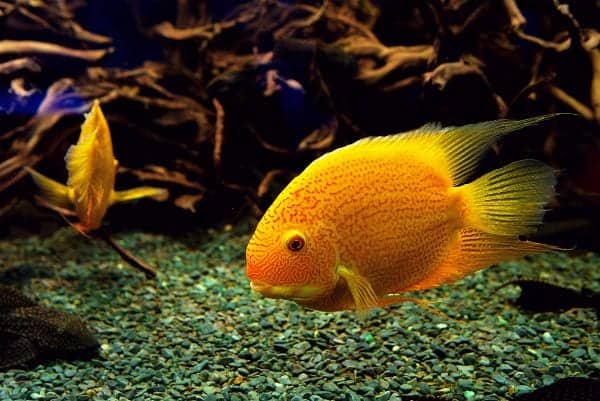
A fully cycled freshwater aquarium with established bacteria supports healthy fish without ammonia or nitrite buildup
These bacteria grow slowly — roughly doubling once per day under good conditions. That slow reproduction rate is why cycling takes weeks, not days. No amount of ammonia makes them grow faster; you simply have to wait for the population to build.
The Science Has Evolved
Most aquarium guides say Nitrosomonas handles ammonia and Nitrobacter handles nitrite. Research over the past 25 years tells a different story. A 2024 study published in Applied and Environmental Microbiology found that comammox Nitrospira bacteria — organisms capable of converting ammonia all the way to nitrate in a single step — were the dominant nitrifiers in 79% of freshwater aquarium biofilters tested. This helps explain why seeded filter media from established tanks works so well for cycling: it contains the actual organisms that dominate in aquarium environments, not the textbook species that most commercial products are based on.
What You Need Before Starting
Gather all equipment before beginning. Do not purchase any fish at this stage — they will be added after cycling is complete, typically 4-6 weeks from now.
Essential Equipment for Cycling
- Aquarium filter — provides the primary surface area where nitrifying bacteria colonize. Filters with biological media (ceramic rings, sponge) work better than cartridge-only designs
- Water heater — maintains stable temperature for bacterial growth
- Substrate — gravel or sand for the tank bottom
- Water conditioner — removes chlorine and chloramine from tap water, both of which kill bacteria on contact
- Ammonia source — a piece of raw shrimp from the grocery store or a daily pinch of fish food. Both produce the ammonia that nitrifying bacteria need to grow as they decompose
- Liquid water test kit — must test ammonia, nitrite, nitrate, pH, and ideally KH. Liquid kits are significantly more accurate than paper test strips for cycling
- Thermometer — confirms water temperature is in the optimal range
If you have access to an established aquarium — your own, a friend’s, or your local fish store’s — ask for a piece of used filter media or a squeeze of sponge filter gunk. This is the single most effective way to speed up cycling (more on this below).
Filter Media Matters
The filter is where the majority of nitrifying bacteria live, because it provides high surface area with constant water flow delivering ammonia and oxygen. Biological filter media like ceramic rings, bio-balls, and sponge provide far more colonization space than disposable cartridges. If your filter uses only a cartridge, consider adding a mesh bag of ceramic media alongside it.
How to Cycle a Freshwater Aquarium (Fishless Method)
Fishless cycling is the standard approach: you grow bacteria using ammonia as a food source, with no fish in the tank. No fish are exposed to toxic water, and you end up with a mature bacterial colony ready to handle a real fish load from day one.
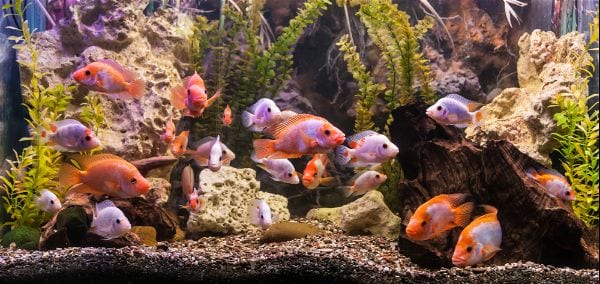
A tank set up for fishless cycling — all equipment running, no fish, just time and ammonia
Step 1: Set Up the Tank
Rinse the aquarium and all equipment in plain water — never use soap. Add substrate, install the filter and heater, fill with dechlorinated water, and arrange any decorations or hardscape. Turn on the filter and heater and let everything run for 24 hours to stabilize.
Set the heater to 80-84°F (27-29°C). This is warmer than most tropical fish prefer, but it’s the optimal range for nitrifying bacteria growth. You’ll lower the temperature to your target species’ preference before adding fish.
Step 2: Add an Ammonia Source
The bacteria you’re growing need ammonia to feed on. There are a few easy ways to provide it:
Raw shrimp method: Drop a piece of raw, uncooked shrimp from the grocery store into the tank and let it decompose. This produces a steady ammonia source without any special products. Remove it once ammonia is consistently detectable, or leave it in and let the cycle consume the ammonia as it’s released. Simple and effective.
Fish food method: Drop a small pinch of fish food into the tank daily. As it decomposes, it releases ammonia. Similar idea to the shrimp — no special products needed. The trade-off is less precise control over ammonia levels, and it takes a few days for decomposition to produce a measurable reading.
Whichever method you choose, test ammonia every few days and aim for around 2 ppm. Remove the shrimp or reduce the fish food if ammonia climbs above 3-4 ppm — higher levels don’t speed things up and can actually stall the cycle by producing massive nitrite spikes.
Step 3: Test Every 2-3 Days
Test ammonia, nitrite, and nitrate using a liquid test kit every 2-3 days. Write down the results — tracking the numbers over time shows the cycle’s progression and helps you spot problems.
What you’ll see:
- Week 1-2: Ammonia stays elevated or rises slowly. Nitrite reads zero. Bacteria are present but the colony is too small to make a visible dent. This is normal.
- Week 2-3: Ammonia starts dropping as the first bacterial group grows large enough to process it. Nitrite begins appearing in test results. This is a good sign — ammonia-oxidizing bacteria are working.
- Week 3-5: Ammonia drops quickly. Nitrite may spike high — sometimes off the chart on an API test kit. This means the first bacterial group is established but the second group (nitrite-to-nitrate) is still catching up.
- Week 4-6: Nitrite begins falling. Nitrate appears for the first time. The full chain is now working.
Step 4: Confirm the Cycle Is Complete
How do you know the cycle is actually done? Run a simple test. Add another ammonia source to the water — a fresh piece of shrimp or a pinch of fish food — and wait 24 hours. Then test the water. If ammonia reads 0 ppm and nitrite reads 0 ppm, with some nitrate showing up, the bacteria are established and your tank is ready. If ammonia or nitrite are still detectable, the colony needs more time — give it a few more days and try again.
Step 5: Water Change and Add Fish
After the cycle completes, the water will have accumulated nitrate from weeks of bacterial processing. Test nitrate and perform water changes to bring it below 20 ppm before adding any fish. Start with a 25-30% water change and test again — repeat over a few days until nitrate is where you want it.
This won’t harm the cycle. Nitrifying bacteria live on surfaces — filter media, substrate, glass, decorations — not in the water column. You can change as much water as you need to get nitrate levels down.
Lower the heater to your target species’ preferred temperature before adding fish.
Speeding Up the Cycle
Seeded Filter Media (Most Effective)
The fastest way to cycle a freshwater aquarium is transferring bacteria from an established tank. A squeeze of dirty sponge filter water, a handful of established substrate, or a used filter cartridge from a cycled aquarium introduces millions of living bacteria directly into the new system.
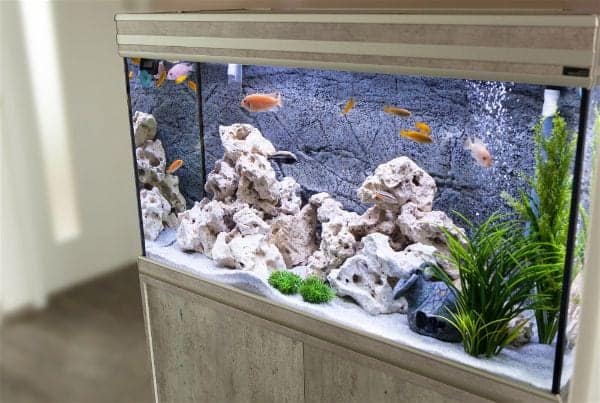
An established aquarium's filter contains the bacteria that can jumpstart a new tank's cycle in 1-2 weeks
With enough seeded material, cycling can complete in as little as 1-2 weeks instead of 4-6. This works because you’re transplanting the actual organisms that dominate in aquarium environments — including the comammox Nitrospira that most commercial products don’t contain.
Where to get seeded media:
- Your own established tanks
- A friend or family member’s aquarium
- Your local fish store (many will provide a piece of used media if you ask)
The trade-off: Seeded media can carry diseases, algae, or pest snails from the source tank. If you trust the source, this is a non-issue. If the source tank has had health problems, the risk may not be worth the speed.
Bacterial Starter Products
Bottled bacterial starters claim to cycle tanks in days to weeks. Not all are created equal — some contain only heterotrophic bacteria that consume organic waste but don’t process ammonia through the nitrogen cycle. These products may clear cloudy water temporarily, but they won’t cycle your tank.
Not All Bacterial Products Are Equal
Look for products that specifically contain live autotrophic nitrifying bacteria. Generic “beneficial bacteria” products that make vague claims are often ineffective. Check reviews from experienced fishkeepers before buying.
Products that contain the right bacteria can meaningfully reduce cycling time when used alongside an ammonia source (shrimp or fish food). They don’t eliminate the wait entirely, but they can shorten it. Here’s what we recommend:
The Planted Tank Approach
Heavily planting a new aquarium from day one is a legitimate alternative approach to traditional cycling. Live aquatic plants directly absorb ammonia and nitrate as fertilizer — research by microbiologist Diana Walstad demonstrated that plants can consume nitrogen waste even more effectively than bacteria in some conditions.
The approach: plant the tank heavily, let plants establish and show new growth over 2-4 weeks, then add fish slowly. The plants handle nitrogen processing while bacterial colonies develop in the background.
This works best with fast-growing plants like hornwort, water sprite, floating plants, and stem plants that absorb nutrients aggressively. It’s less reliable with slow-growing plants like anubias or java fern alone.
Why Fish-In Cycling Should Be Avoided
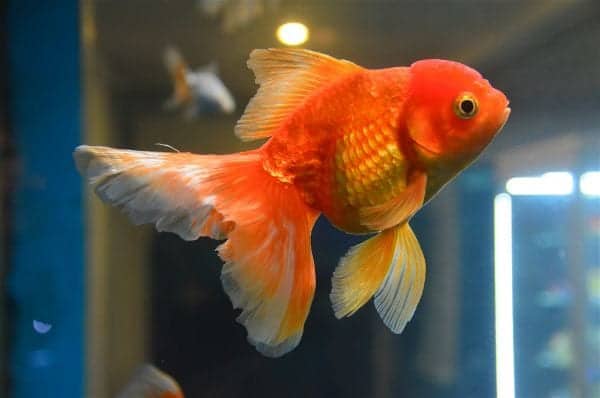
Fish like goldfish should only be added to a fully cycled tank — not used to start the cycle
Older guides recommend adding a few hardy fish to produce ammonia and start the cycle. This practice is unnecessary and harmful. Fish-in cycling exposes fish to toxic ammonia and nitrite for weeks, causing gill damage, immune suppression, and increased disease susceptibility — even if the fish survive.
Fishless cycling produces the same result without any animal suffering, and the bacterial colony it builds is typically more robust because you can dose ammonia at consistent levels rather than relying on the variable output of a few stressed fish.
If you’ve already added fish to an uncycled tank — maybe you received fish as a gift or inherited a tank — the priority shifts to damage control: feed very sparingly, test water daily, and perform water changes whenever ammonia or nitrite is detectable. A bacterial starter like Brightwell Aquatics MicroBacter Start XLF may help in this situation. For detailed water change guidance, see our guide on how to clean your fish tank.
Troubleshooting Cycling Problems
Cycle Stalled: Ammonia or Nitrite Won’t Drop
A stalled cycle — where ammonia or nitrite plateaus for more than two weeks without progressing — most commonly results from water chemistry issues. Nitrifying bacteria are sensitive to pH and carbonate hardness.
Check pH first. Nitrifying bacteria function best between pH 7.0-8.0. Below pH 7.0, their growth rate drops significantly. Below pH 6.0, nitrification stops almost entirely. The cycling process itself produces acid, which gradually lowers pH over time. If pH has dropped below 7.0, add crushed coral to the filter or a small amount of baking soda to buffer it back up. For comprehensive guidance, see our pH management guide.
Check KH next. Carbonate hardness (KH) provides the buffering capacity that keeps pH stable. Nitrifying bacteria consume KH as they work — for every 10 ppm of ammonia converted, roughly 4 dKH of carbonate is consumed. If KH drops below 4 dKH, bacteria slow down and pH becomes unstable. Add baking soda (about 1 teaspoon per 10 gallons raises KH by roughly 3 dKH) or crushed coral to restore buffering.
Cloudy Water During Cycling
Milky, cloudy water during the first few weeks is a harmless heterotrophic bacterial bloom — free-floating bacteria multiplying as they consume dissolved organic matter. This is not the nitrifying bacteria you’re trying to grow (those attach to surfaces). The cloudiness clears on its own within 1-2 weeks as the bloom exhausts its food source. Don’t restart the tank or do excessive water changes — this prolongs it. For more detail, see our cloudy aquarium water guide.
If you notice a dusty brown coating on glass and decorations instead of milky water, that’s brown algae (diatoms) — a separate and very common issue in new tanks that typically resolves on its own within 2-3 months as silicate levels decrease.
No Ammonia Reading After Several Days
If using fish food or raw shrimp as your ammonia source, ammonia may not show up in test results for 5-7 days — the organic matter needs to decompose first. Higher water temperatures (80-84°F) speed this up. If ammonia still reads zero after a week, verify the test kit is working by testing a known sample. Expired reagents give false readings. Also check whether your water conditioner contains ammonia-binding agents — some dechlorinators (like Seachem Prime) temporarily bind ammonia in a way that affects test readings.
Ammonia Toxicity Is pH-Dependent
An important nuance most guides skip: ammonia exists in two forms in water. Free ammonia (NH3) is the toxic form. Ammonium (NH4+) is relatively harmless. Standard test kits measure both combined as “total ammonia nitrogen.”
The ratio shifts dramatically with pH. At pH 7.0 and 77°F, a test reading of 1.0 ppm total ammonia represents only about 0.006 ppm of the toxic form — well below dangerous thresholds. At pH 8.0, that same 1.0 ppm reading represents about 0.05 ppm free ammonia — right at the level where gill damage begins. Higher pH makes ammonia dramatically more dangerous. This matters most during fish-in situations, not fishless cycling.
After Cycling: Adding Fish
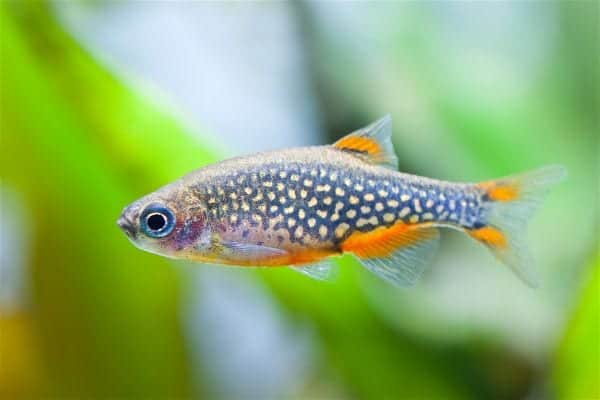
Hardy species like danios, tetras, and rasboras make excellent first fish for a newly cycled tank
Your newly cycled aquarium has just enough bacteria to handle the ammonia load from the cycling process — it is not yet ready for a full stock of fish. Adding too many fish at once overwhelms the bacterial colony, causes an ammonia spike, and can crash the cycle. Patience during stocking is just as important as patience during cycling.
Week 1 after cycling: Add 2-3 hardy fish. Danios, tetras, rasboras, or corydoras catfish are all good choices for a newly cycled freshwater tank. Feed sparingly and test ammonia and nitrite every few days to confirm the bacteria are handling the increased load.
Week 2-3 after cycling: If water parameters remain stable (0 ammonia, 0 nitrite), add another small group of fish. Continue monitoring.
Week 4+ after cycling: Continue adding fish gradually, waiting at least a week between additions. The bacterial colony grows to match the increasing bio-load, but only if you give it time to catch up after each new addition.
Choose First Fish Wisely
Stock hardy community species first. Save sensitive fish like discus, rams, or delicate dwarf cichlids for after the tank has been running stably for 2-3 months. Newly cycled tanks can still have minor parameter fluctuations that hardy species tolerate but sensitive species may not. For species ideas, see our guides on exotic fish for beginners and buying aquarium fish.
Maintaining the Cycle Long-Term
Once the cycle is established, the biggest risk is accidentally destroying the bacterial colony through routine maintenance mistakes. A few simple habits prevent this:
- Never rinse filter media in tap water. Chlorine and chloramine kill nitrifying bacteria on contact. Rinse dirty filter media in a bucket of old tank water during water changes. For detailed guidance, see our guide on changing filter media without losing bacteria.
- Never replace all filter media at once. Replace one piece at a time, waiting at least 2 weeks between replacements. The remaining media keeps the bacterial colony intact while new media gets colonized.
- Don’t overfeed. Excess food decomposes into ammonia faster than bacteria can process it, especially in a newly cycled tank. Learn to recognize the signs of overfeeding.
- Stock gradually. Each new fish increases ammonia production. Adding too many at once overwhelms the bacteria. Build up slowly over weeks.
- Be cautious with medications. Some antibiotics and anti-parasitic treatments kill beneficial bacteria. If you need to medicate, monitor ammonia and nitrite closely afterward and be prepared for extra water changes. See our guide on cleaning an aquarium after disease.
Regular partial water changes (20-25% weekly) keep nitrate in check without disrupting the bacterial colony. The bacteria are attached to surfaces — you can change water freely without affecting them.
For a broader look at what can go wrong and how to avoid it, see our guide on 10 common fishkeeping mistakes. If you’re working with a smaller tank, our guide to setting up a small freshwater tank covers the additional considerations that come with less water volume. And if you’re interested in the marine side, the same nitrogen cycle principles apply — our saltwater cycling guide covers the process using live rock.
How long does it take to cycle a freshwater aquarium?
Cycling a freshwater aquarium takes 4-6 weeks when starting from scratch with ammonia dosing. Using seeded filter media from an established tank can reduce this to 1-2 weeks. The only reliable indicator of completion is test results: 2 ppm ammonia must process to 0 ammonia and 0 nitrite within 24 hours.
Do I need to cycle my aquarium before adding fish?
Yes. Cycling establishes the bacteria that convert toxic ammonia from fish waste into less harmful nitrate. Without cycling, ammonia builds to lethal levels within days — a condition called new tank syndrome, which is the leading cause of fish death in new aquariums. Every new freshwater tank must be cycled before adding fish.
Can I add fish to a new tank immediately?
Adding fish to an uncycled tank is not recommended. The tank has no bacteria to process fish waste, so ammonia accumulates rapidly and poisons the fish. If you inherited fish or received them unexpectedly, use a bacterial starter product, add the fish, feed very sparingly, and test water daily — but understand this is damage control, not ideal.
What is new tank syndrome?
New tank syndrome is the term for fish dying in newly set up aquariums due to ammonia and nitrite poisoning. Without established bacteria to process waste, toxic ammonia builds faster than fish can tolerate. It is entirely preventable by fishless cycling before adding any fish.
Why is my new aquarium water cloudy?
Cloudy water during cycling is a harmless bacterial bloom — heterotrophic bacteria multiplying as they consume dissolved organic matter. This milky cloudiness is normal during the first few weeks and clears on its own. Do not restart the tank or do excessive water changes, as this prolongs the process.
Why won't my nitrite levels drop during cycling?
Persistently high nitrite usually means low carbonate hardness (KH) or low pH. Nitrifying bacteria consume KH as they work, and they slow dramatically when KH drops below 4 dKH or pH falls below 7.0. Test KH and pH — add baking soda or crushed coral to buffer if needed.
How can I speed up aquarium cycling?
The most effective way to speed up cycling is seeding with filter media from an established tank — a squeeze of filter sponge gunk or a handful of established substrate can reduce cycling to 1-2 weeks. Raising temperature to 80-84°F and maintaining pH above 7.0 also help bacteria establish faster.
Should I do water changes during cycling?
Water changes during fishless cycling are generally not needed since there are no fish to protect. However, if pH drops below 7.0 or KH drops below 4 dKH, a partial water change can help restore buffering capacity. Nitrifying bacteria live on surfaces, not in the water column, so water changes do not remove them.
Related Topics
Found this helpful?
Share this guide with your fellow aquarium enthusiasts!
Written by
Jonathan Jenkins
I've been keeping fish for over 15 years — everything from planted freshwater tanks to saltwater reefs. I currently have a 30 gallon overstocked guppy breeding tank, 40 gallon planted self-cleaning aquarium, 200 gallon reef tank, and 55 gallon frag tank. I joined Fish Tank World to continue learning while sharing what I've learned along the way.