
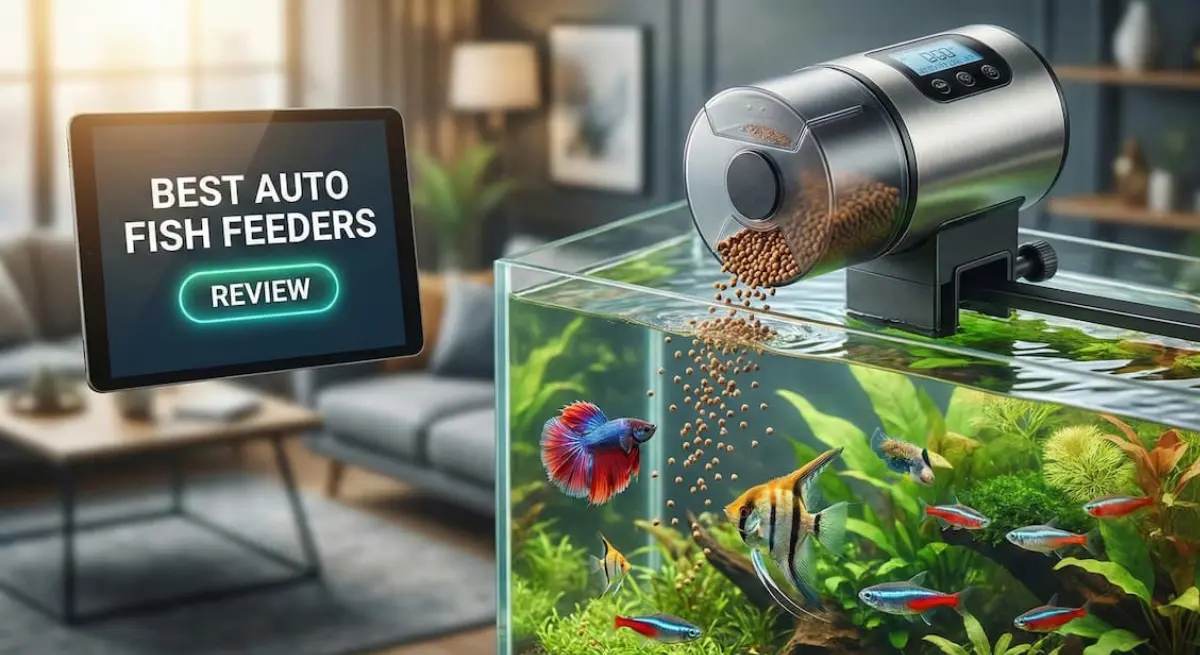
Automatic fish feeders dispense pre-set portions of food on a timer, keeping your fish fed consistently whether you’re at work, traveling, or just want to eliminate the guesswork from daily feeding. The best automatic fish feeder prevents overfeeding, keeps food dry in a humid aquarium environment, and runs reliably for weeks without intervention.
Top Pick
The Petbank Automatic Fish Feeder is the best automatic fish feeder for most aquarium owners. Its 16 sealed compartments keep food moisture-free, the USB-rechargeable battery lasts 1-2 months, and the LCD display makes programming straightforward. It’s the most reliable option for vacations and daily use alike.
Quick Comparison
| Feeder Type | Sealed compartment (16 grids) | Rotating drum | Rotating drum | Rotating drum |
| Food Capacity | 15 individual meals (2g each) | 100ml or 200ml (2 containers) | 200ml | Standard drum |
| Power Source | USB rechargeable (700mAh) | USB + AA battery backup | Rechargeable battery | 2 AA batteries |
| Battery Life | 1-2 months per charge | Months (USB primary) | Full vacation duration | ~2.5 months |
| Moisture-Proof | — | — | ||
| Max Daily Feedings | 3 per day | 6 per day | 3 intervals (8/12/24hr) | Up to 9 (3 times × 3 rotations) |
| WiFi / App Control | — | — | — | |
| Mounting Options | Clamp or suction cup | Stent or funnel base | Clamp or adhesive pad | Clamp base |
| Best For | Vacations & daily precision | Smart home & remote control | Budget-friendly reliability | Beginners & simple setups |
| Check Price | Check Price | Check Price | Check Price |
- Feeder Type
- Sealed compartment (16 grids)
- Food Capacity
- 15 individual meals (2g each)
- Power Source
- USB rechargeable (700mAh)
- Battery Life
- 1-2 months per charge
- Moisture-Proof
- Max Daily Feedings
- 3 per day
- WiFi / App Control
- —
- Mounting Options
- Clamp or suction cup
- Best For
- Vacations & daily precision
- Feeder Type
- Rotating drum
- Food Capacity
- 100ml or 200ml (2 containers)
- Power Source
- USB + AA battery backup
- Battery Life
- Months (USB primary)
- Moisture-Proof
- —
- Max Daily Feedings
- 6 per day
- WiFi / App Control
- Mounting Options
- Stent or funnel base
- Best For
- Smart home & remote control
- Feeder Type
- Rotating drum
- Food Capacity
- 200ml
- Power Source
- Rechargeable battery
- Battery Life
- Full vacation duration
- Moisture-Proof
- Max Daily Feedings
- 3 intervals (8/12/24hr)
- WiFi / App Control
- —
- Mounting Options
- Clamp or adhesive pad
- Best For
- Budget-friendly reliability
- Feeder Type
- Rotating drum
- Food Capacity
- Standard drum
- Power Source
- 2 AA batteries
- Battery Life
- ~2.5 months
- Moisture-Proof
- —
- Max Daily Feedings
- Up to 9 (3 times × 3 rotations)
- WiFi / App Control
- —
- Mounting Options
- Clamp base
- Best For
- Beginners & simple setups
Why Use an Automatic Fish Feeder?
Automatic fish feeders solve two persistent problems in fishkeeping: inconsistent feeding schedules and overfeeding. Manual feeding relies on guesswork — a pinch of flakes is never the same twice, and skipped feedings happen when life gets busy.
Overfeeding is the more dangerous issue. Excess food decomposes on the substrate, spiking ammonia and nitrite levels that stress fish, promote algae growth, and cloud aquarium water. An automatic feeder dispenses the same calibrated amount at the same time every day, removing human error from the equation.
Automatic feeders are particularly valuable for:
- Vacation and travel — feed your fish for weeks without a fish sitter
- Busy or unpredictable schedules — your fish eat on time even when you can't
- Preventing overfeeding — precise portions reduce waste and maintain water quality
- Multiple daily feedings — some species need 2-3 small meals instead of one large one
- Establishing feeding routines — fish thrive on consistent schedules
Pellets Over Flakes
Pellets work significantly better than flakes in automatic feeders. Pellets resist moisture, dispense consistently, and don’t clump or stick to feeder walls. Flakes absorb humidity from the aquarium surface and form clogs — the #1 cause of automatic feeder failures. If you currently feed flakes, switching to a pellet food before setting up an automatic feeder will save you troubleshooting headaches.
The Best Automatic Fish Feeders Reviewed
1. Petbank Automatic Fish Feeder — Best Overall
Petbank Automatic Fish Feeder
- 16 sealed compartments — each holds up to 2g of food for precise portions
- Moisture-proof design — opening closes automatically after each feeding
- USB rechargeable — 700mAh battery lasts 1-2 months per charge
- LCD display for programming up to 3 daily feedings
- Dual mounting: adjustable clamp or suction cup for rimless tanks
- Supports pellets, granules, powders, and small strips
Why we recommend it: The Petbank automatic fish feeder is the most reliable option for vacation use and daily precision feeding. Its sealed-compartment design is the best defense against moisture — each grid closes after dispensing, keeping the remaining food dry. Unlike rotating-drum feeders where humidity from the tank can seep into the entire food supply, the Petbank isolates each meal. The USB rechargeable battery eliminates the hassle and cost of AA battery replacements.
The Petbank automatic fish feeder takes a compartment-based approach instead of a traditional rotating drum. Each of the 16 grids holds a pre-measured portion of food (up to 2g per grid), and the feeder rotates to dispense one grid at a time. This design gives you precise control over how much food each feeding delivers — you can program 1, 2, or 3 grids per feeding session.
The moisture advantage: The biggest reason automatic feeders fail is humidity. Aquarium surfaces produce constant moisture that travels upward into feeder hoppers, turning food into a sticky paste that clogs the dispenser. The Petbank solves this with a fully sealed mechanism — the food opening closes automatically after each feeding, cutting off the moisture path. This makes the Petbank particularly well-suited for tanks with bubblers, HOB filters, or any setup that creates surface agitation.
Scheduling flexibility: The LCD display lets you set up to 3 feeding times per day, with 1-3 grids per feeding. You can also set skip-day intervals (every 1, 2, 3, or 4 days), which is useful for species with slower metabolisms or vacation care scenarios where you want to stretch food reserves.
One limitation: The Petbank doesn’t dispense flakes or shrimp wafers well. The compartment openings are sized for pellets, granules, and powders. If your fish eat primarily large flakes, consider the Aoyar or FISHNOSH instead.
2. DXOPHIEX WiFi Fish Feeder — Best Smart Feeder
DXOPHIEX WiFi Fish Feeder
- WiFi app control via SmartLife — adjust feedings from anywhere
- Up to 6 meals per day with 1-12 portions per meal
- Per-day-of-week scheduling — different feeding plans for different days
- Dual power: USB primary + AA battery backup during outages
- Two container sizes included: 100ml and 200ml
- Feeding ring included to keep food contained at the surface
Why we recommend it: The DXOPHIEX WiFi automatic fish feeder is the best choice for fishkeepers who want remote control over their feeding schedule. The SmartLife app lets you adjust feeding times, portion sizes, and even view feeding history from your phone — whether you're at work or on vacation. The dual power system (USB + AA battery backup) means your fish still eat during power outages, which is a real advantage over battery-only or USB-only feeders.
The DXOPHIEX WiFi fish feeder connects to your home WiFi network and syncs with the SmartLife app (available for iOS and Android). From the app, you can set up to 6 individual feeding times per day, each with 1-12 portion rotations. The granularity goes further — you can create different feeding schedules for different days of the week (for example, twice daily on weekdays but once on weekends).
The dual power system: The DXOPHIEX runs primarily on USB power via the included 6.6-foot cable. Two AA batteries (not included) serve as automatic backup — if USB power is interrupted (power outage, unplugged cable), the feeder switches to battery power without missing a feeding. This fail-safe makes the DXOPHIEX one of the most reliable options for travel situations.
Two container sizes: The package includes both a 100ml and a 200ml food container. Use the smaller one for daily feeding when you’re home and can refill regularly, and swap in the larger container before vacations.
Worth noting: Some users report inconsistency with WiFi connectivity, particularly with 5GHz networks (the feeder requires 2.4GHz). Make sure your router broadcasts a 2.4GHz network before purchasing. The rotating-drum design also means food is exposed to some ambient humidity — position the feeder away from the water line if possible, and use pellets rather than flakes.
3. Aoyar Automatic Fish Feeder — Best Value
Aoyar Automatic Fish Feeder
- 200ml large capacity — enough food for extended vacations
- Upgraded moisture-proof lid reduces 90% of water vapor entry
- 3 fixed interval modes: every 8, 12, or 24 hours
- Adjustable portion slider prevents overfeeding
- Dual mounting: clamp base or adhesive pad for rimless tanks
- 360-degree rotating design for optimal positioning
Why we recommend it: The Aoyar automatic fish feeder delivers the best feature set for the price. The 200ml capacity is the largest on this list, making it ideal for longer vacations or tanks with multiple fish. The moisture-proof lid design addresses the biggest reliability concern with drum-style feeders. For fishkeepers who want a straightforward, set-and-forget automatic feeder without paying for WiFi features they won't use, the Aoyar is the smart pick.
The Aoyar automatic fish feeder uses a 200ml rotating drum — the largest capacity among the feeders on this list. For context, that’s enough pellet food to feed a moderately stocked 50-gallon tank for 2-3 weeks depending on portion size. The oversized hopper means fewer refills during daily use and more runway for vacations.
Simple feeding modes: The Aoyar offers three preset intervals — every 8 hours (3 times daily), every 12 hours (twice daily), or every 24 hours (once daily). Press one button on the settings page, and the feeder runs on that schedule. There’s also a manual feed button for on-demand feeding when you want to watch your fish eat.
Portion control: An adjustable slider on the food output controls how much food drops each rotation. Start with the slider at its smallest opening and increase gradually over 2-3 days until your fish consume everything within 2-3 minutes. This prevents the common problem of overfeeding when first setting up an automatic feeder.
Moisture management: The Aoyar’s updated moisture-proof lid reduces water vapor entering the drum by approximately 90% compared to open-design feeders. It’s not fully sealed like the Petbank’s compartment system, but it’s a meaningful improvement over budget feeders with always-open hoppers. Use pellets to further reduce moisture-related clumping.
The trade-off: The preset interval system (8/12/24 hours) doesn’t let you choose specific feeding times the way the Petbank or DXOPHIEX WiFi do. If your fish need to eat at 7am and 6pm specifically, the 12-hour interval will drift from that schedule unless you set it at exactly the right time.
4. FISHNOSH Automatic Fish Feeder — Best for Beginners
FISHNOSH Automatic Fish Feeder
- Programmable for up to 3 feeding times per day
- 3 rotations per feeding — up to 9 total feedings daily
- Easy refill without removing the feeder from the tank
- Clear directions included — simple enough for kids to set up
- Works with aquariums of all sizes and ponds
- Runs on 2 AA batteries with ~2.5 month battery life
Why we recommend it: The FISHNOSH automatic fish feeder is the easiest automatic feeder to set up and operate. The included directions are genuinely clear, the timer programming is intuitive, and the refill-without-removal design means you never have to recalibrate the mounting position. For first-time automatic feeder users or families with kids helping to care for the tank, the FISHNOSH gets you up and running with the least friction.
The FISHNOSH automatic fish feeder keeps things simple. Set up to 3 feeding times per day, with the feeder rotating the drum up to 3 times per feeding for a maximum of 9 food dispensing events daily. The multiple-rotation feature is useful for larger tanks or species that need slightly more food — instead of opening the slider wider (which can cause overfeeding), you get the same small portion repeated.
Refill design: Unlike feeders that require removal from the tank to refill the food hopper, the FISHNOSH lets you top off the drum in place. Open the lid, pour in food, and close it without disturbing the mounting clamp or reprogramming the timer. This small convenience matters more than you’d think — removing and remounting a feeder every week risks knocking the food delivery point off-target.
Versatility: The FISHNOSH works with fine flakes, granules, pellets, and crumbles. Its wider drum opening and simpler rotation mechanism make it more forgiving with different food types compared to the compartment-based Petbank. This makes the FISHNOSH a solid pick if your tank has multiple species eating different food sizes.
The limitations: The FISHNOSH runs exclusively on AA batteries with no USB power option, and it doesn’t include a moisture-proofing mechanism beyond the standard hopper lid. In high-humidity setups or tanks with heavy surface splash, food degradation can be an issue over time. For vacations longer than a week, add a small silica gel packet near (not inside) the feeder to absorb ambient moisture.
How to Choose the Right Automatic Fish Feeder
Best for Vacations
Going away for 1-4 weeks
- Petbank — 15 sealed meals, no moisture risk
- Aoyar — 200ml capacity lasts weeks
- Test for 7 days before leaving
- Use pellets, not flakes, for reliability
Best for Smart Home
WiFi control & remote monitoring
- DXOPHIEX WiFi — SmartLife app control
- Adjust schedules from your phone
- Dual USB + battery power backup
- Requires 2.4GHz WiFi network
The right automatic fish feeder depends on how you plan to use it:
Choose the Petbank if your primary concern is reliability during vacations or if you’ve had problems with food moisture in previous feeders. The sealed compartment design is the most moisture-proof option available, and the USB rechargeable battery eliminates the risk of batteries dying mid-trip.
Choose the DXOPHIEX WiFi feeder if you want to monitor and adjust feedings remotely. The app-based scheduling is genuinely useful for frequent travelers who want to check feeding logs or change portion sizes without being home.
Choose the Aoyar if you want the best balance of capacity, features, and price. The 200ml drum is the largest here, the moisture-proof lid works well, and the price makes it an easy recommendation for anyone who doesn’t need WiFi control or compartment-level precision.
Choose the FISHNOSH if you want the simplest setup experience and your tank doesn’t have extreme humidity issues. The refill-without-removal design, clear instructions, and straightforward timer make it ideal for beginners and families.
Setting Up Your Automatic Feeder for Success
Getting an automatic fish feeder right takes a few days of calibration. Rushing the setup is the most common reason people have bad experiences with auto feeders.
Step 1 — Choose the right food. Switch to high-quality pellets if you haven’t already. Pellets resist moisture, hold their shape in the feeder mechanism, and sink or float predictably. Flakes work in some feeders but are far more prone to clumping and inconsistent dispensing.
Step 2 — Start with the smallest portion. Set the feeder to its minimum output and run a test feeding into a bowl (not the tank). Count or weigh the food to establish a baseline. Increase gradually until the amount matches what your fish normally consume in 2-3 minutes.
Step 3 — Position correctly. Mount the feeder so food drops directly onto the water surface, not onto the tank rim or lid. Keep the feeder as far above the water line as your mounting allows — distance from the water reduces moisture exposure. Avoid placing it directly above an air pump bubbler or filter output where splash is highest.
Step 4 — Test for a full week. Run the feeder on your desired schedule for 7 days while you’re still home to monitor. Check that every feeding dispenses correctly, that food isn’t accumulating uneaten on the substrate, and that the hopper isn’t developing moisture or clumps.
Before You Leave on Vacation
Never rely on an automatic feeder for vacation without testing it first. Run it for at least one full week while you’re home. Check food freshness in the hopper daily. Confirm the mounting is secure and vibration from the motor isn’t slowly loosening the clamp. Also prepare your tank for vacation — do a 25% water change, clean the filter, and check your heater before leaving.
Troubleshooting Common Automatic Feeder Problems
Even the best automatic fish feeders can run into issues. Here’s how to diagnose and fix the most common problems:
Food clumping or jamming in the hopper: This is almost always caused by moisture. Move the feeder further from the water surface, switch from flakes to pellets, and ensure the lid or seal is fully closed between feedings. For drum-style feeders, adding a small food-safe desiccant pack inside the hopper (separated from the food by a thin mesh) can absorb excess humidity.
Feeder dispensing too much or too little food: Recalibrate the portion size. Remove the feeder, set it to dispense into a bowl, and adjust the slider or grid count until the output matches your target. Different food types (small pellets vs. large pellets) flow differently through the same opening size.
Food falling outside the tank: Reposition the feeder so the output port sits directly over the water, not the rim. Some feeders include a feeding ring or chute — use these accessories to guide food into the water. The DXOPHIEX feeders include a feeding ring specifically for this purpose.
Battery draining faster than expected: Cold room temperatures and older batteries both reduce battery life. Use fresh, name-brand alkaline batteries. For USB-rechargeable feeders like the Petbank, fully charge before deployment and avoid placing the feeder in direct sunlight, which heats the battery and reduces capacity.
Frequently Asked Questions
How long can fish survive with an automatic feeder while on vacation?
Most tropical fish thrive for 2-4 weeks on an automatic feeder without additional care. The Petbank automatic feeder holds 15 individual meals in sealed compartments, making it particularly reliable for extended absences. The Aoyar feeder's 200ml capacity also handles long vacations well. Test your feeder for at least one week before leaving to confirm portion sizes and feeding times are correct.
Will moisture ruin the food inside an automatic fish feeder?
Moisture is the most common cause of automatic feeder failures. Aquarium humidity causes food to clump, clog the dispenser, and rot inside the hopper. Choose a feeder with a sealed or moisture-proof design — the Petbank feeder's individual sealed compartments and the Aoyar's moisture-proof lid both reduce humidity exposure by closing the food opening after each feeding.
How many times per day should I set my automatic fish feeder?
Most freshwater fish do well with 1-2 feedings per day. Smaller species like tetras and bettas can get by on once daily, while larger or more active fish benefit from two smaller meals. The Petbank feeder supports up to 3 feedings daily, and the DXOPHIEX WiFi feeder allows up to 6 for species that need frequent small meals.
Do automatic fish feeders work with flakes or only pellets?
Most automatic feeders work with both flakes and pellets, but pellets perform significantly better. Pellets resist moisture, dispense more consistently, and don't clump the way flakes do. Flakes can stick to feeder walls, absorb humidity, and form clogs — especially in rotating-drum feeders. If you must use flakes, choose a sealed-compartment feeder like the Petbank to keep them dry.
Can I use an automatic feeder on a rimless tank?
Yes. Most modern automatic feeders include two mounting options — a clamp base for tanks with rims, and an adhesive or suction cup mount for rimless or lidded tanks. The Petbank, Aoyar, and DXOPHIEX feeders all include dual-mount hardware. Check that the feeder's food drop point aligns with the water surface and not the tank rim.
What happens if the batteries die in my automatic fish feeder?
If batteries die, the feeder stops dispensing food entirely — your fish won't eat until you replace them. For critical situations like vacations, choose a feeder with dual power: the DXOPHIEX WiFi feeder runs on USB power with AA battery backup, automatically switching to batteries during power outages. Alternatively, the USB-rechargeable Petbank feeder lasts 1-2 months on a single charge.
How do I prevent an automatic feeder from overfeeding my fish?
Start with the smallest portion setting and observe for 2-3 days. Fish should consume all dispensed food within 2-3 minutes. If food reaches the substrate uneaten, reduce the portion. Compartment-style feeders like the Petbank give you the most control — each grid holds a pre-measured amount. For rotating-drum feeders like the Aoyar and FISHNOSH, use the adjustable slider to fine-tune output.
Are WiFi automatic fish feeders worth the extra cost?
WiFi feeders are worth it if you travel frequently or want real-time control over feeding schedules. The DXOPHIEX WiFi feeder lets you adjust feeding times, portion sizes, and schedules from your phone — including setting different schedules for different days of the week. For a basic home setup where the schedule rarely changes, a non-WiFi feeder works just as well at a lower price.
Related Topics
Found this helpful?
Share this guide with your fellow aquarium enthusiasts!

Written by
FTW Team
The FishTankWorld editorial team brings together experienced aquarists to help you succeed in the hobby.