
The best algae eaters for most freshwater aquariums are Otocinclus catfish, Nerite snails, and Amano shrimp — these three species handle the widest range of common algae types with the lowest maintenance demands. For stubborn red or black algae, Siamese Algae Eaters are the top choice. Blue-green algae (cyanobacteria) is not true algae and is rarely consumed by any fish or invertebrate — manual removal and addressing root causes are the primary solutions.
This guide covers all 15 proven algae-eating fish and invertebrates, with species profiles, tank requirements, and a comparison table showing exactly which algae types each species consumes. Adding algae eaters is not strictly necessary — proper lighting, nutrient balance, and regular maintenance remain the foundation of algae control. But these species handle what manual cleaning cannot reach, making them a practical addition to most freshwater tanks.
Before Adding Algae Eaters
Always research compatibility with your existing fish before introducing new species. Many algae eaters cannot survive on algae alone and require supplemental feeding with algae wafers or blanched vegetables. Some species prefer strong water flow, while others need calm, planted environments.
Common Types of Aquarium Algae
Choosing the right algae eater starts with identifying the type of algae in your tank. Different species specialize in different algae types, so matching species to your specific problem produces the best results.
Five Main Algae Types
- Green Surface Algae — coats glass, ornaments, and substrate; the most common type and eaten by the widest range of species
- Brown Diatom Algae — appears as dusty brown patches in newer tanks; often resolves naturally as the tank matures but Otocinclus catfish and Nerite snails clear it quickly (see our brown algae guide for causes and prevention)
- Green Filamentous Algae — hair-like strands including thread algae and brush algae; Siamese Algae Eaters, Florida Flagfish, and Amano shrimp target these effectively
- Red/Black Algae — slow-growing and tough, with reddish-purple coloring that competes with live plants; only Siamese Algae Eaters and Florida Flagfish reliably eat it
- Blue-Green Algae — actually cyanobacteria, not true algae; most fish and invertebrates avoid it entirely due to toxins it produces; manual removal and addressing nutrient imbalances are the primary solutions
Quick Reference: Which Algae Eater Handles Which Algae?
Use this table to match species to your specific algae problem. A ✓ means the species actively consumes that algae type; a — means it does not.
| Species | Green | Brown | Hair/Thread | Red/Black |
|---|---|---|---|---|
| Bristlenose Pleco | ✓ | ✓ | — | — |
| Otocinclus Catfish | ✓ | ✓ | — | — |
| Siamese Algae Eater | ✓ | ✓ | ✓ | ✓ |
| Twig Catfish | ✓ | ✓ | ✓ | — |
| Whiptail Catfish | ✓ | ✓ | — | — |
| Stone-lapping Fish | ✓ | ✓ | ✓ | ✓ |
| Florida Flagfish | — | — | ✓ | ✓ |
| Black Molly | ✓ | ✓ | ✓ | — |
| Amano Shrimp | ✓ | ✓ | ✓ | — |
| Ghost Shrimp | ✓ | ✓ | — | — |
| Nerite Snail | ✓ | ✓ | — | — |
| Ramshorn Snail | ✓ | ✓ | — | — |
| Malaysian Trumpet Snail | ✓ | ✓ | — | — |
| Mystery Snail | ✓ | ✓ | — | — |
Notes: Twig Catfish eat hair algae but slowly — they are not a primary solution for heavy hair algae problems. Stone-lapping Fish effectiveness on red/black algae varies between individuals. Malaysian Trumpet Snails are primarily detritivores that consume algae incidentally while burrowing through substrate. Wood Shrimp (Bamboo Shrimp) are excluded from this table because they filter-feed on suspended micro-algae from the water column rather than grazing visible algae from surfaces. Blue-green algae (cyanobacteria) is not included because no common aquarium species reliably consumes it.
Algae-Eating Fish (8 Species)
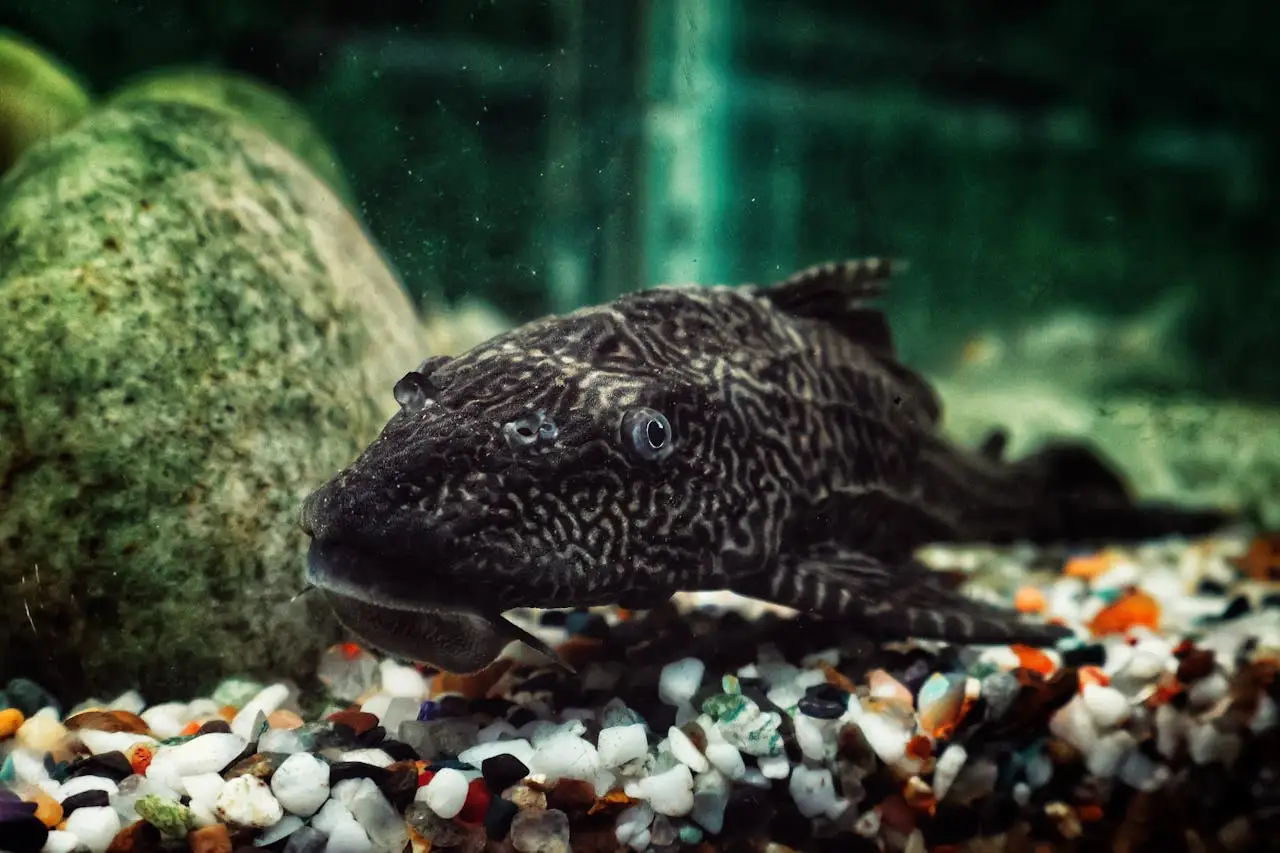
1. Plecos (Hypostomus plecostomus)
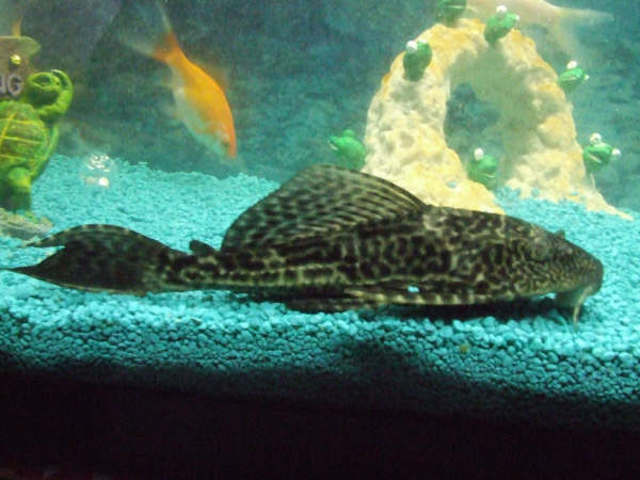
Plecos use sucker-shaped mouths to rasp algae from glass, rocks, and driftwood
Plecos are the most widely kept algae eaters in the aquarium hobby. These catfish attach to surfaces with specialized sucker mouths and rasp away green surface algae and brown diatom algae throughout the night. Plecos are excellent glass cleaners and will work across every hard surface in the tank.
The Common Pleco (Hypostomus plecostomus) can reach two feet in length and requires a tank of 100 gallons or more. For most home aquariums, the Bristlenose Pleco (4–5 inches) or Clown Pleco (3–4 inches) are far better choices. These smaller Pleco varieties perform the same cleaning work in tanks as small as 20 gallons.
| Attribute | Details |
|---|---|
| Maximum Size | 3–24 inches (species dependent) |
| Care Level | Low |
| Diet | Green surface algae, brown diatom algae, algae wafers |
| Minimum Tank Size | 20 gallons (Bristlenose) to 100+ gallons (Common) |
| Compatibility | Solitary — keep one Pleco per tank to prevent territorial disputes |
| Temperature | 72–82°F |
Pleco Feeding
Even in algae-rich tanks, Plecos benefit from supplemental algae wafers and blanched vegetables like zucchini or cucumber. Plecos are nocturnal feeders — drop food in after lights go out for best results.
2. Otocinclus Catfish (Otocinclus)
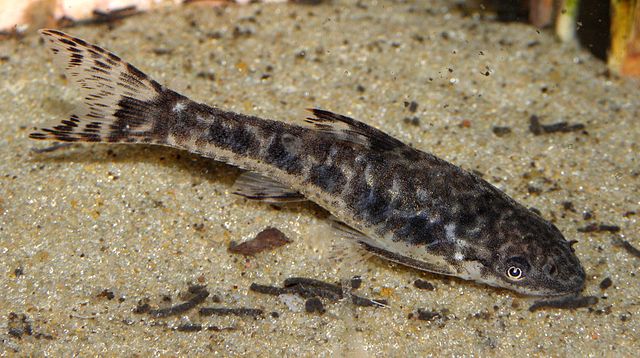
Otocinclus catfish reach spaces larger fish cannot access, making them ideal for planted tanks
Otocinclus catfish are among the best algae eaters for planted aquariums. At just 1.5 inches, Otocinclus catfish reach tight spaces between plant leaves, driftwood crevices, and equipment surfaces that larger species like Plecos cannot access. Unlike Plecos, Otocinclus catfish are social and should be kept in groups of six or more.
Otocinclus catfish specialize in green surface algae and brown diatom algae. A school of six Otocinclus catfish can keep a 20-gallon planted tank remarkably clean — making them a top choice for low-tech planted setups. These catfish are peaceful, active during the day, and safe for even the most delicate aquarium plants.
| Attribute | Details |
|---|---|
| Maximum Size | 1.5 inches |
| Care Level | Moderate |
| Diet | Green surface algae, brown diatoms, algae wafers |
| Minimum Tank Size | 10 gallons |
| Compatibility | Schooling — keep in groups of 6 or more |
| Temperature | 72–79°F |
Otocinclus Sensitivity
Otocinclus catfish are sensitive to water quality and may not survive in newly established tanks. Add Otocinclus only to mature, fully cycled aquariums with established algae growth and stable water parameters.
3. Siamese Algae Eater (Crossocheilus oblongus)
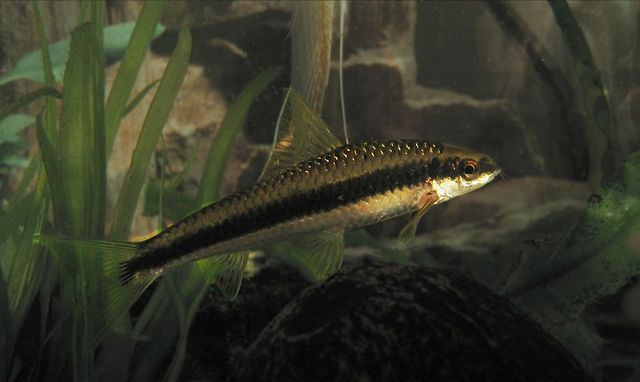
Siamese Algae Eaters are distinguished by a bold horizontal stripe and are one of the few fish that eat red and black algae
Siamese Algae Eaters are one of the few freshwater fish that consume red algae, black algae, thread algae, and brush algae — types that most other algae eaters ignore completely. This makes Siamese Algae Eaters uniquely valuable in planted tanks plagued by stubborn algae varieties.
Siamese Algae Eaters grow to 5 inches and are voracious, active swimmers. A distinctive horizontal black stripe runs from nose to tail, which helps distinguish the true Siamese Algae Eater from lookalikes like the Flying Fox and Stone-lapping Fish. Siamese Algae Eaters do well in groups of one to five and are compatible with most community fish.
| Attribute | Details |
|---|---|
| Maximum Size | 5 inches |
| Care Level | Low |
| Diet | Red/black algae, thread algae, brush algae, green algae |
| Minimum Tank Size | 30 gallons |
| Compatibility | Groups of 1–5; peaceful with most community fish |
| Temperature | 75–79°F |
4. Twig Catfish (Farlowella)
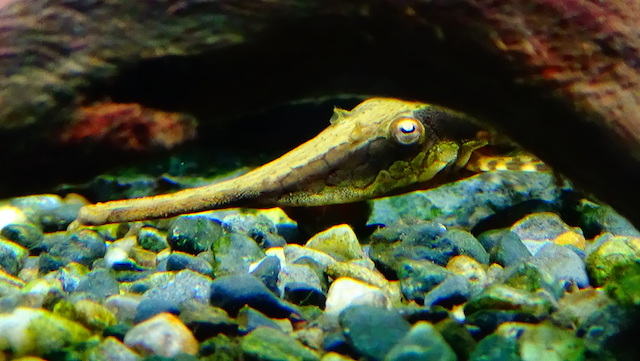
Twig Catfish have extremely slender bodies that camouflage among driftwood and plant stems
Twig Catfish (Farlowella) eat green surface algae, brown diatoms, and some hair algae, making them useful general-purpose algae grazers. Twig Catfish grow 4 to 8 inches long with extremely slender bodies that camouflage among driftwood and plant stems. These catfish require mature aquariums with aged water, live plants, and driftwood — Twig Catfish are more delicate than other algae eaters on this list.
Twig Catfish benefit from supplemental algae wafers and blanched vegetables, as they consume algae slowly and cannot always find enough food in clean aquariums. Avoid housing Twig Catfish with aggressive species like cichlids or tiger barbs, as their gentle temperament makes them vulnerable to bullying.
| Attribute | Details |
|---|---|
| Maximum Size | 4–8 inches |
| Care Level | Medium |
| Diet | Green algae, brown diatoms, hair algae, algae wafers, blanched vegetables |
| Minimum Tank Size | 40 gallons |
| Compatibility | Peaceful community fish only — avoid cichlids and barbs |
| Temperature | 73–79°F |
5. Whiptail Catfish (Rineloricaria)
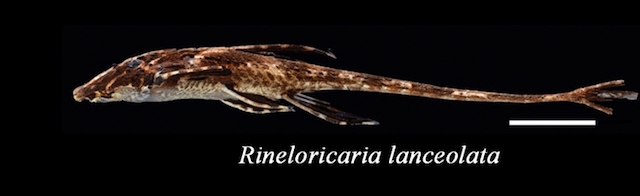
Whiptail Catfish are social omnivores that work best in small groups of three or more
Whiptail Catfish (Rineloricaria) are bottom-dwelling omnivores that consume green surface algae, brown diatom algae, and leftover food. Whiptail Catfish grow to approximately 6 inches and do best in groups of three or more. Their flattened bodies and elongated tails give them a distinct appearance among aquarium catfish.
Unlike solitary Plecos, Whiptail Catfish are social and coexist peacefully with their own kind. Whiptail Catfish prefer tanks with sandy substrate, driftwood hiding spots, and moderate water flow. Supplement their diet with sinking pellets and blanched vegetables when tank algae is insufficient.
| Attribute | Details |
|---|---|
| Maximum Size | 6 inches |
| Care Level | Low to Medium |
| Diet | Green algae, brown algae, omnivorous scavenger |
| Minimum Tank Size | 30 gallons |
| Compatibility | Groups of 3+; peaceful with most community fish |
| Temperature | 73–79°F |
6. Stone-lapping Fish (Garra)
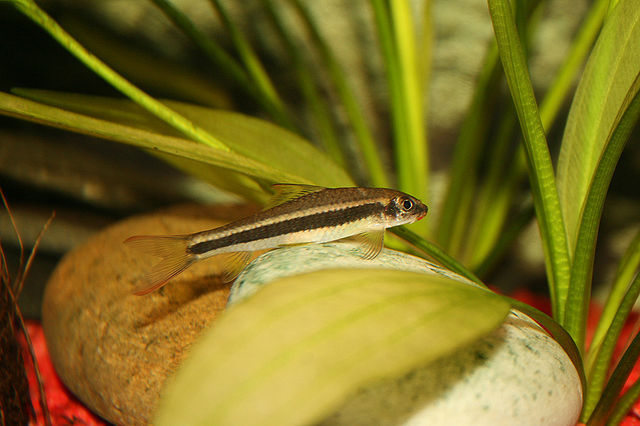
Stone-lapping Fish are versatile algae grazers that handle green algae, diatoms, hair algae, and brush algae
Stone-lapping Fish are small, versatile algae eaters that consume green algae, brown diatoms, hair algae, and brush algae. At just 2.5 inches, Stone-lapping Fish suit medium-sized community tanks where larger algae eaters would be impractical. Stone-lapping Fish are sometimes confused with Flying Foxes and Siamese Algae Eaters due to similar body shape, but Stone-lapping Fish have a distinctive sucker mouth adapted for rasping algae from rocks and driftwood.
Stone-lapping Fish are generally peaceful but may become mildly territorial with their own species in smaller tanks. Providing multiple hiding spots with rocks and driftwood reduces any territorial behavior.
| Attribute | Details |
|---|---|
| Maximum Size | 2.5 inches |
| Care Level | Low |
| Diet | Green algae, brown diatoms, hair algae, brush algae |
| Minimum Tank Size | 20 gallons |
| Compatibility | Peaceful community fish; may be mildly territorial with own kind |
| Temperature | 72–79°F |
7. Florida Flagfish (Jordanella floridae)
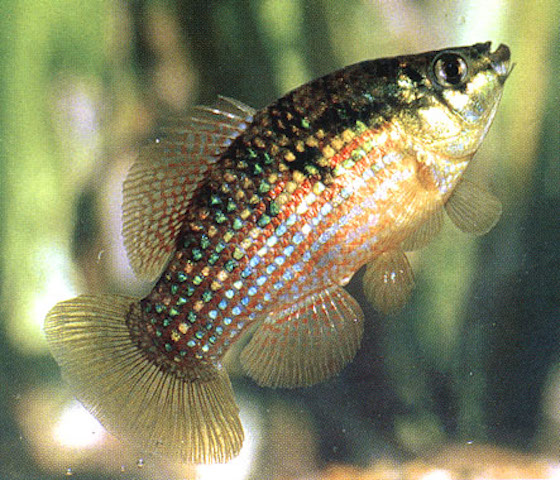
Florida Flagfish are among the most colorful algae eaters and target hair algae, brush algae, and beard algae
Florida Flagfish are colorful killifish that aggressively eat hair algae, brush algae, and beard algae — some of the most stubborn algae types in planted aquariums. Male Florida Flagfish display bold red and blue stripes reminiscent of the American flag, making them one of the most visually striking algae eaters available.
Florida Flagfish grow to 2.5 inches and need tanks with plenty of hiding spaces provided by plants, driftwood, or rock formations. Florida Flagfish can show mild aggression toward slow-moving or long-finned tankmates, so choose companions carefully. Avoid pairing Florida Flagfish with bettas or fancy guppies.
| Attribute | Details |
|---|---|
| Maximum Size | 2.5 inches |
| Care Level | Low |
| Diet | Hair algae, brush algae, beard algae, omnivorous |
| Minimum Tank Size | 20 gallons |
| Compatibility | May be semi-aggressive — avoid slow-moving or long-finned tankmates |
| Temperature | 66–72°F |
8. Black Molly (Poecilia sphenops)
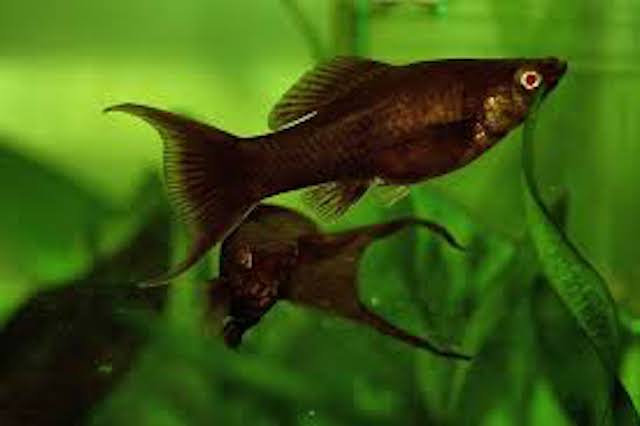
Black Mollies are active community fish that graze on green algae, beard algae, and hair algae throughout the day
Black Mollies are popular community fish that double as effective algae grazers. Black Mollies consume green algae, brown diatoms, beard algae, and hair algae while also accepting standard fish foods. At 4 inches, Black Mollies are active swimmers that add movement and personality to mid-level tank zones where other algae eaters rarely venture.
Black Mollies are livebearers, so maintain a ratio of at least two females per male to reduce harassment. Black Mollies tolerate a wide range of water conditions and even do well in slightly brackish setups. Their versatile diet and hardy nature make Black Mollies one of the easiest algae eaters for beginners.
| Attribute | Details |
|---|---|
| Maximum Size | 4 inches |
| Care Level | Low |
| Diet | Green algae, brown diatoms, beard algae, hair algae, omnivorous |
| Minimum Tank Size | 20 gallons |
| Compatibility | Community fish — maintain 2+ females per male |
| Temperature | 72–82°F |
Algae-Eating Invertebrates (7 Species)
Invertebrates offer distinct advantages over fish as algae eaters. Shrimp and snails access surfaces fish cannot reach, produce less waste per body size, and many species work continuously day and night. Invertebrates are especially effective in small or heavily planted tanks where larger fish would cause disruption. For dedicated shrimp keeping, see our guides to Cherry shrimp care and setting up a nano shrimp tank.
Copper Kills Invertebrates
Shrimp and snails are extremely sensitive to copper. Avoid fertilizers, medications, and water conditioners containing copper in any tank housing invertebrates. Even trace amounts of copper can be lethal to Amano shrimp, Ghost shrimp, and all snail species.
9. Amano Shrimp (Caridina multidentata)
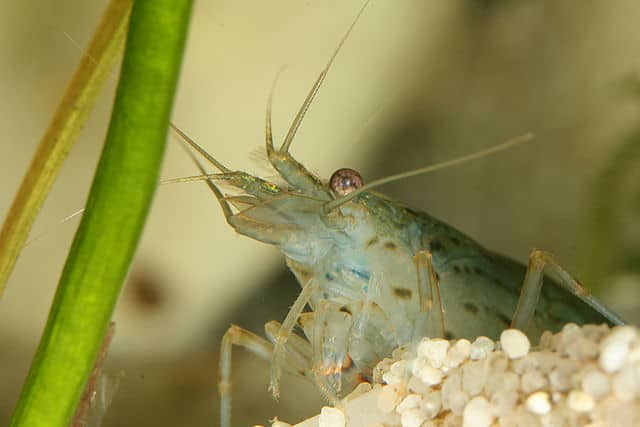
Amano shrimp are the most popular algae-eating shrimp in the hobby and work tirelessly on hair algae
Amano shrimp are the most popular algae-eating shrimp in freshwater aquariums. Named after legendary aquascaper Takashi Amano, who popularized their use in planted tanks, Amano shrimp consume green algae, brown diatoms, hair algae, and thread algae. Amano shrimp are particularly effective against hair algae that drapes over plants and hardscape.
Keep Amano shrimp in groups of three or more for best results — larger groups of 6–10 provide noticeably better algae control. Amano shrimp grow to 2 inches, are active during the day, and coexist peacefully with nearly all community fish. Amano shrimp cannot breed in freshwater (larvae require brackish water), so populations remain stable without risk of overpopulation.
| Attribute | Details |
|---|---|
| Maximum Size | 2 inches |
| Care Level | Low to Medium |
| Diet | Green algae, brown diatoms, hair algae, thread algae |
| Minimum Tank Size | 10 gallons |
| Compatibility | Groups of 3+; peaceful with all community fish |
| Temperature | 72–78°F |
10. Ghost Shrimp (Palaemonetes paludosus)
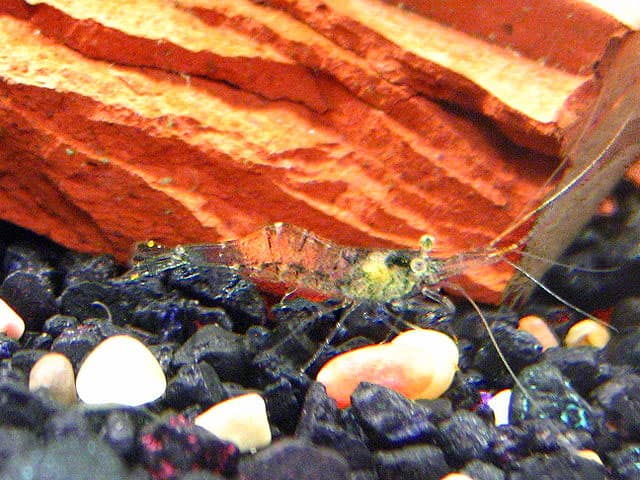
Ghost shrimp have nearly transparent bodies, making them fascinating to observe as they scavenge
Ghost shrimp are inexpensive, hardy, and easy to care for — making Ghost shrimp excellent algae eaters for beginners. Ghost shrimp have nearly transparent bodies that reveal their internal organs, creating a fascinating visual as they forage. These shrimp eat green algae, brown diatoms, leftover food, and organic debris throughout the tank.
Ghost shrimp grow to 2 inches and thrive in groups. Because Ghost shrimp are so affordable (often under $1 each), they serve well as both algae controllers and live food for larger predatory fish. Provide hiding spots with plants or driftwood, as Ghost shrimp are vulnerable to predation by larger fish. For dedicated Ghost shrimp care, see our complete guide.
| Attribute | Details |
|---|---|
| Maximum Size | 2 inches |
| Care Level | Low |
| Diet | Green algae, brown diatoms, detritus, omnivorous scavenger |
| Minimum Tank Size | 5 gallons |
| Compatibility | Peaceful fish only — may be eaten by larger species |
| Temperature | 65–80°F |
11. Wood Shrimp / Bamboo Shrimp (Atyopsis moluccensis)
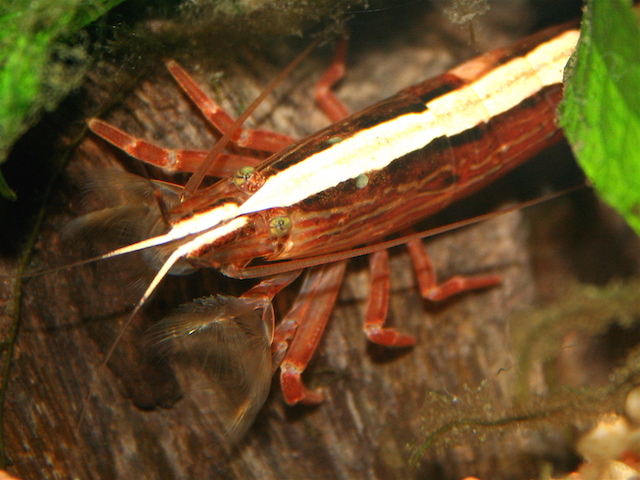
Wood Shrimp use fan-shaped claws to filter micro-algae and organic particles from the water current
Wood Shrimp (also called Bamboo Shrimp) feed differently from every other species on this list. Instead of grazing on surfaces, Wood Shrimp extend fan-shaped front claws into the water current and filter microscopic algae particles, biofilm, and organic debris from the flow. This unique filter-feeding behavior makes Wood Shrimp effective at capturing suspended micro-algae that other species cannot access.
Wood Shrimp grow to 3 inches and need tanks with moderate to strong water flow to feed effectively. Position Wood Shrimp near filter outlets or powerheads where current concentrates food particles. Wood Shrimp are peaceful and compatible with all community fish but require dedicated care — they cannot survive in low-flow or sterile environments.
| Attribute | Details |
|---|---|
| Maximum Size | 3 inches |
| Care Level | Medium |
| Diet | Suspended micro-algae, biofilm, organic particles (filter feeder) |
| Minimum Tank Size | 20 gallons |
| Compatibility | Peaceful; needs moderate to strong water flow |
| Temperature | 75–82°F |
12. Nerite Snail (Neritina)
Nerite snails are widely considered the single best algae-eating snail for freshwater aquariums. Nerite snails consume green surface algae, green spot algae, brown diatoms, and even some soft film algae types — a broader diet than most competing snail species. At approximately 1 inch, Nerite snails fit comfortably in tanks as small as 5 gallons.
The key advantage of Nerite snails over other aquarium snails is population control: Nerite snails cannot reproduce in freshwater. While Nerite snails may lay small white eggs on hard surfaces, these eggs will not hatch without brackish water conditions. This eliminates the population explosions common with Ramshorn snails and Malaysian Trumpet Snails.
Nerite Snail Benefits
- Eat the widest variety of algae among snails, including green spot algae
- Cannot reproduce in freshwater — no risk of population explosions
- Available in attractive shell patterns: zebra, tiger, horned, and olive varieties
- Safe for planted tanks — Nerite snails do not eat healthy live plants
- Extremely low bioload — suitable for nano tanks of 5 gallons or more
| Attribute | Details |
|---|---|
| Maximum Size | 1 inch |
| Care Level | Low |
| Diet | Green algae, green spot algae, brown diatoms, film algae |
| Minimum Tank Size | 5 gallons |
| Compatibility | Peaceful with all tankmates; avoid with snail-eating species like loaches |
| Temperature | 72–78°F |
13. Ramshorn Snail (Planorbella)
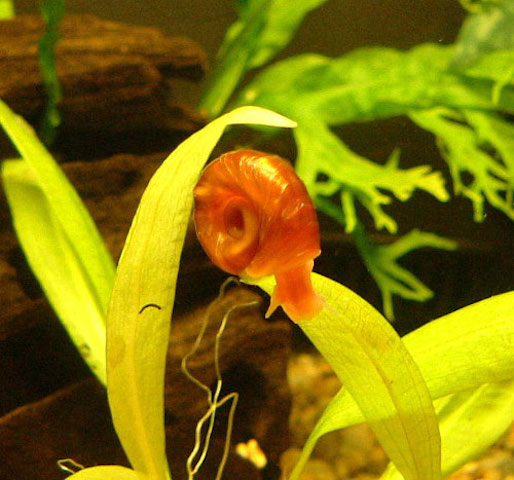
Ramshorn snails come in brown and red varieties and eat all common algae types plus leftover food and debris
Ramshorn snails have distinctive flat spiral shells that resemble a ram’s horn — a unique appearance that sets them apart from other aquarium snails. Ramshorn snails eat all common algae types plus leftover food, decaying plant matter, and organic debris, making them thorough tank cleaners.
Ramshorn snails grow to about 1 inch in shell diameter and come in brown and red color varieties. The red variety is especially popular for its striking appearance. Be aware that Ramshorn snails reproduce readily in freshwater — a single snail can produce offspring, potentially leading to large populations. Control Ramshorn snail numbers by limiting available food. Ramshorn snails are vulnerable to predation by cichlids and loaches.
| Attribute | Details |
|---|---|
| Maximum Size | 1 inch (shell diameter) |
| Care Level | Low |
| Diet | All algae types, detritus, leftover food, decaying plants |
| Minimum Tank Size | 5 gallons |
| Compatibility | Peaceful; vulnerable to cichlids and loaches |
| Temperature | 70–78°F |
14. Malaysian Trumpet Snail (Melanoides tuberculata)
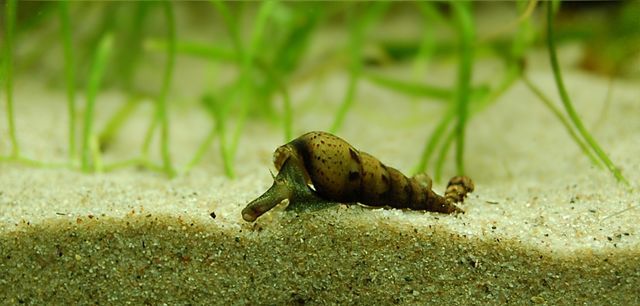
Malaysian Trumpet Snails burrow through substrate, aerating it while consuming algae and detritus
Malaysian Trumpet Snails are unique among algae eaters because they work beneath the substrate surface. Malaysian Trumpet Snails burrow through sand and gravel during the day, aerating the substrate and consuming algae, detritus, and decaying organic matter. This burrowing action promotes healthy plant root growth and prevents dangerous anaerobic gas pockets from forming.
Malaysian Trumpet Snails have elongated cone-shaped shells and grow to approximately 1–2 inches. These snails are primarily nocturnal, emerging at night to graze on glass and hard surfaces. Like Ramshorn snails, Malaysian Trumpet Snails reproduce prolifically in freshwater — a single individual can produce live offspring without a mate. Monitor population levels carefully.
| Attribute | Details |
|---|---|
| Maximum Size | 1–2 inches |
| Care Level | Low |
| Diet | Algae, detritus, decaying organic matter |
| Minimum Tank Size | 5 gallons |
| Compatibility | Peaceful; excellent for planted tanks |
| Temperature | 70–80°F |
15. Mystery Snail (Pomacea bridgesii)
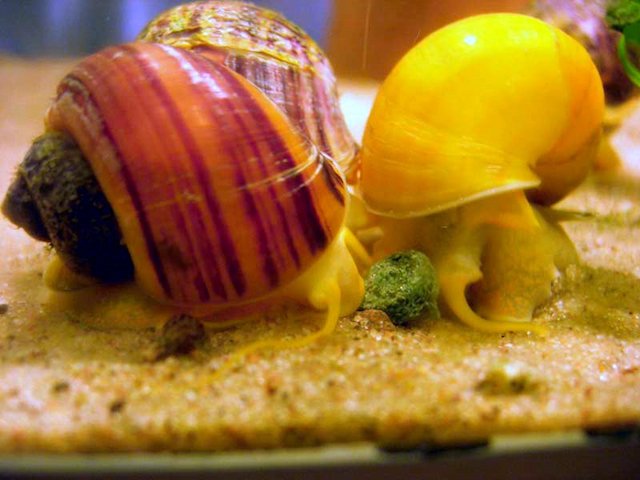
Mystery snails are the largest common aquarium snail and are fascinating to watch with their long, probing antennae
Mystery snails are the largest common freshwater aquarium snail, reaching 2 inches in shell diameter. Mystery snails devour algae, leftover food, and detritus across all tank surfaces. With their prominent antennae constantly probing the environment, Mystery snails are among the most entertaining invertebrates to observe in a home aquarium.
Mystery snails are available in gold, blue, ivory, and dark brown color varieties. Unlike Ramshorn snails and Malaysian Trumpet Snails, Mystery snails lay visible egg clutches above the waterline, making population control straightforward — simply remove egg clutches before they hatch. Mystery snails are peaceful, compatible with nearly all community fish, and safe for planted tanks.
| Attribute | Details |
|---|---|
| Maximum Size | 2 inches (shell diameter) |
| Care Level | Low |
| Diet | Algae, detritus, leftover food |
| Minimum Tank Size | 10 gallons |
| Compatibility | Peaceful with all community fish |
| Temperature | 68–82°F |
How to Choose the Right Algae Eater
Selecting the right algae eater depends on your specific tank conditions, the type of algae you need to control, and your existing fish community.
Selection Criteria
- Identify your algae type first — use the quick reference table above to match species to your specific algae problem
- Match species to your tank size — Otocinclus catfish and Nerite snails suit small tanks, while Plecos and Twig Catfish need 40+ gallons
- Check compatibility — ensure the algae eater is safe with your current fish; shrimp are vulnerable to predatory fish, and some species like Florida Flagfish can be semi-aggressive
- Plan for supplemental feeding — most algae eaters need algae wafers, blanched vegetables, or sinking pellets when natural algae runs low
- Consider bioload — invertebrates like Amano shrimp and Nerite snails add minimal waste compared to fish like Plecos and Black Mollies
- Start with proven species — Otocinclus catfish, Nerite snails, and Amano shrimp are the most reliable combination for general algae control in planted tanks
For a broader approach to keeping your fish tank clean, algae eaters work best alongside proper lighting schedules, regular water changes, and balanced nutrient levels. If you are dealing with persistent brown algae problems, Otocinclus catfish and Nerite snails are usually the fastest solution.
Are algae eaters necessary for an aquarium?
Algae eaters are not strictly necessary, but they make a valuable addition to most freshwater tanks. Species like Otocinclus catfish and Nerite snails help control algae growth naturally while adding visual interest. However, proper lighting control and regular maintenance remain the primary tools for algae prevention.
Can algae eaters survive on algae alone?
Most algae eaters cannot survive solely on tank algae, especially in clean aquariums. Plecos, Otocinclus catfish, and Twig Catfish all benefit from supplemental algae wafers. Amano shrimp and snails may need blanched vegetables when natural algae runs low.
What algae eater is best for small tanks under 20 gallons?
Otocinclus catfish, Nerite snails, and Amano shrimp are excellent choices for small tanks. Otocinclus catfish reach only 1.5 inches, Nerite snails stay around 1 inch, and Amano shrimp grow to 2 inches. All three have minimal bioload compared to larger species like Common Plecos.
Do algae eaters get along with other fish?
Most algae eaters are peaceful and compatible with community fish. Siamese Algae Eaters, Otocinclus catfish, and Amano shrimp coexist well with nearly all tankmates. Florida Flagfish can show mild aggression, and some Plecos become territorial in smaller tanks. Shrimp species may be eaten by larger predatory fish.
Which algae eater handles red or black algae?
Siamese Algae Eaters are one of the few fish that consume red and black algae, including brush algae and thread algae. Florida Flagfish also eat brush and beard algae. Most other algae eaters focus on green surface algae and brown diatoms.
What eats blue-green algae (cyanobacteria) in an aquarium?
Blue-green algae is actually cyanobacteria, not true algae, and most fish and invertebrates avoid it because it produces mild toxins. No common aquarium species reliably consumes cyanobacteria. The most effective solutions are manual removal, reducing light duration, improving water flow, and addressing excess nutrients like phosphates.
Related Topics
Found this helpful?
Share this guide with your fellow aquarium enthusiasts!
Written by
FTW Team
The FishTankWorld editorial team brings together experienced aquarists to help you succeed in the hobby.