
Yes — fish sleep. Every fish species studied so far shows some form of rest behavior, though fish sleep looks nothing like the sleep of dogs, cats, or humans. Fish don’t close their eyes, don’t lie down, and don’t lose awareness of their surroundings. Instead, fish enter a low-energy state where movement stops, metabolism slows, and brain activity drops — while staying alert enough to escape danger.
Understanding fish sleep matters for aquarium keepers because lighting schedules, tank setup, and even tankmate selection directly affect whether fish get the rest they need.
How Do Fish Sleep?
Fish sleep by entering a state of reduced activity, lowered metabolism, and decreased responsiveness to stimuli. During sleep, a fish’s heart rate drops, gill movement slows, and the fish stops foraging, swimming, or interacting with tankmates.
Unlike mammals, fish lack a neocortex — the brain structure responsible for the deep REM sleep humans experience. For decades, scientists debated whether fish truly “sleep” or merely rest. That question was settled in 2019 when researchers at Stanford University used fluorescence imaging to monitor brain activity in zebrafish (Danio rerio). The study, published in Nature, identified two distinct sleep signatures: slow bursting sleep and propagating wave sleep. These patterns share clear similarities with mammalian slow-wave sleep and REM sleep, confirming that fish experience genuine neurological sleep states.
Fish Sleep Is Real Sleep
Zebrafish brain imaging at Stanford University revealed two sleep signatures that parallel mammalian slow-wave sleep and REM sleep. Fish sleep isn’t just “resting” — it involves measurable changes in brain activity, heart rate, and responsiveness. This discovery pushed the evolutionary origin of neurological sleep back at least 450 million years.
Fish remain partially alert during sleep because survival depends on it. Open-water species face constant predation risk, so their sleep state allows rapid arousal if a threat approaches. This is why sleeping fish can still dart away when startled — their escape reflexes remain active even during rest.
What Does a Sleeping Fish Look Like?
Sleeping fish are easy to miss because they don’t show the obvious signs mammals do — no closed eyes, no curled-up posture, no snoring. The differences between a sleeping fish and an awake fish are entirely behavioral.
Signs a Fish Is Sleeping
- Hovering motionless or drifting very slowly in one spot
- Resting near the bottom of the tank, on a leaf, or inside a decoration
- Fins held still with only occasional micro-adjustments for balance
- Slow, rhythmic gill movement — noticeably slower than when active
- Delayed or absent response to movement outside the glass
- Slightly faded coloration compared to active daytime hours
Where fish choose to sleep varies by species. Bottom-dwellers like corydoras catfish rest on the substrate. Mid-water schooling fish like neon tetras drift motionless among plants. Bettas often wedge themselves into a leaf hammock or rest on a broad plant leaf near the surface.
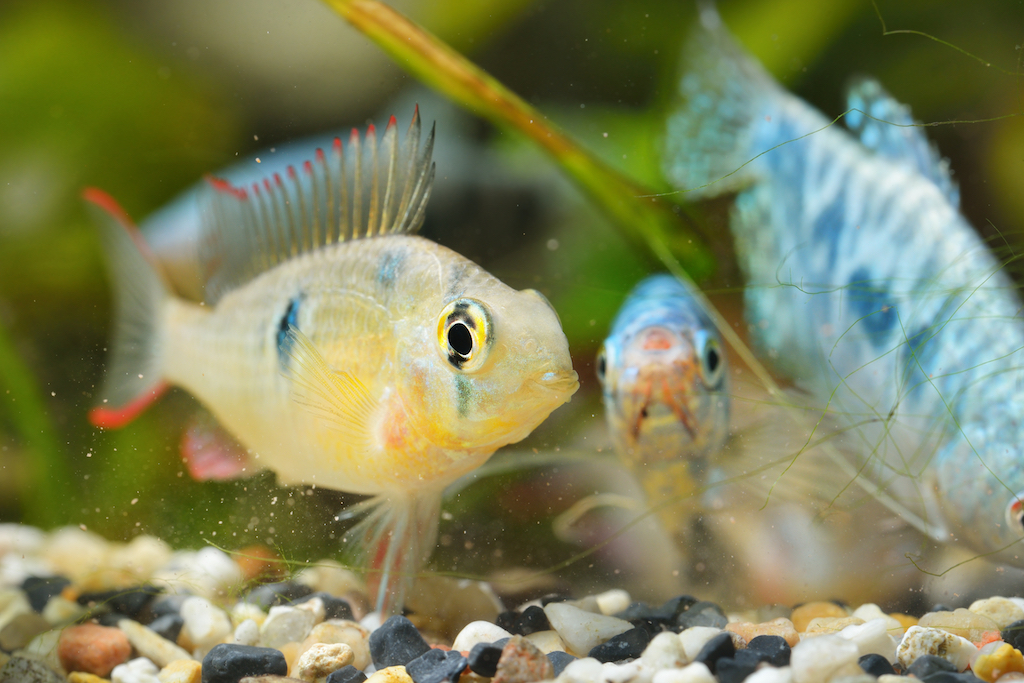
Fish seek out sheltered, dimly lit spots when settling into their rest period — plants, caves, and decorations all serve as sleeping areas
Do Fish Sleep with Their Eyes Open?
Yes — nearly all fish sleep with their eyes wide open. Most fish species lack eyelids entirely, so their eyes cannot close. This single fact is the main reason many people assume fish never sleep at all.
A few exceptions exist. Some shark species possess nictitating membranes — a translucent third eyelid that slides across the eye for protection. Certain pufferfish can partially retract a fold of skin over their eyes. But in a home aquarium, every common freshwater and saltwater fish — tetras, guppies, cichlids, goldfish, bettas, angelfish, clownfish — sleeps with open eyes.
Watch the Body, Not the Eyes
Since fish eyes stay open during sleep, look for behavioral cues instead. A sleeping fish hovers motionless in a sheltered spot with slow gill movement. An awake fish actively swims, reacts quickly to your presence, and has faster gill movement.
When Do Fish Sleep? Diurnal vs. Nocturnal Species
Most aquarium fish are diurnal — active during daylight and asleep at night — mirroring the natural light cycles of the rivers, lakes, and reefs they evolved in. But a significant number of popular aquarium species are nocturnal, and understanding this distinction affects how you stock and manage your tank.
Diurnal species (sleep at night, active during the day):
- Tetras — neon tetras, cardinal tetras, rummy-nose tetras
- Livebearers — guppies, mollies, platies, swordtails
- Cichlids — angelfish, discus, rams, most African cichlids
- Goldfish — all varieties including fancy goldfish
- Bettas — Siamese fighting fish rest at night, often on leaves or near the surface
- Gouramis — dwarf gouramis, pearl gouramis, honey gouramis
Nocturnal species (sleep during the day, active after dark):
- Corydoras catfish — rest motionless during the day, forage along the bottom at night
- Kuhli loaches — hide in substrate or decorations all day, emerge after lights out
- Bristlenose plecos — hide in caves during the day, graze on algae at night
- Pictus catfish — nocturnal predators that hunt small fish after dark
- Glass catfish — despite being translucent and visible, most active in dim conditions
Crepuscular species — some fish, including many barbs and rasboras, are most active at dawn and dusk, resting during both bright midday and complete darkness.
Nocturnal Predator Warning
Mixing nocturnal predators with small diurnal fish creates a dangerous situation. Pictus catfish, for example, hunt actively at night when tetras and guppies are sleeping and defenseless. Always research whether a species is diurnal or nocturnal before adding it to a community tank.
How Long Do Fish Sleep?
Most aquarium fish sleep between 8 and 12 hours per day. The exact duration depends on the species, the fish’s age, and environmental conditions like light exposure and water temperature.
Fish don’t sleep in one continuous block the way humans typically do. Instead, many species cycle between short rest periods and brief arousals throughout their sleep phase. A sleeping fish might rest for 20–30 minutes, stir briefly, reposition, and then settle back into rest.
Sleep deprivation research on zebrafish, published in PLOS Biology, showed that zebrafish deprived of sleep compensate by entering “microsleeps” — extremely brief involuntary sleep episodes — and will recover at least 5 to 10 percent of lost sleep when given the opportunity. This “sleep rebound” effect closely parallels what happens in sleep-deprived humans.
One surprising finding: not all fish sleep from birth. Research on tilapia (Oreochromis mossambicus) demonstrated that tilapia fry do not exhibit recognizable sleep behavior until approximately 22 weeks of age. Sleep appears to develop gradually as the brain matures.
The Science Behind Fish Sleep: Light, Melatonin, and Circadian Rhythms
Fish regulate their sleep-wake cycles through the same hormone that regulates human sleep: melatonin. The pineal gland in a fish’s brain produces melatonin in response to darkness, signaling the body to enter a rest state. When light returns, melatonin production drops and activity resumes.
Research published in the Proceedings of the National Academy of Sciences (PNAS) demonstrated that the hypocretin system — a network of brain neuropeptides that regulate wakefulness — directly interacts with melatonin production in zebrafish. Zebrafish with mutations in the hypocretin receptor showed a 30 percent reduction in nighttime sleep and 60 percent shorter sleep bouts, a pattern remarkably similar to human narcolepsy.
This melatonin connection is why aquarium lighting schedules matter so much. Consistent dark periods trigger melatonin production. Irregular lighting disrupts the cycle, producing the fish equivalent of jet lag — elevated stress hormones, weakened immunity, and fragmented rest.
The Mexican Cavefish: A Fish That Evolved to Sleep Less
One of the most fascinating examples of fish sleep evolution is the Mexican cavefish (Astyanax mexicanus). Surface-dwelling populations of this species sleep normally. But populations that colonized lightless underground caves over thousands of generations evolved to sleep dramatically less — in some cases, up to 80 percent less than their surface relatives.
Scientists studying Mexican cavefish discovered that the reduced sleep is linked to changes in hypocretin signaling and increased metabolic demand in nutrient-scarce cave environments. These cavefish demonstrate that sleep needs can evolve based on environmental pressures — a finding with implications for understanding sleep disorders in humans.
Is My Fish Sleeping or Sick? How to Tell the Difference
This is the question that drives most aquarium keepers to search for information about fish sleep. A fish hovering motionless at the bottom of the tank can look alarmingly similar whether it’s peacefully resting or seriously ill.
Sleeping fish show these characteristics:
Normal Sleep Behavior
- Stays upright — not tilting, listing, or floating sideways
- Gills move slowly but rhythmically — steady, even breathing
- Responds to stimulation — reacts (even if slowly) to light turning on or tapping near the glass
- Normal coloration returns quickly once awake and active
- Behavior occurs during the fish's natural rest period (night for diurnal species, day for nocturnal)
Sick fish show these warning signs:
Signs of Illness, Not Sleep
- Floating upside down or listing to one side — likely swim bladder disease
- Gasping at the surface — indicates low oxygen or gill damage
- Clamped fins pressed tightly against the body — stress or parasites
- White spots, fuzzy patches, or fin erosion — active infection
- Bottom-sitting during hours when the fish is normally active
- Loss of appetite persisting beyond normal rest periods
Upside Down Means Trouble
Fish never sleep upside down. A fish floating inverted or severely tilted has swim bladder disease — a condition affecting the gas-filled organ that controls buoyancy. Goldfish and bettas are especially susceptible. Common causes include overfeeding, constipation, bacterial infection, or sudden temperature changes. Test water parameters immediately and consider fasting the fish for 24–48 hours.
When Bottom-Sitting Is Normal vs. Concerning
Bottom-resting is completely normal for species that naturally live near the substrate. Corydoras catfish, loaches, and plecos all rest on the bottom during their sleep periods. Bettas sometimes rest on flat leaves or even on the substrate.
Bottom-sitting becomes a concern when:
- A normally active mid-water swimmer suddenly stays on the substrate all day
- The fish doesn’t respond to feeding or light changes
- Ammonia or nitrite levels are above zero
- The fish shows labored breathing or clamped fins
- Multiple fish in the tank exhibit the same lethargic behavior simultaneously
If multiple fish show lethargy at the same time, test water parameters immediately. Ammonia or nitrite spikes, dissolved oxygen crashes, or rapid temperature swings affect all tank inhabitants simultaneously.
How to Set Up Your Aquarium for Healthy Fish Sleep
Use a Timer on Your Aquarium Light
A plug-in timer is the single most effective tool for ensuring healthy fish sleep. Set it to provide 8–10 hours of light and 14–16 hours of darkness daily. Consistency matters far more than the specific hours — choose a schedule and maintain it.
Without a timer, it’s easy to forget lights are on. Leaving aquarium lights on 24/7 causes chronic stress, sleep deprivation, faded coloration, weakened immunity, and explosive algae growth. A basic mechanical timer costs a few dollars and eliminates this risk entirely.
Choose the Right Aquarium Light
LED aquarium lights offer the best combination of features for maintaining healthy fish sleep cycles:
Why LED Lighting Works Best
- Timer-compatible — works seamlessly with plug-in or built-in timers
- Dimming and ramping — simulates gradual sunrise and sunset, reducing the stress of sudden light changes
- Uniform coverage — illuminates the entire tank evenly without hot spots or dark corners
- Low heat — won't raise water temperature like incandescent or metal halide fixtures
- Energy efficient — lower operating costs for daily 8-to-10-hour run times
Avoid relying on natural window light as your tank’s only light source. Seasonal day-length changes create inconsistent light schedules, and direct sunlight promotes rapid algae growth.
Provide Sleeping Spots and Shelter
Fish sleep better when they can retreat to a protected, dimly lit spot. Tanks without adequate cover force fish to rest in exposed positions, increasing stress and reducing sleep quality.
Effective sleeping shelter includes:
- Live plants — java fern, anubias, and amazon swords provide dense cover at various tank levels
- Caves and rock formations — especially important for bottom-dwelling species like plecos and loaches
- Driftwood — branches and crevices offer mid-level hiding spots
- Floating plants — water lettuce, frogbit, or red root floaters create shaded zones beneath the surface, ideal for bettas and surface-dwelling species
- Ceramic or coconut shell hides — affordable, easy-to-clean hiding spots for small fish and shrimp
Position Your Tank Thoughtfully
Where your aquarium sits in the room affects fish sleep quality. Avoid placing tanks where they receive unwanted light during dark hours:
- Television screens that flicker at night
- Hallway or bathroom lights turned on after the aquarium light shuts off
- Windows where passing car headlights sweep across the tank
- Streetlights or porch lights visible through nearby windows
The Simple Sleep Setup
A timer on your aquarium light, a few plants or decorations for shelter, and thoughtful tank placement solve the vast majority of fish sleep problems. These three simple adjustments cost very little and make a measurable difference in fish health and coloration.
Remarkable Fish Sleep Adaptations
Fish have spent hundreds of millions of years evolving creative solutions for sleeping safely in a world where predators never stop hunting.
-
Parrotfish secrete a transparent mucus cocoon each night that completely envelops their body. Researchers believe this cocoon masks the parrotfish’s scent from nocturnal predators like moray eels and may also block parasites.
-
Wrasses — including the rainbow wrasse and several cleaner wrasse species — bury themselves in the sand at dusk, disappearing completely beneath the substrate until morning light triggers them to emerge.
-
Nurse sharks are among the few shark species that can sleep completely motionless on the ocean floor. Unlike most sharks, nurse sharks actively pump water over their gills, so they don’t need to swim to breathe during rest.
-
Dolphins and whales practice unihemispheric sleep — shutting down one brain hemisphere at a time while the other stays awake. This allows them to continue swimming to the surface to breathe while still getting neurological rest.
-
Spanish hogfish and many other reef species visibly change color when they fall asleep, often fading to paler tones. These color shifts are controlled by melanophores — pigment cells that contract in darkness.
-
Mexican cavefish (Astyanax mexicanus) populations living in lightless caves evolved to need up to 80 percent less sleep than their surface-dwelling relatives — one of the most dramatic examples of sleep evolution in any vertebrate.
Frequently Asked Questions
Is my fish dead or just sleeping?
A sleeping fish stays upright, keeps its gills moving rhythmically, and will eventually respond to light changes or gentle tapping near the glass. A dead fish stops gill movement entirely, often floats sideways at the surface or lies on its side at the bottom, and may show discoloration or cloudy eyes. If the gills are still moving, the fish is alive.
Do fish sleep with their eyes open?
Yes. Most fish lack eyelids entirely, so their eyes remain open during sleep. A few exceptions exist — some shark species have a nictitating membrane that partially covers the eye, and certain pufferfish can close a skin fold over their eyes — but nearly all common aquarium fish sleep with eyes wide open.
How many hours do fish sleep per day?
Most aquarium fish sleep between 8 and 12 hours per day. Diurnal species like tetras, guppies, and cichlids sleep at night and are active during the day. Nocturnal species like corydoras catfish and kuhli loaches sleep during daylight hours and become active after dark.
Why is my fish laying at the bottom of the tank?
Bottom-resting during dark or quiet hours is normal sleep behavior, especially for bottom-dwelling species like corydoras catfish and loaches. However, a fish that normally swims mid-water suddenly sitting on the substrate during active hours may indicate poor water quality, low oxygen, disease, or stress from aggressive tankmates. Test ammonia and nitrite levels immediately if the behavior seems unusual.
Can fish sleep with the aquarium light on?
Fish can rest with lights on, but they strongly prefer darkness. Leaving aquarium lights on 24 hours a day causes chronic stress, faded coloration, weakened immunity, and excessive algae growth. Provide at least 8 hours of uninterrupted darkness using a timer on your aquarium light.
Do baby fish sleep?
Not all baby fish sleep right away. Research on tilapia shows that fry do not exhibit sleep behavior until approximately 22 weeks of age. Young zebrafish larvae do sleep, but their sleep patterns differ from adults and develop gradually during the first few weeks of life.
Why does my fish change color at night?
Many fish species fade or shift color during sleep as a natural response to reduced light. This color change is controlled by melanophores — pigment cells in the skin that contract in darkness. The fish's normal bright coloration returns once lights come back on. Persistent color loss during active hours, however, may indicate stress or illness.
Related Topics
Found this helpful?
Share this guide with your fellow aquarium enthusiasts!

Written by
Ynes Carrillo
Ynes grew up in the Andes mountains of Venezuela, where she spent decades as a teacher and cultivated a lush garden of native and non-native plants around her backyard fish pond. She holds a Master's degree in Education and now lives in Texas, where she keeps a low-tech planted aquarium and tends a vegetable garden. Though retired from the classroom, Ynes channels her lifelong passion for teaching into helping others succeed with fishkeeping and aquatic plants.