

Short Answer
Yes, betta fish need a heater. Bettas are tropical fish that require water temperatures of 76-82°F. Most indoor rooms sit at 68-72°F — too cold for bettas. An adjustable submersible heater (25-50W depending on tank size) with a separate thermometer is the safest setup.
Why Bettas Need Warm Water
Betta fish (Betta splendens) are native to the shallow rice paddies, ponds, and slow-moving streams of Thailand, Cambodia, and Malaysia — regions where water temperatures range from 76-86°F year-round. During breeding season, wild betta habitats can reach 86°F (30°C), with ideal spawning temperatures around 80°F (27°C).
Unlike mammals, bettas are ectothermic (cold-blooded). They cannot generate their own body heat. Their internal temperature matches the surrounding water exactly. Every metabolic process — digestion, immune function, growth, coloration, activity level — depends on water temperature being in the correct range.
This is why temperature control isn’t optional for bettas. It’s as fundamental as clean water and food.
Betta Temperature Requirements
What Happens Without a Heater
When bettas are kept in water below 76°F, the effects compound over time. Some damage appears within days; other problems develop over weeks and are mistakenly attributed to “old age” or bad genetics.
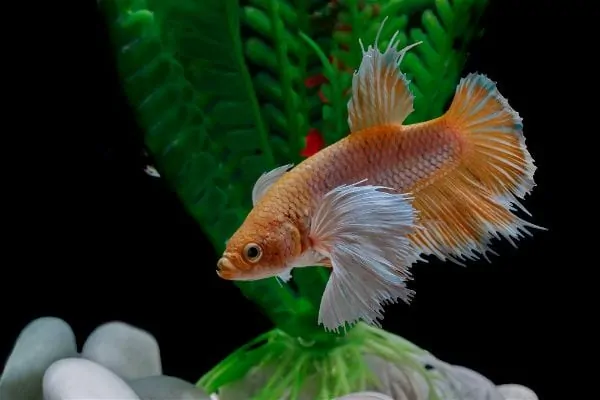
A betta sitting motionless near the bottom of the tank is often a sign of water that's too cold — not a calm personality.
Metabolic Slowdown
Cold water slows every biological process in your betta’s body. Digestion takes longer, meaning food sits in the gut and partially rots — leading to bloating and constipation. Nutrient absorption drops, so even well-fed bettas in cold tanks can be malnourished. Growth slows or stops entirely in juvenile fish.
Immune System Failure
A betta’s immune system functions optimally between 76-82°F. Below this range, white blood cell activity decreases and the mucous coat that protects against pathogens thins. Bacteria and fungi that a healthy betta would fight off become life-threatening infections.
Behavioral Changes
Cold bettas become lethargic. They sit at the bottom of the tank, stop flaring, lose interest in food, and clamp their fins tightly against their body. Keepers sometimes mistake this for a “calm” or “easy” fish — but it’s a stress response.
Symptoms of a Cold Betta:
- Lethargy — resting on the tank bottom or barely moving for hours
- Clamped fins — held tight against the body instead of spread naturally
- Appetite loss — ignoring food or spitting it out
- Faded color — pale or washed-out appearance compared to normal
- Cottony white patches — fungal infections exploiting a weakened immune system
- Fin deterioration — ragged edges, splits, or disintegrating fin tissue
- Slow or absent gill movement — reduced breathing rate in cold water
- Sudden death — sometimes with no visible symptoms if temperature drops rapidly overnight
The Room Temperature Myth
Many betta care guides and tank kits claim bettas are fine at room temperature. Most rooms sit at 68-72°F — at least 4-8°F below what bettas need. Worse, room temperature fluctuates throughout the day as HVAC cycles on and off, windows let in drafts, and night temperatures drop. A betta in an unheated tank may experience 5-10°F swings daily, causing chronic stress even if the daytime high briefly touches an acceptable range.
Choosing the Right Heater
Not all heaters are equal. For betta tanks, you need a heater that’s appropriately sized, adjustable, and reliable.
Adjustable vs. Preset Heaters
Preset heaters are locked to a fixed temperature (usually 78°F). They’re simple but inflexible — if your room runs cold in winter, a preset heater may struggle to reach its target. Adjustable heaters let you dial in the exact temperature and compensate for seasonal changes, which makes them the better choice.
Adjustable Heater
Recommended for most setups
- Set any temperature between 68-92°F
- Compensate for seasonal room temp changes
- Useful if you need to raise temp for disease treatment
- Slightly higher upfront cost ($15-25)
Preset Heater
Budget option for stable rooms
- Fixed at ~78°F — no adjustment possible
- Simpler setup with no dial to configure
- May not reach target in cold rooms
- Lower cost ($8-15)
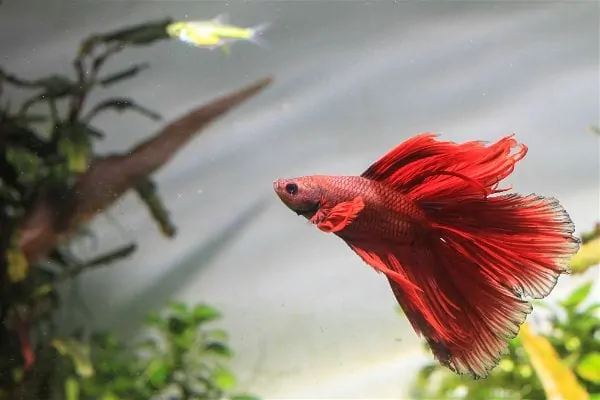
A properly heated betta tank with a submersible heater keeps water stable between 78-80°F regardless of room temperature.
Heater Sizing Guide
The general rule is 3-5 watts per gallon. Undersized heaters run constantly and struggle to maintain temperature. Oversized heaters heat water too quickly, increasing the risk of overheating if the thermostat fails.
Heater Wattage by Tank Size
Recommended Heaters
hygger Small Betta Aquarium Heater (50W)
- Adjustable temperature (59-93°F range)
- Slim profile to hide easily
- Built-in safety shutoff prevents overheating
- Fully submersible with suction cup mount
Why we recommend it: Best for 5-10 gallon tanks. The hygger 50W is compact enough to hide in smaller betta tanks while offering a wide adjustable temperature range and reliable safety shutoff.
Fluval M Compact Submersible Aquarium Heater (100W)
- Powerful and reliable heating
- Engineered for durability
- Compact & sleek design
- Mirror technology to blend into tank
Why we recommend it: Best for 10-30 gallon tanks. The Fluval M 100W combines powerful heating with a sleek mirror-finish design that blends into your aquarium rather than standing out.
Setting Up Your Heater
Proper placement and verification prevent the most common heater-related problems.
Heater Installation Steps
Position the heater
Place the heater near your filter outflow or return so circulating water distributes heat evenly. Mount it horizontally near the bottom of the tank if the manufacturer allows horizontal placement — heat rises, so a low position warms the tank more uniformly than a vertical mount near the surface.
Wait before plugging in
After submerging the heater, wait 15-30 minutes before plugging it in. This allows the heater's internal thermostat to equilibrate with the water temperature. Plugging in a dry or unadjusted heater can crack the glass casing or cause it to overshoot the target temperature.
Set the temperature
For adjustable heaters, set the dial to 78-80°F. For preset heaters, verify the target temperature in the product specifications. Don't rely solely on the heater's built-in thermometer — they can be off by 2-4°F.
Install a separate thermometer
Place a digital or glass thermometer on the opposite side of the tank from the heater. This verifies actual water temperature and reveals any hot/cold zones. Stick-on LCD strip thermometers are less accurate — digital probe thermometers are more reliable.
Monitor for 24 hours
Check the thermometer several times over the first 24 hours, including morning and evening when room temperature changes most. Adjust the heater dial as needed until the tank holds a stable 78-80°F. Small adjustments (1°F at a time) are best — wait 4-6 hours between changes for the tank to stabilize.
Safety Tip: Always Use a Backup Thermometer
Heater thermostats fail — it’s not a question of if, but when. A separate thermometer is your early warning system. Check it daily as part of your routine. If the temperature drifts more than 2°F from your setting, the heater may be malfunctioning. A $5 digital thermometer can prevent the loss of your fish.
Tank Placement and Temperature Stability
Where you place your betta’s tank affects how hard the heater has to work and how stable the temperature stays.
Good Placement:
- Interior wall away from windows — stable ambient temperature year-round
- Away from HVAC vents and radiators — prevents temperature swings from heating/cooling cycles
- Sturdy, level surface away from high-traffic areas — reduces vibration stress
- Out of direct sunlight — prevents uncontrolled heating and algae growth
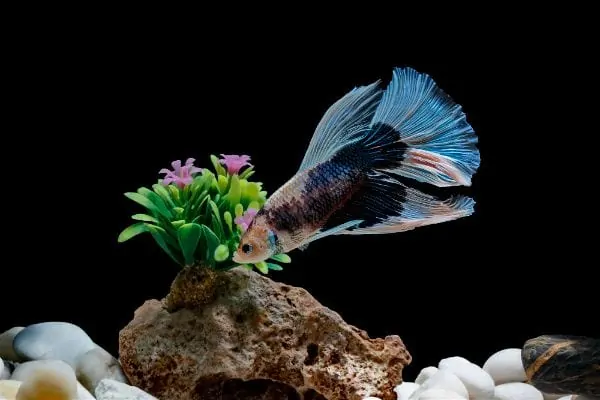
Placing the tank on an interior wall away from windows and vents helps the heater maintain consistent temperature.
Avoid These Locations:
- Windowsills or near windows — direct sun causes overheating, and nighttime cold radiates through glass
- Under or near AC vents — cold air blasts can drop tank temperature several degrees in minutes
- On top of appliances — vibration and heat from electronics disrupt temperature stability
- Uninsulated garages or porches — temperature swings mirror outdoor conditions, overwhelming most heaters
What Proper Temperature Looks Like
Once your betta is in the correct temperature range (76-82°F) with a stable, heated tank, you should notice clear improvements:
Signs of a Healthy, Warm Betta:
- Active swimming and exploration throughout the tank
- Fins held open and displayed — not clamped against the body
- Vibrant, rich coloration with no fading or paleness
- Eager feeding response — approaching food within seconds
- Regular flaring behavior at their reflection or passing objects
- Consistent bubble nest building (in males) — a sign of comfort and readiness

A warm, healthy betta shows vibrant color, open fins, and active swimming — the result of stable tropical temperatures.
These aren’t signs of an exceptional betta — they’re signs of a betta that’s simply being kept at the right temperature. If your betta is lethargic, pale, or uninterested in food, check the thermometer before anything else.
Frequently Asked Questions
Do betta fish need a heater?
Yes. Bettas are tropical fish native to Thailand, Cambodia, and Malaysia where water temperatures stay between 76-86°F year-round. Without a heater, most indoor aquariums sit at 68-72°F — well below the minimum 76°F bettas need. A heater with a thermostat maintains the stable 78-80°F that keeps bettas healthy.
What temperature is too cold for a betta fish?
Temperatures below 74°F cause metabolic slowdown, immune suppression, and lethargy in bettas. Below 70°F, bettas become critically stressed — they stop eating, lose color, and become highly susceptible to fungal and bacterial infections. Prolonged exposure below 68°F can be fatal.
Can betta fish live at room temperature?
Most rooms sit between 68-72°F, which is too cold for bettas. Even rooms that feel warm to humans fluctuate 5-10°F between day and night or when HVAC cycles. Bettas need stable temperatures — the fluctuation is as harmful as the cold itself. A heater is the only reliable way to maintain the 76-82°F range.
What size heater do I need for a betta tank?
Use 3-5 watts per gallon as a guideline. A 25-watt adjustable heater works well for 5-gallon tanks, and a 50-watt heater suits 10-gallon tanks. Always choose an adjustable heater over preset models — adjustable heaters let you fine-tune temperature and respond to seasonal room temperature changes.
Can a heater make my betta tank too hot?
Yes, a malfunctioning or oversized heater can overheat water. Temperatures above 86°F stress bettas and reduce dissolved oxygen. Always use a separate thermometer to verify your heater's accuracy, and choose a heater sized appropriately for your tank — an overpowered heater can heat water dangerously fast if the thermostat fails.
Where should I place a heater in a betta tank?
Place the heater near the filter outflow or an area with water circulation so heat distributes evenly. Position it horizontally near the bottom of the tank for best results. Keep the heater away from decorations and substrate, and always use a separate thermometer on the opposite end of the tank to verify temperature consistency.
Complete Your Betta's Setup
A heater is one piece of the puzzle. Make sure the rest of your betta's environment is dialed in too.
Related Topics
Found this helpful?
Share this guide with your fellow aquarium enthusiasts!

Written by
FTW Team
The FishTankWorld editorial team brings together experienced aquarists to help you succeed in the hobby.