
Bow front aquariums are the better choice for aquarists who want a visually distinctive display piece and are willing to pay a 20–40% premium over flat front tanks. Flat front aquariums are the better choice for budget-conscious buyers who want the widest range of sizes, easiest cleaning, and sharpest photography through the glass.
Both bow front and flat front aquariums use the same filtration, heating, and lighting systems — the functional differences are limited to shape, price, stand requirements, and the cleaning tools that work on the front panel. This comparison covers every factor to help you choose the right aquarium shape for your space, budget, and experience level.
Quick Comparison: Bow Front vs Flat Front Aquariums
| Feature | Bow Front Aquarium | Flat Front Aquarium |
|---|---|---|
| Price | 20–40% more expensive | Most affordable option |
| Viewing | Magnified, slight distortion | Clear, undistorted view |
| Photography | Harder due to curvature | Easier, sharper photos |
| Water Volume | Extra volume from curve | Standard volume for size |
| Cleaning | Sponge only on curved panel | Magnetic cleaners, scrapers, razors |
| Stand | Requires curved-tank stand | Any flat-surface stand works |
| Sizes Available | 16–72 gallons typical | 2.5–300+ gallons |
| Best For | Aesthetic impact, focal points | Versatility, budget setups |
Bow Front vs Flat Front: Which One to Choose?
Choosing between a bow front aquarium and a flat front aquarium is a decision you will live with for years. Once a tank is filled with water, substrate, live plants, and fish, replacing or relocating the aquarium becomes an expensive and stressful process. Selecting the right tank shape before setup avoids that problem entirely.
Plan Before You Buy
Moving an established aquarium with a mature fish community and live plants risks killing livestock and crashing the nitrogen cycle. Before purchasing any tank, evaluate your budget, available floor space, stand requirements, and long-term fishkeeping goals. A well-planned initial purchase prevents the need for a costly tank swap later.
Bow front aquariums and flat front aquariums share the same core components — filters, lights, heaters, and substrate. Where bow front and flat front tanks differ is in shape, price, stand compatibility, maintenance tools, and visual impact. The sections below break down each difference so you can make a confident, informed decision.
Filtration, Heating, and Lighting Work the Same in Both Tank Shapes
Bow front aquariums and flat front aquariums use identical filtration, heating, and lighting systems. A hang-on-back filter, canister filter, or sponge filter works the same way regardless of whether the front panel is curved or flat. The same applies to heaters, LED lighting systems, and air pumps. Whether you keep a freshwater community tank or a saltwater reef setup, the biological and mechanical requirements remain the same in both tank shapes.
The differences between bow front and flat front aquariums are entirely structural — the shape of the front panel, the price, the stand requirements, the cleaning tools that work on the curved glass, and the visual experience for the viewer.
Shape: The Core Difference
Flat front aquariums use rectangular or square designs with flat glass or acrylic panels on all sides. Flat front tanks are the most common aquarium shape on the market and are available in sizes ranging from small 2.5-gallon nano tanks to massive 300-gallon display aquariums. The standardized shape keeps manufacturing costs low and makes flat front aquariums the most affordable option at every size.
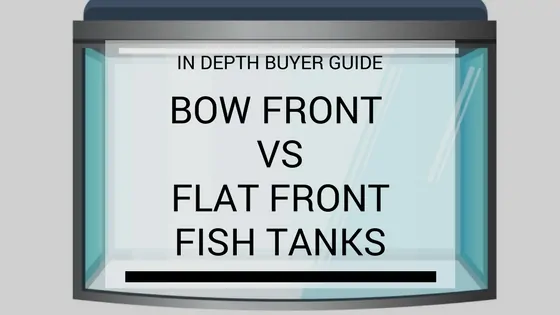
A bow front aquarium features a curved front panel that adds extra water volume and creates a magnifying effect on fish and plants inside the tank
Bow front aquariums feature a curved front panel that bows outward, creating a bulging effect on the facade. The curved shape provides more internal water volume than a flat front aquarium with the same footprint dimensions. Bow front aquariums are available in both glass and acrylic, with sizes typically ranging from 16 gallons to 72 gallons. Some manufacturers also produce corner bow front models that fit diagonally into room corners, saving floor space while still providing the curved viewing experience.
Bow Front Aquarium Features
- Available in glass or acrylic materials
- Sizes typically range from 16 gallons to 72 gallons
- Creates additional water volume due to the curved front panel
- Corner bow front models available for space-saving placement
- Provides a unique magnifying viewing perspective
Viewing Experience: Magnification vs Clarity
Bow front aquariums produce a noticeable visual distortion due to the curved glass or acrylic front panel. Fish and plants near the curved surface appear magnified — sometimes looking 10–20% larger than actual size. Objects near the back wall may appear slightly warped when the viewer stands at an angle rather than directly in front. Some aquarists consider the distortion a dealbreaker, while others actively prefer the magnifying effect because it makes fish appear larger and more detailed than they would through flat glass.
Flat front aquariums provide an undistorted, true-to-life view of the aquarium interior from any angle. Flat glass does not bend or magnify light, so fish, plants, and decorations appear at their actual size and proportions. For aquarists who prioritize a crystal-clear, accurate window into their underwater world, flat front aquariums deliver the most faithful visual experience.
Photography: Flat Front Wins
Bow front aquariums present a challenge for aquarium photography. The curved glass creates background distortion, making it difficult to capture sharp images of fish and plants — especially with a smartphone camera. The curvature bends light unevenly, producing blurry or warped backgrounds behind the subject.
Photography Tip
Aquarists with DSLR cameras and manual focus experience can work around the curved glass by adjusting focal length and aperture. Smartphone cameras struggle more with bow front distortion because autofocus systems cannot compensate for the uneven light refraction. If aquarium photography is important to you, a flat front aquarium makes the process significantly easier.
For aquarists who rarely photograph their tanks, this limitation is a minor detail that does not outweigh the aesthetic appeal of a bow front aquarium in everyday viewing.
Stand and Support Requirements
Flat front aquariums with glass panels can rest on metal stands with corner support, since the weight distributes evenly across the flat bottom. Acrylic flat front tanks require full bottom support, but stands for rectangular tanks are widely available and affordable.
Bow front aquariums require specially designed stands that accommodate the curved front panel. The weight distribution of a filled bow front tank differs from a rectangular tank, and standard furniture — TV stands, bookshelves, or dressers — cannot safely support a bow front aquarium. Always purchase a stand specifically engineered for your bow front tank model.
Bow Front Stand Requirements
- Requires a stand designed specifically for curved-front tanks
- Standard furniture and TV stands cannot support the weight distribution
- Must accommodate the extra depth created by the curved front panel
- Factor in stand dimensions when planning your aquarium location
- A dedicated aquarium stand like the Aqueon bow front stand ensures proper support
If you are shopping for a stand, our guide to the best 55-gallon fish tank stands covers key factors to evaluate for any tank shape.
Who Should Buy a Bow Front Aquarium?
Beginners: All-in-One Kits Make It Easy
Bow front aquariums are beginner-friendly when purchased as all-in-one kits. Brands like Aqueon sell bow front aquarium kits that include the tank, LED lighting, a filter, and a hinged cover — everything needed to get started. The Aqueon Deluxe LED Bow Front Aquarium Kit, for example, comes in multiple sizes and eliminates the guesswork of matching individual components.
Purchasing an all-in-one bow front kit minimizes startup errors and gets your aquarium running faster. If you prefer choosing components individually, a knowledgeable staff member at a local fish store can help match a filter, light, and heater to your specific bow front tank.
Experienced Aquarists: A Fresh Perspective
Experienced aquarium keepers who have maintained flat front tanks for years often find that switching to a bow front aquarium reignites enthusiasm for the hobby. The curved viewing angle of a bow front tank makes familiar fish species look different, and the extra internal water volume created by the curve provides slightly more swimming space without requiring a larger footprint.
Experienced aquarists who already own quality equipment — canister filters, LED light fixtures, and heaters — can purchase a standalone bow front tank and fit it with their preferred components. This approach gives full control over the build while avoiding the cost of an all-in-one kit that bundles equipment you may not need.
Interior Design: A Statement Piece
Bow front aquariums function as furniture-grade display pieces that draw attention in living rooms, offices, waiting areas, and reception lobbies. The curved front panel catches and refracts ambient light differently than flat glass, creating a dynamic visual effect that changes depending on the viewer’s position. The distinctive silhouette of a bow front aquarium breaks up the straight lines found in most furniture and cabinetry, making the tank a natural conversation starter.
In homes or offices with modern or eclectic interior design, a bow front aquarium complements the space in ways that a standard rectangular flat front tank cannot. The curved shape also pairs well with corner bow front stands, which tuck the aquarium into an otherwise unused corner while still presenting the curved viewing panel to the room.
Budget-Conscious Buyers: Consider the Tradeoff
Bow front aquariums cost more per gallon than flat front tanks of the same capacity. If your budget is limited, spending the same amount on a flat front aquarium gets you a larger tank with more water volume — and in aquarium keeping, bigger tanks are almost always easier to maintain and support a wider variety of fish.
Budget Advice
If your budget only allows for a small bow front aquarium (under 20 gallons), consider purchasing a larger flat front tank instead. A 20-gallon flat front aquarium provides more stocking options and more stable water chemistry than a 16-gallon bow front at a similar price. If budget is not a concern, go as large as your space allows — the aesthetic impact of a large bow front aquarium is hard to beat.
Bow Front Aquarium Pros and Cons
Before diving into the detailed cost and size breakdown, here is a summary of the advantages and disadvantages of bow front aquariums compared to flat front tanks.
Bow Front Aquarium Advantages
- Visually striking curved design creates a room focal point
- Magnifying effect makes fish and plants appear larger
- Extra water volume compared to a flat front tank with the same footprint
- Corner bow front models save floor space in small rooms
- All-in-one kits from Aqueon make setup beginner-friendly
- Stands out from standard rectangular tanks in any decor
Bow Front Aquarium Disadvantages
- Costs 20–40% more than a flat front tank of the same gallon capacity
- Requires a specially designed stand — standard furniture does not work
- Curved glass makes aquarium photography difficult, especially with smartphones
- Magnetic algae cleaners and flat scrapers do not work on the curved panel
- Available in fewer sizes than flat front aquariums (typically 16–72 gallons)
- Slight visual distortion when viewed from an angle
Cost Comparison: Bow Front vs Flat Front Aquariums
Bow front aquariums carry a premium price tag due to the specialized manufacturing process required to curve glass or acrylic panels. Flat glass panels are cut and assembled on a large scale using standardized equipment, keeping production costs low. Curved panels require additional forming steps, molds, and quality control — all of which increase the retail price.
Bow front aquariums typically cost 20–40% more than flat front tanks of the same gallon capacity. For example, a SeaClear 46-gallon bowfront acrylic aquarium combo set costs noticeably more than a SeaClear flat front combo set of similar volume. The same pattern holds across brands — the Aqueon 36-gallon bow front carries a higher price tag than the Aqueon 36-gallon flat front equivalent. This price premium applies to both tank-only purchases and all-in-one kits.
Setting up an aquarium is a long-term investment — most well-maintained tanks run for five to ten years or longer. Spending a bit more upfront for the bow front shape you truly want prevents the regret of staring at a flat front aquarium a year later and wishing you had chosen differently. Watch for sales and promotions at local fish stores and online retailers to reduce the premium.
Size and Variety: Flat Front Offers More Options
Flat front aquariums are available in a far wider range of sizes than bow front models. Flat front tanks come in every size from nano setups under 5 gallons to 10-gallon starter kits, 20-gallon community tanks, and large display aquariums exceeding 200 gallons. Bow front aquariums, by contrast, typically range from 16 gallons to 72 gallons, with fewer models available at each size point.
The same dollar amount buys a larger gallon capacity in a flat front aquarium than in a bow front. A budget that gets you a 26-gallon bow front tank might buy a 36-gallon flat front — and in aquarium keeping, more water volume means more stable water parameters, more stocking options, and easier maintenance. For some aquarists, the visual impact of the curved front panel justifies accepting a slightly smaller tank. That tradeoff may mean fewer fish and plants, but the aesthetic satisfaction of a bow front aquarium often makes up the difference.
Aesthetic Appeal: The Top Reason Aquarists Buy Bow Front Tanks
Aesthetic impact is the primary reason aquarists choose bow front aquariums over flat front tanks. Bow front aquariums are visually striking in a way that standard rectangular tanks cannot replicate — the curved glass creates a sense of depth and three-dimensional immersion that draws viewers in.
The curved front panel of a bow front aquarium acts as a natural focal point in any room, pulling the viewer’s eye toward the aquascape inside. Creative aquascapers take advantage of the extra front depth by layering foreground plants, midground hardscape, and background stems to create depth that the magnifying effect enhances further. The result is an aquarium that feels more immersive and dynamic than a flat front setup of the same gallon capacity.
Bow front aquariums are attention grabbers. Guests notice bow front tanks immediately, ask questions about them, and remember them long after visiting. If creating a visually memorable aquarium display is a priority, a bow front aquarium delivers that impact better than any rectangular flat front tank.
Maintenance: Mostly the Same, With One Key Difference
Bow front aquariums and flat front aquariums require identical maintenance schedules — regular water changes, filter maintenance, and algae control. The one difference is the tools you can use on the curved front panel.
Cleaning a Bow Front Aquarium
Flat front aquariums accept magnetic algae cleaners, flat razor blades, and rigid scrapers for cleaning the interior glass. Bow front aquariums do not work well with any of these tools on the curved panel. Magnetic cleaners may lose contact on the curve, and flat blades cannot conform to the rounded surface.
Bow Front Cleaning Limitations
- Standard magnetic algae cleaners may not maintain contact on curved glass
- Flat razor blades and rigid scrapers cannot conform to the curved surface
- A soft aquarium sponge is the most effective tool for the curved panel
- Narrow magnetic cleaners used vertically may work on gentle curves
- Bow front tanks require slightly more manual cleaning effort on the front panel
Bow front aquariums do require a bit more elbow grease when cleaning the front panel, but the back and side panels are flat and accept all standard cleaning tools. For most aquarists, using a sponge on the curved front during regular tank cleaning sessions adds only a minute or two to the routine.
Final Verdict: Bow Front vs Flat Front Aquariums
Bow front aquariums and flat front aquariums are functionally identical — same filtration systems, same water chemistry management, same maintenance schedule. The choice between bow front and flat front comes down to three factors: aesthetics, budget, and personal preference.
Choose a bow front aquarium if you want a visually distinctive tank that creates a room focal point, you have the budget for the 20–40% price premium, and you are comfortable using a sponge instead of a magnetic scraper on the curved front panel. Bow front aquariums deliver unmatched visual impact and make even common fish species look more impressive through the magnifying glass.
Choose a flat front aquarium if you want the widest selection of tank sizes, the lowest price per gallon, sharp aquarium photography, and compatibility with every cleaning tool on the market. Flat front aquariums are the most practical and versatile option for aquarists at any experience level.
Both bow front and flat front aquariums make excellent homes for fish. The best aquarium is the one that fits your available space, matches your budget, and makes you excited to maintain the tank for years to come. Once you have chosen your tank shape, our guide to glass vs acrylic aquariums helps you decide on the right material, and our aquarium placement guide covers the best location for your new setup.
Are bow front aquariums harder to clean?
Bow front aquariums require slightly different cleaning tools. Magnetic algae cleaners may not conform to the curved glass, and flat razors or scrapers cannot be used on the curved surface. A soft aquarium sponge is the most effective tool for cleaning a bow front tank's curved glass panel. All other maintenance tasks — water changes, filter cleaning, gravel vacuuming — remain identical to flat front aquariums.
Do bow front aquariums cost more than flat front tanks?
Yes, bow front aquariums typically cost 20–40% more than comparable flat front tanks of the same gallon capacity. The curved glass or acrylic panel requires specialized manufacturing equipment, which increases production costs. You will get fewer gallons per dollar with a bow front design compared to a standard rectangular aquarium.
Can beginners use bow front aquariums?
Absolutely. Brands like Aqueon sell bow front aquariums as all-in-one kits that include filters, LED lights, and hinged covers. These kits make setup straightforward for beginners and eliminate the guesswork of matching components. The maintenance schedule for a bow front aquarium is nearly identical to a flat front tank.
Does the curved glass distort the view of fish?
The curved front panel of a bow front aquarium does create some visual distortion, especially when viewed from an angle. However, many aquarists enjoy this magnifying effect because it makes fish and plants appear larger and more prominent. Viewing the bow front aquarium directly from the center minimizes distortion.
Do bow front aquariums need special stands?
Yes, bow front aquariums require stands specifically engineered to support the curved front panel. Standard furniture, TV stands, or flat-top tables cannot properly distribute the weight of a filled bow front tank. Always purchase a stand designed for your specific bow front aquarium model to prevent structural failure.
Related Topics
Found this helpful?
Share this guide with your fellow aquarium enthusiasts!

Written by
FTW Team
The FishTankWorld editorial team brings together experienced aquarists to help you succeed in the hobby.