
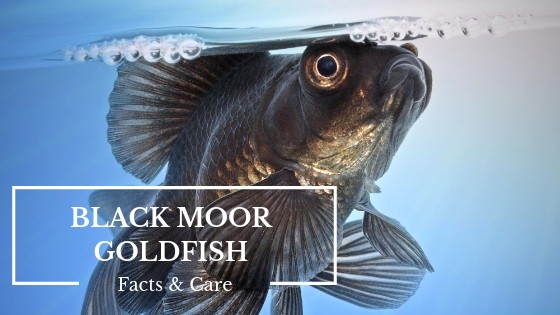
The Black Moor goldfish (Carassius auratus auratus) is one of the most recognizable fancy goldfish varieties, distinguished by its velvety black coloration and prominent telescope eyes. Unlike the typical orange, red, or white goldfish, every part of the Black Moor is black — body, fins, and eyes. These elegant fish have been selectively bred for centuries and make excellent pets for aquarists who understand their unique requirements.
Unique Characteristics
Black Moor goldfish feature distinctive protruding eyes that develop as they mature, earning them names like “Dragon Fish” and “Dragon Eyes.” Their limited vision means they need special tank considerations — smooth decorations, slow-moving tank mates, and plenty of space to navigate safely.
Black Moor Goldfish at a Glance
Care Requirements
Origins of the Black Moor Goldfish
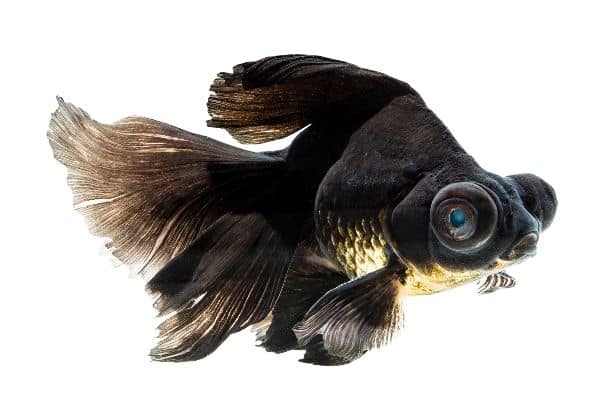
A well-cared-for Black Moor goldfish with characteristic deep black color
Black Moor goldfish descend from common carp through centuries of selective breeding. All modern goldfish varieties likely stem from the Prussian carp (Carassius gibelio) or Crucian carp (Carassius carassius), which were originally drab olive-colored fish farmed for food — one of the earliest forms of fish farming.
Genetic abnormalities occasionally produced yellow, orange, or red-colored carp. Chinese breeders isolated these unusual specimens in separate ponds, locking in color patterns through selective interbreeding. Historical records indicate Chinese breeders began developing fancy goldfish varieties before 1000 AD, based on surviving writings and artwork from the period.
Black Moor goldfish ancestors later spread to Japan in the 1500s, where Japanese breeders developed the long, flowing tail fins and bright color patterns that define modern fancy goldfish. The telescope eye trait eventually appeared, leading to names including “Dragon Fish” and “Dragon Eyes,” and the distinctive black coloration was isolated through further selective breeding.
Types of Black Moor Goldfish
Black Moor goldfish share the traditional short, egg-shaped body common to fancy goldfish, but they stand out due to their protruding telescope eyes and deep black coloration.
Eye Variations
Collectors classify Black Moor goldfish by eye style. The telescope eyes develop gradually as the fish matures and can appear in several forms:
Eye Styles
- Smooth cone-shaped protrusions — the most common form
- Concentric ridges — textured, layered appearance on the eye surface
- Balloon-like forms — rounded protrusions with tiny inflated sacs near the cheeks
Tail Variations
Black Moor goldfish also vary in tail shape. The most common tail types include:
Tail Types
- Original fantail — the classic split-tail shape
- Wide tails — broader, more flowing fins
- Butterfly tails — spread horizontally, resembling butterfly wings when viewed from above
- Ribbon-like tails — long, trailing fins with a delicate appearance
Related Black Goldfish Varieties
Although the Black Moor is the most well-known black goldfish, breeders have developed black coloration in several other fancy goldfish varieties. Originally, black coloration was believed to be linked exclusively to telescoping eyes, but Black Moors sometimes produce offspring with black coloration and normal eyes.
Modern black fancy goldfish varieties include the Black Oranda, Black Lionhead, Black Ranchu, Black Ryukin, Black Pearlscale, Black Comet, and Black Bubble Eye goldfish.
Color Development
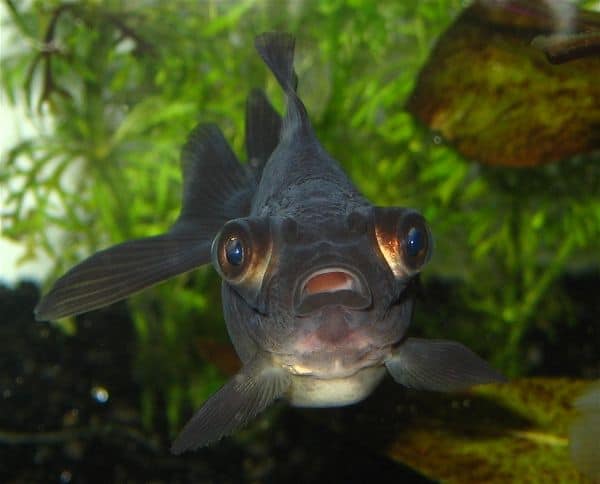
Black Moor goldfish cared for in a healthy planted aquarium. Photo by Svampen, CC BY-SA 4.0
Young Black Moor goldfish (less than one month old) typically display brownish-bronze coloration. At this stage, they have the traditional egg-shaped body but lack the telescoping eyes, making them look like ordinary goldfish. The characteristic velvety black coloration and protruding eyes gradually develop over six to eight weeks.
Temperature Affects Color
Warm water minimizes the formation of black pigment, causing Black Moor goldfish to develop bronze coloration instead of the desired black. Keep water temperature below 72°F to maintain rich black coloring. Some aquarists have observed that mature Black Moors can lose their black coloration if kept in consistently warm water.
Several factors influence how well a Black Moor goldfish retains its black color over time:
Color Retention Factors
- Water temperature — cooler water promotes stronger black pigment
- Genetics — some bloodlines hold color better than others
- Age — some individuals remain jet black throughout life, while others gradually fade in old age
- Diet — carotenoid-rich color enhancers can cause unwanted orange or gold tones
Feeding Black Moor Goldfish
Black Moor goldfish are omnivorous, just like their carp ancestors. In the wild, carp and goldfish forage through mud and leaf litter, consuming insects, worms, and plant material. Many breeders believe that muddy-bottom, algae-rich environments stimulate strong pigment formation in black goldfish.
A poor diet leads to health problems and color loss, so feeding Black Moor goldfish the right foods matters. Commercial specialty goldfish pellets provide the essential nutrition formulated specifically for fancy aquarium and pond varieties.
Floating vs. Sinking Pellets
Floating pellets are made with high plant-based ingredients like alfalfa and kale. They contain starch that gives them buoyancy and come in various sizes. The advantage of floating pellets is that you can easily monitor how much your Black Moor goldfish are eating. Look for brands where corn is not the primary ingredient.
Sinking pellets contain less starch and air, allowing them to fall to the aquarium bottom. They typically offer greater nutritional diversity. Since goldfish naturally forage along the bottom, sinking pellets encourage natural feeding behavior. However, you need to be careful with portions — uneaten sinking pellets decompose quickly and foul the water.
Feeding Tips
Avoid Overfeeding
Black Moor goldfish will always act like they are hungry — so don’t fall for their tricks and overfeed your fish! Their compact egg-shaped bodies are prone to digestive issues, particularly swim bladder disorders. Feed small amounts 2-3 times daily rather than one large feeding.
Uneaten food dissolves within about one hour. As it breaks down, the dissolved nutrients reduce water quality and promote bacterial blooms — cloudy water is often a sign of overfeeding. Black Moor goldfish can learn to accept hand-fed food over time, which helps you control portions.
Supplement the pellet diet with fresh vegetables for variety and extra nutrition:
Supplement Options
- Blanched zucchini slices
- Shelled, blanched peas (excellent for digestion)
- Small pieces of banana
- Blanched spinach leaves
Remove any uneaten fresh food after 30 minutes to prevent water quality problems.
Color-Enhancing Foods: A Warning for Black Moors
The black coloration in Black Moor goldfish is produced by specialized skin cells called chromatophores. Specifically, cells known as melanophores store the black pigment melanin, which creates the characteristic velvety black appearance.
Here is the important part: color-enhancing foods formulated for red, orange, and yellow goldfish contain carotenoids that boost those pigments — but they cannot boost melanin. Feeding these color enhancers to Black Moor goldfish can actually cause them to lose their desirable black coloration and develop unwanted orange or gold tones. Avoid carotenoid-rich color enhancers for this variety entirely.
Black Moor goldfish are also built to digest primarily plant matter. High-protein foods are unnecessary and generally not recommended as daily sustenance.
Tank Mates for Black Moor Goldfish
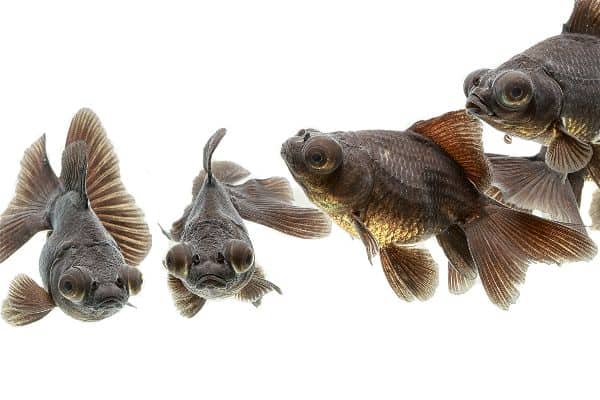
Four Black Moor goldfish swimming together — single-variety tanks are the safest choice
Black Moor goldfish move slowly due to their elongated telescope eyes, which give them poor vision. They cannot quickly zero in on food, causing them to miss feeding opportunities when kept with faster fish. Some goldfish varieties can also display aggression and compete for food through head-butting behavior.
Compatible Tank Mates
Safe Companions
- Other Black Moor goldfish — the ideal choice
- Telescope goldfish of other colors
- Bubble Eye goldfish
- Celestial goldfish
- Lionhead and Ranchu goldfish
Tank Mates to Avoid
Incompatible Species
- Common and Comet goldfish — too fast and competitive for food
- Sarasa and Shubunkin goldfish — same speed and aggression concerns
- Any tropical fish — different temperature requirements
- Aggressive species of any kind
Most aquarists prefer keeping two or more Black Moor goldfish together as a single-variety fancy goldfish tank. This eliminates food competition and ensures all fish can thrive at the same pace. For more on fancy goldfish compatibility, see our guide to Oranda goldfish tank mates.
Aquarium Setup
Black Moor goldfish can live over 10 years with proper care. Although you can purchase them as small specimens, they grow to over ten inches in length in a relatively short period, so planning ahead for tank size is essential.
Tank Size
Tank Size Recommendations
- Starter tank: 10-gallon aquarium is acceptable for 1-2 baby Black Moors
- Mid-size upgrade: 20-gallon tank holds 2-4 Black Moors for an extended period
- Adult tank: Minimum 30-gallon aquarium as fish reach full size
A 20-gallon aquarium kit is an excellent starting point for beginners. Most kits include the tank, filter, heater, LED light, and additional small items — you just add gravel, water conditioner, and fish. For more guidance, see our article on how to set up a goldfish aquarium.
Filtration
A quality power filter is essential for keeping Black Moor goldfish healthy. Goldfish produce more waste than tropical fish of the same size, so choose a filter rated for at least twice your tank volume. Look for filters that provide both mechanical filtration (removing floating particles) and chemical filtration with activated carbon.
Activated carbon works by adsorbing dissolved organic compounds that accumulate in aquariums. Without it, these compounds give the water a tea-like discoloration over time. Change your filter cartridge or media at least monthly — after about 30 days, the media becomes clogged and loses its purification effectiveness.
Water Changes
Regular water changes are critical for Black Moor goldfish health. Change approximately 20% of the water monthly to dilute algae-promoting nutrients like nitrate and phosphate. Use a gravel siphon to vacuum sludge and organic debris from the gravel bed during each water change.
Regular cleaning prevents fish disease pathogens from finding breeding grounds in accumulated waste, and it keeps the aquarium looking clear and attractive. For a step-by-step walkthrough, see our complete guide to cleaning your fish tank.
Temperature Control
Although Black Moor goldfish do not require tropical temperatures, they are sensitive to dramatic temperature fluctuations. Set an aquarium heater to approximately 70°F to protect against accidental temperature drops from drafts or seasonal changes. This also keeps the water cool enough to maintain the Black Moor’s rich black coloration.
Water Conditions
Ideal Water Parameters
Cooler Water Means Better Color
It is generally accepted among goldfish keepers that cooler water helps Black Moor goldfish develop and maintain their rich black color. Aim for the lower end of the temperature range (65-72°F) for the most vibrant coloration, and avoid placing the aquarium in warm rooms or near heat sources like fireplaces or radiators.
Aquascaping for Black Moor Goldfish
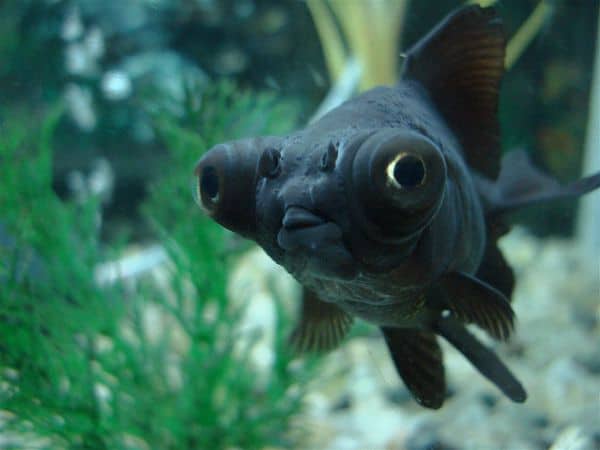
Choose smooth decorations to protect the Black Moor's delicate telescope eyes
All goldfish are notorious diggers, and Black Moor goldfish are no exception. They naturally sift through sand or small gravel searching for bits of food. This digging behavior is normal, but it means you need to plan your substrate and decorations carefully.
Substrate
Any aquarium-safe gravel or sand works for Black Moor goldfish. However, food can work its way into gravel beds and decompose, causing water quality problems. Regular gravel vacuuming during water changes prevents this buildup.
If you keep live plants or plastic plants in the tank, place larger smooth pebbles around the plant bases to discourage your Black Moor goldfish from digging them up.
Decorations
Black Moor goldfish will explore resin caves, ornaments, and other tank decorations. However, their limited vision makes decoration selection particularly important for this variety.
Safe Decorations
- Smooth river rocks and pebbles
- Rounded driftwood pieces
- Silk or soft plastic plants
- Hardy live plants like Anubias and Java Fern
Decorations to Avoid
- Sharp-edged rocks or pointy decorations
- Rough plastic plants with stiff edges
- Rough surfaces that could scratch or damage telescope eyes
- Small gravel that can be ingested
Protect Those Eyes
Avoid any ornaments that are sharp or pointy with Black Moor goldfish. Telescope and Bubble Eye goldfish have poorer vision than other fish, making them especially susceptible to scratching or poking injuries on sharp sticks, rocks, and rough decorations.
Related Goldfish Care Guides
If you are new to goldfish keeping or want to learn more, visit our complete goldfish care hub or explore these specific guides:
- Goldfish Care for Beginners — start here if this is your first goldfish
- How to Set Up a Goldfish Aquarium — step-by-step tank setup
- Feeding Goldfish — detailed nutrition guide for all goldfish types
- Oranda Goldfish Tank Mates — compatibility guide for another popular fancy variety
- Koi vs. Goldfish — understand the differences between these related species
Final Thoughts
Fancy goldfish are a fascinating segment of the aquarium hobby, and Black Moor goldfish are among the most popular varieties for good reason. Their unique velvety appearance, friendly personality, and playful behavior offer years of companionship for aquarists willing to meet their care requirements.
Focus on maintaining excellent water quality, providing a proper diet built around specialty goldfish pellets, choosing compatible slow-moving tank mates, and keeping temperatures cool. Follow these steps and your Black Moor goldfish will reward you with an attractive, healthy aquatic display for many years to come.
How big do Black Moor goldfish get?
Black Moor goldfish can reach over 10 inches in length when fully grown. They start small but grow steadily throughout their lives, which is why a 30-gallon or larger tank is recommended for adult fish.
Why is my Black Moor turning orange?
Black Moors can lose their black coloration due to warm water temperatures, genetics, or age. Cooler water (65-72°F) helps maintain their black color. Color-enhancing foods containing carotenoids can actually cause them to develop orange or gold tones, which is undesirable for this variety.
Can Black Moor goldfish see well?
Black Moors have limited vision due to their protruding telescope eyes. They rely more on their lateral line system and sense of smell to navigate. This is why they should only be kept with other slow-moving fancy goldfish varieties.
How long do Black Moor goldfish live?
With proper care, Black Moor goldfish can live 10-15 years or longer. Good water quality, appropriate diet, and adequate tank size are the key factors in achieving a long lifespan.
What is the best tank size for Black Moor goldfish?
A 10-gallon tank works temporarily for one or two baby Black Moors, but you should plan on upgrading to at least 30 gallons as they grow. A 20-gallon tank is a practical middle ground that can hold 2-4 Black Moors for an extended period.
Do Black Moor goldfish need a heater?
Black Moor goldfish do not need tropical temperatures, but a heater set to around 70°F prevents harmful temperature swings. Stable, cool water (65-72°F) also helps them maintain their rich black coloration.
Related Topics
Found this helpful?
Share this guide with your fellow aquarium enthusiasts!

Written by
FTW Team
The FishTankWorld editorial team brings together experienced aquarists to help you succeed in the hobby.