
Aquarium circulation pumps move water inside the tank to eliminate dead spots, distribute heat evenly, deliver nutrients to plants and corals, and keep debris suspended so the filter can remove it. Every aquarium benefits from water movement, but planted tanks, reef tanks, and tanks larger than 20 gallons often need a dedicated circulation pump beyond what the filter provides.
Circulation Pump vs. Filter
An aquarium filter cleans water by passing it through media, but the outflow only reaches part of the tank. A circulation pump moves water throughout the entire aquarium — preventing stagnant zones, equalizing temperature, and improving oxygen exchange at the surface.
Powerhead vs. Circulation Pump vs. Wavemaker
Aquarium hobbyists use the terms powerhead, circulation pump, and wavemaker interchangeably, but each device moves water differently. Understanding the distinction helps match the right pump to your tank’s needs.
Powerhead
A powerhead is a submersible pump that draws water through a narrow intake and pushes it out in a focused, directional stream. Powerheads use AC motors with a magnet-encased impeller spinning on a shaft. The strong, directional output works well for driving undergravel filters, powering protein skimmers, or targeting a specific area of the tank that needs flow.
Circulation Pump
An aquarium circulation pump uses a propeller-style impeller inside an open housing to push a wide column of water at lower velocity. Circulation pumps move a large volume of water gently — more like a fan than a jet nozzle. The broad flow pattern makes circulation pumps ideal for general tank movement without creating intense currents that stress fish or flatten plants.
Wavemaker
A wavemaker is a DC-powered circulation pump with a programmable controller that varies flow intensity and direction over time. Wavemakers simulate natural ocean conditions by creating wave surges, tide cycles, and random flow patterns. The programmable controller allows feeding modes that pause flow temporarily and nighttime modes that reduce intensity. For a deeper look at how these motors and impellers work, see our guide on how aquarium water pumps work.
| Powerhead | Wavemaker | |
|---|---|---|
| Flow Pattern | Narrow, directional jet | Wide, variable, wave-like |
| Motor Type | AC — fixed speed | DC — adjustable speed |
| Flow Control | On/off only (valve to reduce) | App or controller — precise % |
| Flow Modes | Constant single direction | Waves, tides, gyre, feeding mode |
| Noise Level | Moderate — may chatter on startup | Low — soft-start eliminates chatter |
| Best For | Undergravel filters, targeted flow | Reef tanks, planted tanks, gentle circulation |
| Price Range | $10–$40 | $30–$300+ |
Terminology Tip
Manufacturers label products inconsistently — some call a DC wavemaker a “circulation pump” and some call a basic powerhead a “wave maker.” Check whether the pump has a programmable controller and an open propeller design rather than relying on the marketing name alone.
How to Size an Aquarium Circulation Pump
Aquarium circulation pump sizing depends on two factors: tank volume and the type of aquarium. The flow rate target represents total water movement from all sources combined — filter output plus any additional circulation pumps or wavemakers.
Flow Rate Guidelines by Aquarium Type
Sizing Example
A 55-gallon planted freshwater tank with a canister filter rated at 250 GPH needs 220 to 330 GPH of total circulation (4–6× volume). The canister filter already provides 250 GPH, so an additional circulation pump in the 100–150 GPH range would bring total flow into the optimal zone without creating excessive current.
A 50-gallon mixed reef tank needs 1,000 to 1,500 GPH of total flow (20–30× volume). A return pump delivering 300 GPH from the sump leaves a gap of 700 to 1,200 GPH that one or two wavemakers should fill.
Check Actual Flow, Not Maximum Rating
Pump manufacturers advertise maximum flow at zero head pressure. Actual output drops significantly with vertical lift, tubing length, and fittings. Always check the manufacturer’s flow chart at your specific head height before purchasing. For detailed pump sizing calculations, see our aquarium water pump guide.
Water Flow in Freshwater Planted Aquariums
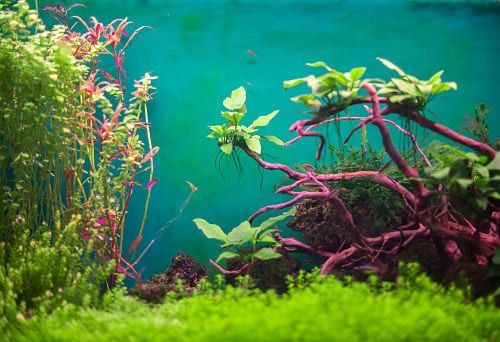
Gentle water flow helps aquatic plants absorb nutrients through the boundary layer surrounding each leaf
Aquatic plants depend on water movement to deliver carbon dioxide and dissolved nutrients to their leaves. A thin film of stagnant water called the boundary layer surrounds every submerged leaf, creating a barrier that slows gas exchange. Carbon dioxide diffuses 10,000 times more slowly through water than through air, making this boundary layer the primary bottleneck for photosynthesis in planted tanks.
How Circulation Improves Plant Growth
Aquarium circulation pumps reduce the boundary layer thickness around plant leaves, increasing the rate of CO2 and nutrient absorption. Aquatic plant photosynthesis rates correlate positively with moderate water flow — studies on submerged macrophytes demonstrate that even small increases in flow velocity significantly improve carbon uptake through the leaf boundary layer. Planted aquariums with proper circulation produce visibly faster growth across all plant species compared to tanks with stagnant zones.
Optimal Flow Speed for Plants
The ideal flow speed for planted aquariums is approximately one inch per second at the plant level. Faster currents bend stems and leaves, physically stressing the plants and potentially damaging delicate species like Rotala or Ludwigia. Slower flow fails to penetrate dense plant stands, leaving interior leaves nutrient-starved.
Signs of Proper Flow in a Planted Tank
- Plant leaves gently sway without excessive bending or flattening
- CO2 distribution reaches all areas of the tank evenly
- No debris accumulation on leaves, substrate, or hardscape
- Consistent temperature throughout the tank — no warm or cool pockets
- Healthy growth across all plant species, not just those near the filter outflow
Placement Strategy for Planted Tanks
Position the circulation pump near the back glass, aimed toward the front or across the tank at a slight downward angle. Directing the output toward the glass creates a dampening “bounce effect” that disperses water movement evenly instead of blasting plants with a direct jet. This technique works especially well in tanks with dense background plantings like Vallisneria or stem plants that would otherwise block flow to the midground.
Protecting CO2 Levels
Excessive surface agitation drives dissolved CO2 out of the water and into the atmosphere, reducing the effectiveness of CO2 injection systems. Position the circulation pump below the waterline and angle it slightly downward to maintain CO2 levels while still providing adequate subsurface flow. A reduction in filter flow at the outflow can also help minimize surface disturbance.
Water Flow in Reef Aquariums
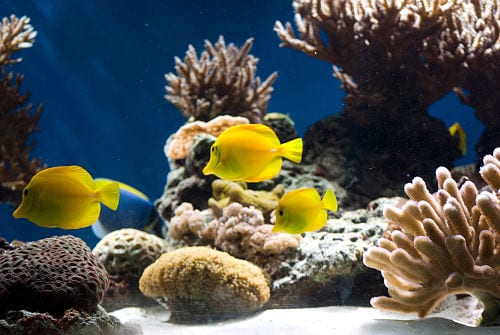
Reef tanks require varied flow patterns — corals depend on water movement for nutrient delivery and waste removal
Corals develop a boundary layer approximately 1 mm thick around their polyps. Water movement through this boundary layer delivers dissolved nutrients, removes metabolic waste, prevents sediment from smothering tissue, and enables the zooxanthellae algae within coral tissue to photosynthesize efficiently. Without adequate circulation, corals retract their polyps, develop tissue recession, and become vulnerable to algae overgrowth.
Signs of Healthy Flow in a Reef Tank
Observable Benefits of Proper Reef Circulation
- Coral polyps extend fully, reaching into the water column for food
- Vibrant coloration and visible growth at coral edges and tips
- Natural feeding responses during flow changes and wave patterns
- Faster recovery and healing of coral frags after fragging
- Reduced algae and detritus accumulation on rock surfaces and coral bases
Placement Strategy for Reef Tanks
Reef tank circulation pump placement varies based on coral positioning and aquascape layout. No single placement works for every reef — the goal is varied, turbulent flow that reaches all corals without creating dead spots behind rock structures.
Single-pump setups work for nano reefs under 30 gallons. Position the pump on the back glass aimed across the tank at a slight downward angle, bouncing flow off the opposite glass to create a circular pattern.
Multi-pump setups are necessary for tanks over 30 gallons. Position pumps on opposite ends of the tank aimed at each other or at slight offsets to create turbulent, unpredictable flow. Alternating which pump runs stronger mimics natural wave action.
Smart programmable wavemakers offer the most flexibility for reef tanks. Programmable flow modes include:
Programmable Flow Patterns for Reef Tanks
- Wave surge patterns that mimic natural reef conditions with rhythmic pulses
- Slack tide periods that reduce flow for coral feeding opportunities
- Gyre circulation that sweeps debris toward the overflow for efficient removal
- Feeding mode that temporarily reduces or pauses flow so food reaches corals
- Nighttime mode that lowers intensity while corals rest and polyps extend
Eliminating Dead Spots in Reef Tanks
Dead spots behind rockwork allow detritus to accumulate, fuel nuisance algae growth, and create pockets of low oxygen. Use multiple circulation pumps aimed at different angles to reach all areas. Periodically adjust pump positioning as the coral colony grows and changes the flow dynamics inside the tank.
How to Identify and Fix Dead Spots
Dead spots — areas with little or no water movement — develop in every aquarium, especially larger tanks with complex hardscaping or dense plant growth. Stagnant water in dead spots allows debris to settle, oxygen levels to drop, and blue-green algae (cyanobacteria) to establish colonies.
Finding Dead Spots
Sprinkle a small pinch of fish food or fine floating particles into the tank with all pumps and filters running. Watch where the particles settle and accumulate — those areas are dead spots. Common dead spot locations include:
Typical Dead Spot Locations
- Behind large rocks, driftwood, or decorations that block flow
- Corners of the tank opposite from the filter outflow
- The base of tall plants or dense stem plant clusters
- Along the substrate surface in areas far from any pump output
- Inside cave formations or under overhangs in the hardscape
Fixing Dead Spots
Reposition the circulation pump to aim toward the stagnant area, or add a second small pump targeting the dead zone specifically. Adjusting the angle of an existing pump by just 10 to 15 degrees often redirects enough flow to eliminate the problem without adding equipment. In tanks with complex aquascapes, two smaller circulation pumps positioned on opposite sides of the tank provide more even coverage than one large pump.
Features to Look for in a Circulation Pump
Selecting the right aquarium circulation pump means matching the pump’s features to your tank’s specific requirements. An undersized pump fails to circulate the full tank volume, while an oversized pump creates currents that stress fish and uproot plants.
Key Features to Evaluate
- Adjustable flow rate — essential for fine-tuning output to match tank inhabitants
- Quiet operation — look for DC motors with soft-start and under 35 dB at three feet
- Magnetic mounting — stronger and more vibration-resistant than suction cups
- Programmable controller — enables wave, tide, and feeding modes (DC pumps only)
- Energy efficiency — DC pumps draw 10–30 watts for most tank sizes, running 24/7
- Easy disassembly — impellers need periodic cleaning to maintain flow and quiet operation
Species-Specific Flow Considerations
Aquarium circulation pump output should match the flow tolerance of the species in your tank. Fish from slow-moving rivers and still ponds need significantly less flow than species from fast-moving streams or reef environments.
Flow Tolerance by Fish Type
When in Doubt, Go Adjustable
A DC circulation pump with adjustable flow output eliminates guesswork. Start at the lowest setting and gradually increase until inhabitants appear comfortable — fish swimming naturally rather than fighting the current, and plants swaying gently rather than bending flat. Adjustable pumps also adapt when you change stocking or add corals later.
Recommended Aquarium Circulation Pumps
The following circulation pumps cover the most common freshwater and reef tank scenarios — from nano tanks under 30 gallons to mid-size setups needing stronger flow.
Circulation Pump Comparison
| Flow Rate | 240 GPH | 530 GPH | 750–850 GPH | 1,600 GPH (adjustable) |
| Tank Size | 10–30 gallons | 20–55 gallons | 50–100 gallons | 5–30 gallons |
| Power | 3.5W | 5W | 5W | 3–14W (adjustable) |
| Motor Type | AC | AC | AC | DC — programmable |
| Mount | Magnetic suction cup | Magnetic 360° rotation | 360° ball joint magnetic | Magnetic |
| Best For | Nano freshwater & planted tanks | Mid-size freshwater & saltwater | Larger freshwater & reef tanks | Budget DC wavemaker with controller |
| Check Price | Check Price | Check Price | Check Price |
- Flow Rate
- 240 GPH
- Tank Size
- 10–30 gallons
- Power
- 3.5W
- Motor Type
- AC
- Mount
- Magnetic suction cup
- Best For
- Nano freshwater & planted tanks
- Flow Rate
- 530 GPH
- Tank Size
- 20–55 gallons
- Power
- 5W
- Motor Type
- AC
- Mount
- Magnetic 360° rotation
- Best For
- Mid-size freshwater & saltwater
- Flow Rate
- 750–850 GPH
- Tank Size
- 50–100 gallons
- Power
- 5W
- Motor Type
- AC
- Mount
- 360° ball joint magnetic
- Best For
- Larger freshwater & reef tanks
- Flow Rate
- 1,600 GPH (adjustable)
- Tank Size
- 5–30 gallons
- Power
- 3–14W (adjustable)
- Motor Type
- DC — programmable
- Mount
- Magnetic
- Best For
- Budget DC wavemaker with controller
The Hydor Koralia Nano 240 is the most popular circulation pump for small planted freshwater tanks — the 240 GPH output delivers gentle flow without overpowering nano setups. For mid-size aquariums in the 20 to 55 gallon range, the Sicce Voyager Nano 2000 provides 530 GPH through a compact 2.35-inch body with a self-cleaning impeller and vibration-absorbing magnetic mount.
The Hydor Koralia Evolution 750 handles larger tanks up to 100 gallons with its shaftless impeller design and 360-degree articulating ball joint mount. For aquarists who want programmable DC flow modes — wave patterns, feeding mode, and adjustable intensity — the hygger Mini Wavemaker delivers 1,600 GPH of controllable flow at a fraction of the cost of premium brands.
Making the Most of Your Circulation Pump
Aquarium circulation pumps benefit every tank type by preventing debris accumulation, equalizing temperature, improving oxygen exchange, and delivering nutrients to plants and corals. The combination of proper sizing, correct placement, and regular maintenance produces the healthiest possible environment for aquatic life.
Clean the pump and impeller every two to three months by soaking in a 50/50 white vinegar and water solution, then scrubbing with a small brush. Replace worn impellers when flow drops or noise increases — impellers are consumable parts that most manufacturers sell separately. For more on pump maintenance and troubleshooting, see our aquarium water pump guide.
What is the difference between a powerhead, circulation pump, and wavemaker?
A powerhead is a submersible pump that pushes water in a single fixed direction using a narrow jet. A circulation pump uses a propeller-style impeller to move a wider column of water more gently. A wavemaker is a programmable pump that alternates flow direction and intensity to simulate natural ocean currents. Manufacturers use these terms loosely, so check the actual impeller design and whether the pump has programmable flow modes.
Do I need a circulation pump if I already have a filter?
Aquarium filters move water through filtration media but often create limited flow patterns inside the tank. Tanks larger than 20 gallons, densely planted aquariums, and reef tanks benefit from a dedicated circulation pump that eliminates dead spots, distributes heat evenly, and delivers nutrients to plants and corals that the filter outflow alone cannot reach.
How much water flow does a planted tank need?
Planted freshwater aquariums need 4 to 6 times the tank volume turned over per hour. A 40-gallon planted tank needs 160 to 240 GPH of total flow from all sources combined — filter output plus any circulation pumps. The ideal flow speed at the plant level is approximately one inch per second, which is gentle enough to avoid stressing plants while reducing the boundary layer around leaves.
How much flow does a reef tank need?
Reef aquariums need 10 to 20 times the tank volume turned over per hour for soft corals and LPS, and up to 40 times or more for SPS-dominant systems. A 50-gallon mixed reef needs 500 to 1,000 GPH of total circulation. Multiple pumps positioned at different angles create the varied, turbulent flow patterns that corals require.
Where should I place a circulation pump in a freshwater tank?
Position a freshwater circulation pump near the back glass, aimed toward the front or across the tank at a slight downward angle. This creates a gentle circular flow pattern that reaches all areas without blasting fish or uprooting plants. Aim the output toward the glass to create a dampening bounce effect that disperses water movement evenly throughout the aquarium.
Where should I place a circulation pump in a reef tank?
Reef tank circulation pump placement depends on coral placement and tank layout. Position pumps to create varied flow patterns across the entire reef structure. Aim flow directly at rock formations or bounce it off the glass walls. Smart programmable pumps allow wave surge patterns, slack tide feeding modes, and gyre circulation that reaches all corals without creating dead spots.
Can too much water flow harm fish or corals?
Excessive flow stresses both fish and corals. Fish swimming constantly against the current, plants bending flat, and corals retracting their polyps are signs of too much flow. Long-finned species like bettas and angelfish are especially sensitive to strong currents. Reduce flow by repositioning the pump, using a flow diffuser, or switching to an adjustable DC pump that allows precise output control.
How do I find dead spots in my aquarium?
Dead spots in an aquarium are areas with little or no water movement where debris accumulates and algae grows. Look for mulm (brown organic debris) collecting on the substrate, blue-green algae (cyanobacteria) growing in specific patches, or areas where food particles settle and remain. Adding a small amount of food or fine particles and watching where they collect reveals stagnant zones that need better circulation.
Should I run my circulation pump 24 hours a day?
Aquarium circulation pumps should run continuously. Fish, beneficial bacteria, and corals depend on constant water movement for oxygen, waste removal, and nutrient delivery. Turning off the pump even for a few hours can cause oxygen levels to drop and allow ammonia to accumulate. DC wavemakers with feeding modes are an exception — they pause flow for a few minutes during feeding, then resume automatically.
Are DC circulation pumps better than AC pumps?
DC circulation pumps offer several advantages over AC models. DC pumps allow adjustable flow speed, use less electricity, run cooler, start quietly without impeller chatter, and support programmable flow modes like wave patterns and feeding modes. AC pumps cost less upfront but lack flow control and generate more heat. For reef tanks and planted aquariums where precise flow matters, DC pumps are the better choice.
How do I reduce circulation pump noise?
A noisy circulation pump usually has a worn impeller, debris caught in the impeller housing, or vibration transferring through the glass. Clean the pump and impeller in a 50/50 white vinegar and water solution. Replace worn impellers — they are consumable parts. Use magnetic mounts instead of suction cups to reduce vibration transmission. DC pumps with soft-start features run significantly quieter than AC powerheads.
Will a circulation pump help with algae problems?
Aquarium circulation pumps help reduce algae growth by eliminating dead spots where blue-green algae (cyanobacteria) thrives in stagnant water. Improved flow also suspends debris particles so the filter can capture them before they decompose and release the nutrients that fuel algae blooms. Circulation alone will not solve algae problems caused by excess light, overfeeding, or high nutrient levels, but proper flow is one important part of algae prevention.
Related Topics
Found this helpful?
Share this guide with your fellow aquarium enthusiasts!

Written by
FTW Team
The FishTankWorld editorial team brings together experienced aquarists to help you succeed in the hobby.