
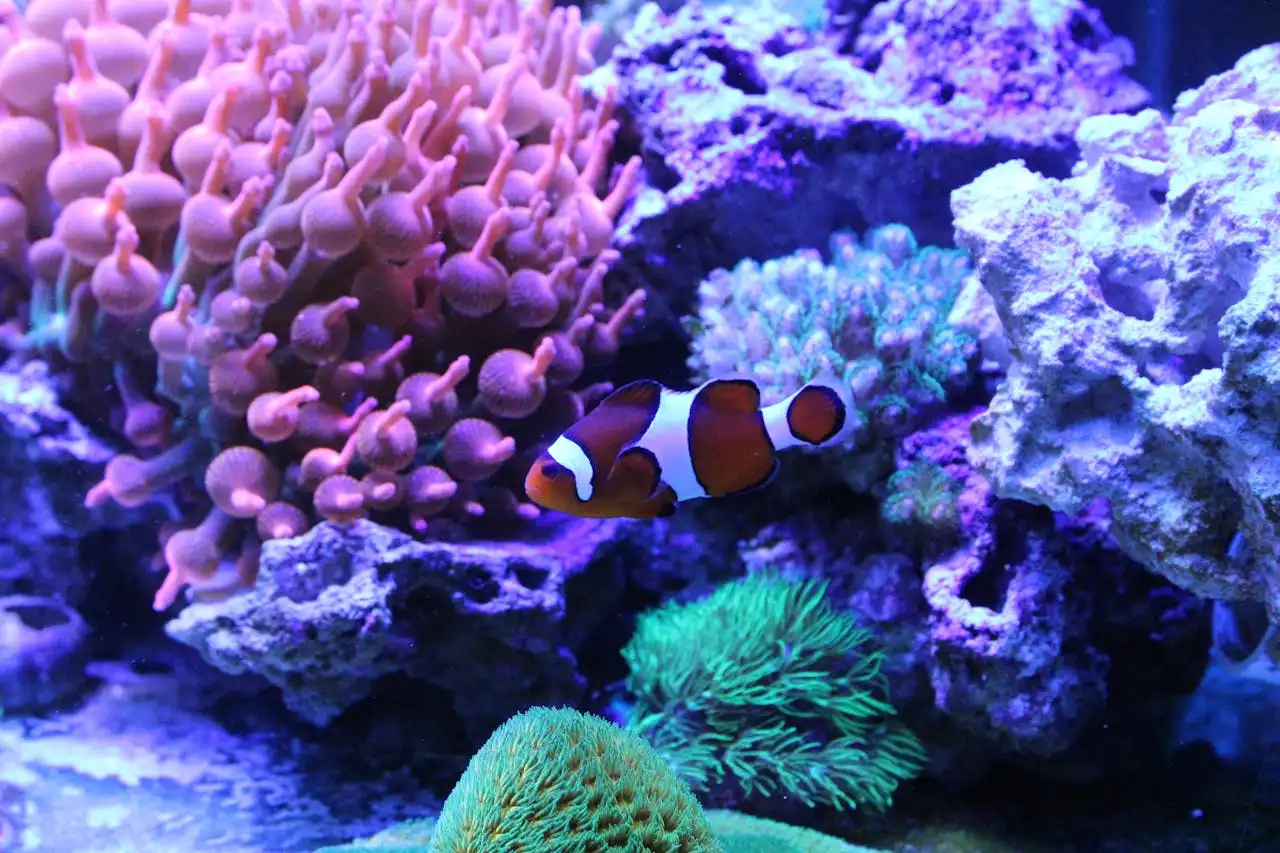
An all-in-one saltwater aquarium bundles the tank, filtration, and return pump into a single unit — with the equipment hidden in a rear chamber so only the display area is visible. For anyone starting their first reef or setting up a nano tank, AIO kits remove the most intimidating part of the hobby: figuring out which equipment works together.
We evaluated five AIO saltwater kits across build quality, lighting capability, filtration design, noise level, and overall value. Each kit was assessed using manufacturer specifications, verified Amazon customer feedback, and reef hobbyist community discussions. Whether you want a 5-gallon desktop nano or a 32-gallon reef-ready system, one of these kits fits.
Quick Comparison: Best AIO Saltwater Kits
| Tank Volume | 32 gallons | 20 gallons | 13.5 gallons | 16 gallons | 5 gallons |
| Lighting | 3-channel LED with timer | Not included | 14,000K LED | 3-channel LED with timer | 11,000K LED |
| Filtration Type | Rear chamber with pump | Filter socks + DC pumps | 3-stage rear filtration | Rear chamber with pump | 3-stage rear filtration |
| Reef-Capable Light | — | ||||
| Heater Included | — | — | — | — | — |
| Day/Night Cycle | — | ||||
| Best For | Best overall AIO kit | Best build quality | Best starter nano reef | Compact reef setup | Desktop nano tank |
| Check Price | Check Price | Check Price | Check Price | Check Price |
- Tank Volume
- 32 gallons
- Lighting
- 3-channel LED with timer
- Filtration Type
- Rear chamber with pump
- Reef-Capable Light
- Heater Included
- —
- Day/Night Cycle
- Best For
- Best overall AIO kit
- Tank Volume
- 20 gallons
- Lighting
- Not included
- Filtration Type
- Filter socks + DC pumps
- Reef-Capable Light
- Heater Included
- —
- Day/Night Cycle
- —
- Best For
- Best build quality
- Tank Volume
- 13.5 gallons
- Lighting
- 14,000K LED
- Filtration Type
- 3-stage rear filtration
- Reef-Capable Light
- Heater Included
- —
- Day/Night Cycle
- Best For
- Best starter nano reef
- Tank Volume
- 16 gallons
- Lighting
- 3-channel LED with timer
- Filtration Type
- Rear chamber with pump
- Reef-Capable Light
- Heater Included
- —
- Day/Night Cycle
- Best For
- Compact reef setup
- Tank Volume
- 5 gallons
- Lighting
- 11,000K LED
- Filtration Type
- 3-stage rear filtration
- Reef-Capable Light
- —
- Heater Included
- —
- Day/Night Cycle
- Best For
- Desktop nano tank
What Makes a Tank “All-In-One”?
All-in-one aquariums feature an integrated rear chamber — a walled-off section at the back of the tank that hides the filtration system, return pump, and (optionally) heater from view. Water flows over or through an overflow into the rear chamber, passes through filter media and/or filter socks, then gets pumped back into the display through a return nozzle.
This design offers three key advantages over traditional setups:
- Clean aesthetics — no hang-on-back filters, no visible powerheads or heaters cluttering the display
- Simplified equipment — components are matched to the tank size, so there’s less guesswork
- Compact footprint — everything fits within the tank’s dimensions, with no external sump taking up cabinet space
The tradeoff is limited customization. The rear chamber has a fixed size, which restricts how much equipment you can fit back there. For most beginners and nano reef setups, this limitation rarely matters. For larger, more demanding reef systems, a sump-based setup provides more flexibility.
Detailed Reviews
1. Coralife BioCube 32 Gallon — Best Overall AIO Kit
Coralife BioCube 32 Gallon Aquarium Kit
- 3-channel LED system: bright white, blue actinic, and color-enhancing LEDs
- Built-in 24-hour timer with automatic sunrise/sunset and moonrise/moonset
- Rear filtration chamber with customizable media baskets
- Quiet submersible return pump with adjustable nozzle
- Dual intake design for balanced water flow
- Compatible with all Coralife BioCube accessories
Why we recommend it: The BioCube 32 is the most complete all-in-one saltwater package at this price point. The 3-channel LED system is genuinely reef-capable for soft corals and many LPS species out of the box, and the 24-hour timer with sunrise/sunset simulation means you don't need to buy a separate light controller. At 32 gallons, the water volume is large enough to buffer against the parameter swings that frustrate nano reef beginners.
The Coralife BioCube 32 has been a staple of the AIO saltwater market for years, and for good reason — it delivers the most balanced combination of lighting, filtration, and tank volume in a single kit.
The lighting system is the BioCube’s strongest feature. Three independent LED channels (bright white, sparkling blue actinic, and color-enhancing) let you dial in the spectrum for your specific coral selection. The built-in 24-hour timer automates everything: a 30-minute sunrise/sunset transition and a 60-minute moonrise/moonset cycle replicate a natural day/night schedule without any external controllers. For soft corals, zoanthids, mushrooms, and many LPS corals, the stock BioCube LEDs provide sufficient PAR to sustain healthy growth.
The filtration chamber occupies the rear section of the tank and is divided into multiple compartments. The stock configuration includes mechanical filtration and space for chemical media (like activated carbon or ChemiPure). Most reefers add a small media rack and protein skimmer to the rear chamber — both fit with room to spare in the 32-gallon model.
What customers say: The BioCube 32 earns consistent praise for easy setup, excellent lighting, and good value. The most common complaint is about long-term durability — some customers report glass cracks developing over time. Inspect the tank carefully upon delivery and ensure it’s on a level, fully supported surface.
What to know before buying: The BioCube doesn’t include a heater, substrate, live rock, or salt mix. Budget for these separately. The return pump is quiet but produces moderate flow — many reefers add a small powerhead or wavemaker for better circulation. The canopy design limits aftermarket light upgrades, so if you plan to keep demanding SPS corals, you’ll need to modify the canopy or switch to a rimless tank.
Who it’s for: Beginners who want a ready-to-go saltwater setup with reef-capable lighting, and hobbyists who prefer the convenience of integrated equipment in a mid-sized tank.
Smaller BioCube Option
2. Innovative Marine 20 Gallon Long — Best Build Quality
Innovative Marine 20 Gallon Long Starter Kit
- Low-iron glass with beveled and polished edges — superior clarity
- 6mm glass thickness with signature black silicone
- Dual adjustable 130 GPH DC return pumps (5W/24V each)
- Built-in acrylic overflow wall with integrated emergency overflow
- Two removable 200-micron filter socks for mechanical filtration
- Pre-installed rubber leveling mat for even weight distribution
Why we recommend it: The Innovative Marine 20L is the highest-rated AIO tank on this list for good reason: the build quality is in a different class. Low-iron glass provides noticeably better clarity than standard glass, the black silicone seams are clean and precise, and the dual DC return pumps are adjustable and energy-efficient. The 20-gallon long footprint gives you a wide, shallow aquascape — ideal for creating natural reef layouts with good coral placement options.
The Innovative Marine 20 Gallon Long takes a different approach than other kits on this list: it delivers a premium tank and filtration platform, and lets you choose your own light. This means a lower upfront cost for the kit itself while giving you the freedom to select lighting that matches your specific reef goals.
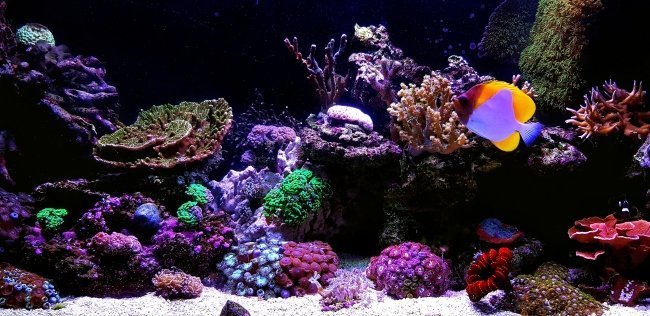
Rimless AIO tanks like the Innovative Marine create a clean, modern look with unobstructed views
The glass quality is immediately noticeable. Low-iron glass eliminates the greenish tint visible in standard glass panels, giving you a crystal-clear view of your livestock. The 6mm thickness provides solid structural integrity, and the beveled, polished edges give the rimless design a refined finish. The pre-installed rubber leveling mat ensures even weight distribution — a critical detail that prevents stress cracks.
The filtration design uses an acrylic overflow wall rather than a surface skimmer box. Water flows over the overflow into the rear chamber, where it passes through two removable 200-micron filter socks. These trap particulate matter before it reaches the return pumps, keeping your display water polished. The integrated emergency overflow prevents floods if the primary overflow gets restricted. The dual DC return pumps (130 GPH each) are adjustable and run at just 5 watts — whisper-quiet and energy-efficient.
What customers say: At 4.6 stars, this is the highest-rated tank on this list. Customers consistently praise the build quality, calling it the best AIO starter tank available. The rimless design and low-iron glass get particular praise for aesthetics.
What to know before buying: This kit does not include a light. Budget an additional $100-250 for a reef-capable LED fixture (the AI Prime, Kessil A80, or Aqua Illumination Hydra Nano are popular choices for this tank). No heater is included either. The 20-gallon long footprint (23.6” x 15” x 13”) is wider and shallower than a standard 20-gallon, which is actually preferable for reef aquascaping but requires a surface that can support the wider footprint.
Who it’s for: Reefers who want premium build quality and don’t mind choosing their own light. Particularly well-suited for hobbyists planning to grow corals, since you can select a light with the exact PAR output you need rather than being limited by a stock LED.
3. Fluval EVO XII 13.5 Gallon — Best Starter Nano Reef
Fluval EVO XII 13.5 Gallon Saltwater Aquarium Kit
- 14,000K reef-capable LED with touch-start day and night illumination
- Powerful 3-stage rear filtration with oversized Fluval filter media
- Stylish honeycomb panel conceals rear chamber and water line
- Multi-functional canopy with easy-access feeding door
- All-aluminum waterproof LED casing for marine durability
- Compact 22" x 11.5" x 15" footprint fits desks and countertops
Why we recommend it: The Fluval EVO XII is the best plug-and-play entry point into nano reefing. The 14,000K LED puts out enough PAR for soft corals and some LPS species, the 3-stage filtration is oversized for a tank this size (Fluval includes mechanical, chemical, and biological media), and the whole package fits on a desk or countertop. At 13.5 gallons, it's small enough to be manageable but large enough to keep a pair of [clownfish](/small-saltwater-fish/) with a few corals.
The Fluval EVO XII has earned its reputation as the go-to starter nano reef for a reason: Fluval put genuine thought into making every component work well at this size. The 14,000K LED isn’t an afterthought — it’s powerful enough at 16 watts and 1,383 lumens to sustain soft corals and many LPS species without an immediate upgrade.
The filtration is where Fluval over-delivers for a nano tank. The 3-stage rear chamber includes oversized mechanical, chemical, and biological media — more filtration capacity than most competing nano kits. The honeycomb rear panel is both functional and aesthetic: it conceals the filtration chamber and water line from view while looking modern. Water enters through the panel, passes through all three filtration stages, and returns to the display via the integrated circulation pump.
The canopy includes a feeding door so you can feed fish and corals without removing the entire lid. This small detail matters in saltwater setups where you want to minimize evaporation and salt creep. The LED is integrated into the canopy with touch-start controls for switching between day and night modes.
What customers say: The EVO XII gets consistent praise as a great beginner-friendly nano reef. Setup is straightforward and maintenance is manageable. The main complaints center on the stock LED — while adequate for soft corals, some hobbyists find it insufficient for demanding corals and upgrade to an aftermarket fixture. A few customers report the bottom glass cracking during use, so place the tank on a flat, fully supported surface.
What to know before buying: No heater included — you’ll need a small nano heater that fits in the rear chamber (the Cobalt Aquatics Neo-Therm 25W or Fluval P10 are popular choices). The 13.5-gallon volume means parameters can shift faster than in larger tanks, so consistent maintenance is critical. Plan for weekly 10-20% water changes.
Who it’s for: First-time saltwater hobbyists who want an affordable, complete nano reef kit that looks good on a desk, countertop, or bookshelf. Also a solid choice for experienced reefers wanting a secondary display tank.
Smaller Fluval EVO Option
4. Coralife BioCube 16 Gallon — Compact Reef Setup
Coralife BioCube 16 Gallon Nano Aquarium Kit
- Same 3-channel LED system as the BioCube 32 — white, blue, and color-enhancing
- 24-hour timer with 30-minute sunrise/sunset and 60-minute moonrise/moonset
- Rear filtration chamber with quiet submersible pump
- Dual intake design with adjustable return nozzle
- Compact form factor for apartments and smaller spaces
- Compatible with all BioCube accessories and upgrades
Why we recommend it: The BioCube 16 gives you everything that makes the BioCube 32 great — the 3-channel reef LED, the automatic day/night cycle, the rear filtration chamber — in a smaller package for tighter spaces. If you want BioCube quality but don't have room for the 32-gallon model, this is the answer.
The Coralife BioCube 16 is essentially the BioCube 32’s little sibling. It shares the same 3-channel LED lighting system, the same 24-hour timer with sunrise/sunset simulation, and the same rear filtration design — all scaled down to 16 gallons.
The lighting is identical in technology to the 32-gallon model: three independent channels (bright white, sparkling blue actinic, and color-enhancing LEDs) provide a customizable spectrum suitable for soft corals, mushrooms, and zoanthids. The automatic 30-minute sunrise/sunset and 60-minute moonrise/moonset cycle runs without any external controllers.
Size considerations make the BioCube 16 both attractive and challenging. At 16 gallons, it’s compact enough for apartments, dorm rooms, and offices where a 32-gallon tank won’t fit. But that smaller water volume means less margin for error. Temperature and salinity fluctuations happen faster, and the bioload capacity is limited. Plan to keep no more than 2-3 small fish with a modest coral selection.
What to know before buying: Like the 32-gallon BioCube, no heater, substrate, live rock, or salt mix is included. The rear chamber in the 16-gallon model is smaller, so fitting a protein skimmer is tighter — look for compact models designed specifically for nano tanks (the Tunze 9001 or Aquaticlife 115 fit well). The same canopy design applies, meaning aftermarket light upgrades require canopy modification.
Who it’s for: Hobbyists who love the BioCube design and lighting but need a smaller footprint. Good for second tanks, office setups, or anyone transitioning from freshwater to saltwater who wants to start small.
5. Fluval Sea EVO V 5 Gallon — Desktop Nano
Fluval Sea EVO V 5 Gallon Saltwater Aquarium Kit
- Strong 11,000K white and blue LED lighting
- 3-stage rear filtration with oversized Fluval media
- Honeycomb rear panel conceals equipment and water line
- Multi-functional canopy with feeding door
- Ultra-compact 20.5" x 11.6" x 7.5" footprint
- Touch-start day and night LED illumination
Why we recommend it: The Fluval EVO V is the most affordable entry point into saltwater on this list. At 5 gallons, it's a true desktop aquarium — light enough to place on a sturdy desk or shelf. The 3-stage filtration is well-designed for the tank's size, and the LED provides sufficient light for hardy invertebrates and macroalgae. This isn't a reef tank, but it's an excellent introduction to saltwater keeping at minimal cost and space.
The Fluval EVO V is the pico-sized version of the EVO XII. At just 5 gallons, this is a specialty tank for experienced hobbyists who understand the challenges of maintaining stable parameters in very small volumes — or for beginners who want the absolute smallest and most affordable saltwater introduction.
The lighting uses an 11,000K white and blue LED system at 10 watts (759 lumens). This is adequate for hardy invertebrates, macroalgae displays, and FOWLR (fish only with live rock) setups, but won’t sustain most corals long-term. Think of this as a marine observation tank rather than a coral reef.
The filtration follows the same 3-stage design as the EVO XII: mechanical, chemical, and biological media in the rear chamber. Fluval sizes the media appropriately for 5 gallons, and the system does a good job of keeping water clear. The same honeycomb panel conceals the rear chamber for a clean look.
Nano Tank Warning
Five-gallon saltwater tanks are challenging to maintain. Temperature can swing several degrees in hours, evaporation concentrates salinity rapidly, and there’s very little room for error. Weekly water changes of 20-30% are essential, and an auto top-off system is strongly recommended to maintain stable salinity. This tank is best suited for experienced nano keepers or as a macroalgae/invertebrate display rather than a reef.
What customers say: Build quality and appearance get high marks. The LED strength and pump power receive mixed feedback — some find the lighting strong enough for their needs, others want more output. The filtration system gets some criticism for not performing well enough in demanding setups, though this is partly a limitation of the ultra-small tank size.
Who it’s for: Experienced nano hobbyists who want a desktop marine display, or budget-conscious beginners who understand the maintenance demands of pico tanks. Excellent for shrimp, snails, hermit crabs, and macroalgae displays.
How to Choose the Right AIO Saltwater Kit
First Saltwater Tank
20-32 gallons recommended
- Coralife BioCube 32 — most complete kit with reef lighting
- Innovative Marine 20L — premium build, choose your own light
- Larger volume buffers against beginner mistakes
- Room for 4-6 small fish plus corals
Nano Reef on a Budget
13.5-16 gallons
- Fluval EVO XII — best value nano with reef-capable LED
- Coralife BioCube 16 — same BioCube quality, smaller size
- Good for 2-3 small fish with soft corals
- Fits on desks, countertops, and bookshelves
Desktop or Pico Tank
5 gallons
- Fluval EVO V — affordable, compact saltwater intro
- Best for invertebrates and macroalgae
- Requires strict maintenance discipline
- Not ideal for coral-heavy setups
Coral Growth Priority
Choose your own light
- Innovative Marine 20L — no stock light to outgrow
- Pair with AI Prime, Kessil, or Hydra Nano
- Low-iron glass maximizes light transmission
- Best long-term investment for serious reefers
Tank Size Matters More Than You Think
In saltwater, bigger tanks are genuinely easier. A 32-gallon tank doesn’t just give you more room for fish — it gives you more stable water chemistry. Temperature changes happen slowly. A dose of salt mix that would spike salinity in a 5-gallon tank barely registers in a 32-gallon. And when something goes wrong (a dead fish, a heater malfunction, a skipped water change), the larger water volume buys you time to fix it.
AIO Tank Size Guide
Lighting Considerations
The included LED is often the deciding factor between AIO kits. Here’s what you need to know:
- Reef-capable LEDs (BioCube series, Fluval EVO XII) can sustain soft corals, mushrooms, zoanthids, and some LPS corals with stock lighting. SPS corals typically need an upgrade. Once corals are established, you’ll also want to research coral feeding to supplement photosynthesis.
- No included light (Innovative Marine 20L) means higher initial cost but lets you choose the right fixture from the start — ideal if you plan to grow demanding corals.
- Basic LEDs (Fluval EVO V) are fine for fish-only or invertebrate tanks but aren’t powerful enough for most coral species.
Plan Your Light Before Your Tank
If you already know you want to grow SPS corals, choose the Innovative Marine 20L and pair it with a high-output LED from the start. It’s cheaper than buying a BioCube, outgrowing the stock light, modifying the canopy, and buying a separate fixture later.
What You Still Need to Buy
No AIO kit includes everything you need for a working saltwater aquarium. You’ll also want a reliable saltwater test kit from day one — testing is how you know your tank is safe for livestock. Here’s what you’ll need to add:
Essential Additional Equipment
- Marine salt mix — Instant Ocean or Red Sea Blue Bucket are popular, affordable choices
- Substrate — live sand or dry aragonite sand, 1-2 inches deep
- Live rock or dry rock — 1-1.5 lbs per gallon for biological filtration and aquascaping
- Heater — sized to your tank (50W for nano, 100-150W for 20-32 gallon)
- Refractometer — for accurate salinity measurement (not a hydrometer)
- Test kits — ammonia, nitrite, nitrate, pH, and alkalinity at minimum
- Auto top-off system — replaces water lost to evaporation to maintain stable salinity
- Protein skimmer — optional for nano tanks, recommended for 20+ gallons
Cycle Before Adding Fish
Never add fish to a new tank immediately. Every saltwater aquarium must complete the nitrogen cycle before it can safely support livestock. This process takes 4-6 weeks. Add live rock or a bacterial starter product, then test water daily until ammonia and nitrite both read zero. Only then is it safe to begin adding fish — slowly, one or two at a time.
Setting Up Your AIO Tank
Position and level the tank
Add substrate and rock
Mix and add saltwater
Install equipment and start the cycle
Add livestock slowly
AIO Tanks vs. Building Your Own Setup
All-In-One Kits
Convenience-first approach
- Everything matched and sized to work together
- Compact — no external sump or plumbing
- Faster setup with less research required
- Limited upgrade path and filtration capacity
Custom Sump-Based Setup
Maximum flexibility
- Unlimited equipment and media capacity
- Larger total water volume for stability
- Easy to upgrade individual components
- More complex, more expensive, more space required
For most hobbyists starting their first saltwater tank — or setting up a nano reef — an AIO kit is the right choice. The convenience, the aesthetics, and the reduced complexity outweigh the limitations. Once you’ve learned the fundamentals of saltwater chemistry and maintenance, you can always build a custom sump-based system for your next tank.
Are all-in-one saltwater tanks good for beginners?
Yes. AIO tanks are the best way for beginners to start saltwater because they eliminate the most confusing part of the hobby — figuring out which equipment is compatible. The integrated filtration, lighting, and return pump are matched to the tank size, so there's no guesswork. You still need to learn about water chemistry, the nitrogen cycle, and marine livestock care, but the equipment side is handled for you.
What size AIO saltwater tank should I get?
For a first saltwater tank, 20-32 gallons is the sweet spot. Larger water volume is more forgiving of mistakes — temperature and salinity swings happen more slowly in bigger tanks. Nano tanks under 15 gallons are challenging for beginners because parameters can shift rapidly. If space allows, the Coralife BioCube 32 or Innovative Marine 20 Long are the best starting sizes.
What else do I need besides an AIO kit?
Most AIO kits don't include everything. You'll still need: marine salt mix, live sand or aragonite substrate, live rock or dry rock, a heater (check if your kit includes one), a refractometer for measuring salinity, test kits for ammonia, nitrite, nitrate, and pH, and an auto top-off system for evaporation. Budget an additional $150-300 for these items depending on tank size.
Can I keep corals in an all-in-one tank?
Yes, but it depends on the lighting. Tanks with reef-capable LEDs like the Coralife BioCube series and Fluval EVO XII can support soft corals and many LPS corals with the stock lights. SPS corals typically need a lighting upgrade. Tanks sold without lights, like the Innovative Marine Starter Kit, let you choose an appropriately powerful light from the start.
Do I need a protein skimmer for an AIO tank?
It's not strictly required for nano and small AIO tanks if you maintain a light bioload and do regular water changes (10-20% weekly). However, a protein skimmer significantly improves water quality by removing dissolved organics before they break down. For tanks 20 gallons and larger, adding a nano protein skimmer to the rear filtration chamber is highly recommended.
How long does it take to cycle an AIO saltwater tank?
Cycling typically takes 4-6 weeks. Add live rock or a bacterial starter, then monitor ammonia and nitrite levels with test kits. When ammonia and nitrite both read zero and nitrate is present, the cycle is complete and you can begin adding livestock slowly — one or two animals at a time, spaced a week or more apart.
What's the difference between AIO tanks and sump-based systems?
AIO tanks hide the filtration in a rear chamber built into the tank itself. Sump-based systems use a separate tank (the sump) below the display, connected by an overflow and return pump. Sumps offer more filtration capacity, equipment space, and water volume, but they're more complex to set up and require a stand with cabinet space. AIO tanks are simpler, more compact, and better suited for beginners and smaller setups.
Can I upgrade the stock light on an AIO tank?
Yes. Most AIO tanks accept aftermarket LED fixtures. Popular upgrades include the AI Prime, Kessil A80/A160, and Aqua Illumination Hydra Nano. If your AIO tank has a canopy (like the BioCube), you may need to remove or modify it to mount a separate light. Rimless AIO tanks like the Innovative Marine accept clamp-on or gooseneck mounted lights without modification.
Related Topics
Found this helpful?
Share this guide with your fellow aquarium enthusiasts!

Written by
FTW Team
The FishTankWorld editorial team brings together experienced aquarists to help you succeed in the hobby.